
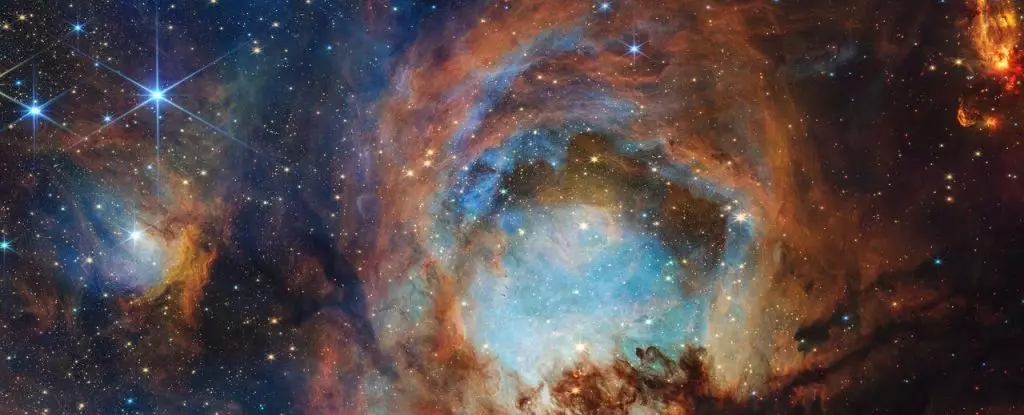
The James Webb Space Telescope (JWST) marks a transformative era in astronomical exploration, particularly in our understanding of the birthplaces of stars. Unlike previous telescopes hampered by dust and limited infrared capabilities, JWST penetrates these cosmic veils with unprecedented clarity. Its observation of the Cat’s Paw Nebula exemplifies how cutting-edge technology allows us to witness a dynamic universe still in the throes of creation. This success underscores a broader shift in astrophysics, where we are steadily replacing superficial curiosity with profound insights into our celestial origins.
Deciphering the Enigma of Star Formation
The process of star formation remains one of the universe’s most captivating puzzles. The nebula’s thick dust and gas have historically obscured our view, stymieing efforts to understand how new stars ignite amidst chaos. JWST’s infrared eyes reveal this process in stunning detail, transforming abstract theories into visual reality. The images show young stars still cocooned in their natal material, while others have emerged, shining brightly after clearing their surroundings. This layered perspective enables scientists to piece together the evolutionary timeline of star birth, revealing a universe that is both violent and beautiful in its creation.
The Power of Infrared Observation
What makes JWST uniquely powerful is its capacity to see through dense interstellar dust—a feat impossible for visible-light telescopes. This observational advantage grants us direct insight into regions previously shrouded in mystery. For instance, the “Opera House” structure in the Nebula is illuminated by a nascent star, an event that marks a critical phase in stellar evolution. Meanwhile, red blobs of dust exemplify active regions of star formation where gravity pulls material into dense knots, igniting the flames of new stars. Such imagery not only enhances our scientific understanding but also ignites wonder about the universe’s perpetual cycle of creation.
The Broader Implications of JWST’s Discoveries
While the immediate allure of these images lies in their aesthetic beauty, their true significance is found in their scientific potential. By studying star formation locally in the Cat’s Paw Nebula, astronomers can refine models applicable across the cosmos, including distant galaxies forming billions of years ago. The observations challenge and refine existing theories—prompting us to reconsider our assumptions about the timeline and mechanisms of star birth. Ultimately, JWST’s revelations deepen our cosmic narrative, reminding us that in the vast darkness, bright new worlds are continually emerging.
Inspiration for Humanity’s Cosmic Journey
The clarity with which JWST captures the vigorous birth of stars is not just a scientific milestone; it is a testament to human curiosity and ingenuity. The image of a youthful star illuminating its surroundings resonates with our desire to understand our place in the universe. Each discovery, each glimpse into these stellar nurseries, nurtures our collective imagination and fuels our quest to explore the uncharted. In viewing these celestial phenomena, we are reminded that our universe is an ancient, ever-evolving masterpiece—more alive, more mysterious, and more inspiring than ever before.
Leave a Reply