
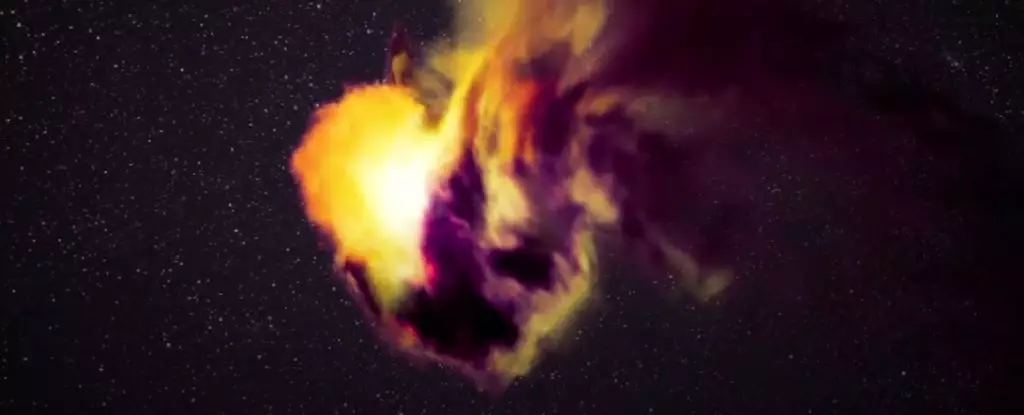
The cosmos has always been a realm of mystery, but every so often, astronomers encounter phenomena that challenge their fundamental understanding of the universe. The explosion of SN2021yfj in 2021 was one such groundbreaking event. Located 2.2 billion light-years away, this supernova shattered previous models by revealing an unexpected cocktail of elements—silicon, sulfur, and argon—in its ejecta, substances rarely seen together during stellar explosions. This discovery was nothing short of revolutionary, forcing astrophysicists to rethink how they interpret the lifecycle of massive stars.
What makes SN2021yfj extraordinary isn’t merely its distance or brightness but what it represented scientifically. Typically, when we observe a supernova, the chemical fingerprint we detect aligns with the layered onion-like structure theorized in stellar evolution—lighter elements on the outside, heavier toward the core. But SN2021yfj’s signature pointed to a different narrative, one that hints at a violent, turbulent prelude to its explosion, potentially rewriting the textbooks on stellar death.
Challenging Classical Views of Stellar Structure
For decades, the standard model has depicted massive stars as cosmic onions: their interiors layered by successive fusion processes, culminating in an iron core that spells imminent doom. When a star runs out of fuel for fusion, it collapses under gravity, triggering a supernova that disperses the star’s outer layers into space. In this model, the heavy elements like silicon and sulfur are expected to be confined deep inside, only seen in the supernova remnants after the explosion.
However, SN2021yfj challenges this rigid depiction. The spectral analysis reveals that the star was catastrophically stripped of much of its outer material, exposing inner layers rich in heavy elements before the explosion even occurred. This implies a vastly more dynamic and chaotic pre-supernova phase. Instead of a neatly layered onion, the star appeared to be a stripped-down core, almost “baked” to exhaustion, yet still capable of producing an extraordinary explosion visible across billions of light-years.
The implications are profound: stars can shed significant portions of their mass in violent eruptions, long before their final cataclysm. This revelation opens doors to new questions—how often does this stripping occur? Are our models of stellar evolution incomplete? The data from SN2021yfj suggests that our understanding of the life cycles of massive stars is still in infancy, stalled by assumptions that may not hold in all cases.
The Turbulent Final Acts of Stellar Giants
One of the most astonishing insights from SN2021yfj is the evidence of intense instability leading up to the supernova. Instead of a gradual collapse, the star underwent repeated episodes of mass ejection—like cosmic tantrums—that whittled down its outer layers. This process resulted in a virtually stripped core, exposing the elements that would normally be hidden beneath layers of stellar material.
This pattern of mass loss is not just a minor detail; it fundamentally alters the physics of the explosion. When the core eventually ignited its final death throes, the resulting shockwave didn’t just burst outward— it collided with the earlier ejected shells traveling at different speeds. Such violent interactions could amplify the brightness, making the supernova more luminous and energetic than typical models would predict. SN2021yfj seemed to be a cosmic fireworks display fueled by a tumultuous upheaval, rather than a straightforward stellar death.
By understanding these pre-explosion processes, scientists gain insight into the extreme conditions that might produce other exotic phenomena—perhaps even linking to fast radio bursts, gamma-ray bursts, or other high-energy cosmic events. This event signals that the lifecycle of a massive star isn’t a simple, predictable path but a rollercoaster of violent episodes culminating in an extraordinary explosion.
Rethinking Stellar Evolution and Explosive Pathways
The silicone, sulfur, and argon detected in the supernova legacy not only confirm the complex internal layering of stellar interiors but also hint at processes previously considered rare or insignificant. It suggests that stars can lose massive chunks of their mass far earlier, setting the stage for novel pathways to supernova explosion types.
The current models primarily focus on supernovae as the result of iron-core collapse in stars that retain much of their outer layers until the final moments. SN2021yfj, however, hints at a different route—one where heavy element-rich shells are ejected over time, leading to a more turbulent, layered environment when the explosion finally occurs. This could imply a broader spectrum of supernova phenomena than currently appreciated, from relatively gentle explosions to catastrophic, “stripped” core events.
Furthermore, these findings challenge astrophysicists to reconsider how mass loss, pre-supernova instability, and internal mixing influence stellar death. Are we underestimating how often stars undergo violent mass ejections? Do some stars effectively end their lives as “ghosts”—bare cores—still capable of spectacular explosions? The answers remain elusive, but SN2021yfj acts as a catalyst for new theories and more detailed simulations.
While still in the realm of hypothesis, the idea that such exotic, turbulent pathways are more common than we think could reshape how we interpret cosmic history, the distribution of heavy elements, and the evolution of galaxies. The universe, it seems, is far more chaotic and fascinating in its death throes than the tidy models we have long relied upon suggest.
—
Note: This analysis highlights the significance of SN2021yfj’s discovery and its implications. The event demonstrates that the universe’s most monumental processes often defy our expectations, urging the scientific community to pursue deeper, more nuanced models of stellar evolution. This supernova isn’t just an astronomical curiosity—it’s a clarion call to revisit and refine our understanding of how the cosmos marks its own end, and perhaps, its rebirth.
Leave a Reply