
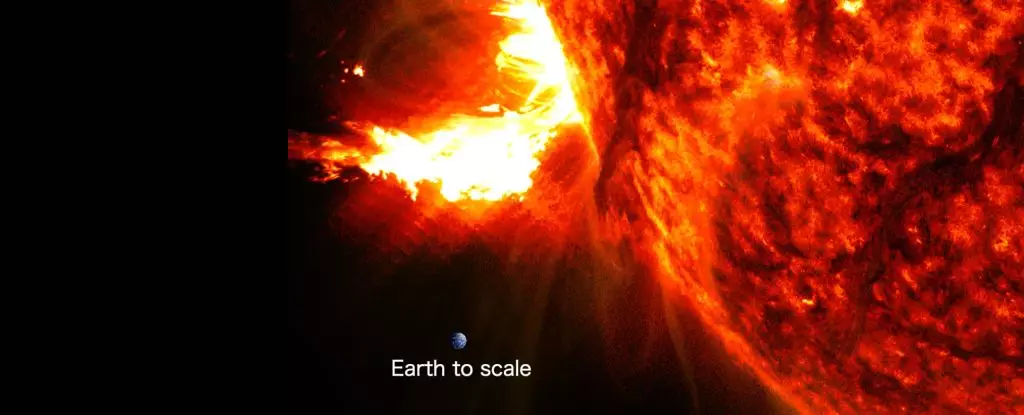
For centuries, scientists have pondered the incredible energy outputs of solar flares—explosive bursts of radiation that ripple across the Sun’s atmosphere. Traditionally, these phenomena have been studied under the assumption that electrons and ions within the flare plasma share similar temperatures, giving us a measurable baseline for the flare’s intensity. However, recent advances in mathematical modeling challenge this long-held notion, suggesting that the true nature of solar flare heating is far more extreme and complex. Instead of a uniform temperature landscape, the evidence points toward a dramatic disparity: ions might be reaching temperatures magnitudes higher than previously estimated, soaring up to 60 million Kelvin. This revelation could have profound implications for how we understand solar activity and its effects on our planet.
The Physics Behind the Fireworks: Magnetic Reconnection and Energy Transfer
At the core of solar flares lies the intricate dance of the Sun’s magnetic fields. Due to the differential rotation—where the equator spins faster than the poles—the magnetic lines become tangled and stressed, eventually snapping and reconnecting in a process aptly named magnetic reconnection. This sudden reordering releases vast amounts of energy, which heats the surrounding plasma, emits powerful radiation, and accelerates charged particles. Until now, scientists believed that this energy was dissipated uniformly among electrons and ions. But emerging research suggests a different story. Magnetic reconnection appears to preferentially heat ions more intensely, a phenomenon observed not only on Earth but also confirmed through space-based measurements and sophisticated computer simulations.
This insight shifts the paradigm from a uniform radiation model toward one where ions could dominate the thermal landscape, reaching temperatures that dwarf those of electrons. Such a stark difference could explain various spectral features of solar flares that have puzzled astronomers for decades, including unexpectedly high-energy emissions and certain spectral lines. Recognizing that ions could bear the brunt of heating challenges the conventional wisdom and encourages scientists to revisit the fundamental physics governing solar eruptions.
Implications Beyond the Sun: A Window Into Universal Plasma Processes
The prospect that ions in solar flare plasma can attain temperatures as high as 60 million Kelvin sparks a cascade of questions about the universality of plasma physics. Recent studies outside the solar context—such as space weather phenomena around Earth and plasma behavior in laboratory settings—have already indicated that ions often receive a disproportionate share of energy during magnetic reconnection events. These findings hint at a broader principle: that the mechanisms heating space plasmas inherently favor ion acceleration and heating.
This understanding compels us to reconsider the models used in space weather prediction, satellite protection, and even future astronaut safety protocols. If ions are not only hotter but also more energetic than previously assumed, the impact on electromagnetic radiation, particle fluxes, and radiation hazards could be far more severe. Furthermore, this new perspective might bridge the gap between solar physics and astrophysics, offering explanations for high-energy phenomena observed in distant stars and other magnetically active cosmic bodies.
Charting the Path Forward: The Need for Empirical Validation
While these revelations are thrilling, they are, at present, rooted in theoretical calculations and computer simulations. The scientific community must now undertake targeted observational campaigns and specialized experiments to verify these claims. Future solar observatories equipped with advanced spectrometers and high-energy detectors will be crucial in measuring ion temperatures directly during flare events. Instruments capable of discerning the subtle differences between electron and ion heating signatures will help solidify or refute these theoretical predictions.
Moreover, understanding the detailed heating mechanisms will have tangible benefits. Better models of flare energetics can improve our ability to forecast space weather, which affects everything from satellite operations to power grids on Earth. Recognizing the potential for superheated ions also opens avenues for innovating protective technologies and refining our comprehension of astrophysical plasma phenomena.
In essence, this emerging picture of solar flare physics invites us to rethink our solar models radically. It urges the scientific community to view the Sun not just as a glowing sphere of plasma but as a fundamentally more energetic and dynamic system than previously appreciated. If confirmed, the idea that the Sun’s fury is powered, in part, by fiercely hot ions could transform our understanding of stellar activity and its galactic counterparts, revealing a hidden layer of cosmic power that had been overlooked all along.
Leave a Reply