
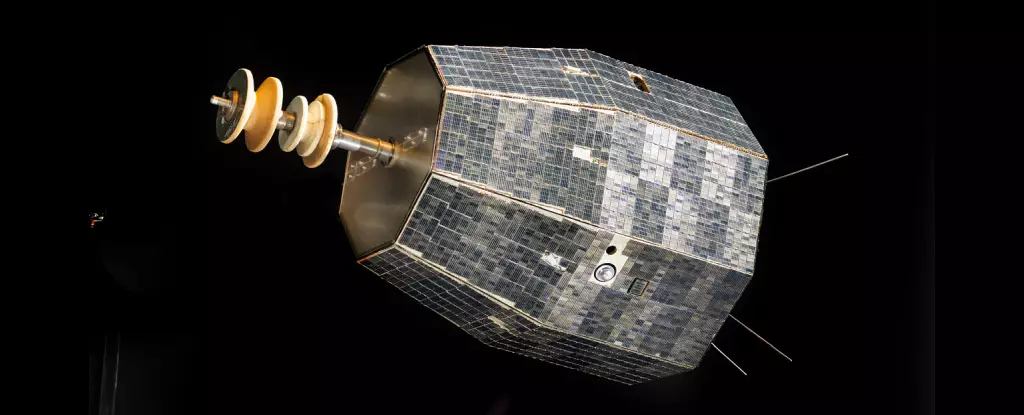
In a stunning revelation that challenges our understanding of fast radio bursts, astronomers have traced a recent signal not to the unfathomable depths of the universe, but to an unexpected source right here within Earth’s orbit. The fast radio burst detected on June 13, 2024, was confirmed by researchers at the Curtin University’s International Centre for Radio Astronomy Research to have originated from a long-decommissioned NASA satellite, Relay 2, which has been stranded in space for over half a century. This finding is not just an academic curiosity; it underscores the need for a deeper awareness of how our own technologies can mislead astronomical research and how they complicate our quest to decipher the cosmos.
The Burgeoning Realm of Anthropic Signals
As humanity’s technological advancements propel us further into space, the potential for our own machines to generate signals that mimic extraterrestrial activity becomes increasingly pertinent. This incident demonstrates a critical need for enhanced discernment in our astronomical endeavours. While the typical fast radio bursts, which are thought to emanate from cosmic phenomena, are often millions of light-years away, the Relay 2 source was a mere 4,500 kilometers from Earth. Such proximity raises vital questions about our methods of detection and classification of signals coming from space, as well as how to differentiate between terrestrial and extraterrestrial phenomena.
Consider the multitude of signals previously attributed to alien technology, only to be later identified as mundane sources such as commercial trucks or household appliances. These misidentifications dilute the scientific field’s credibility. Similar instances of confusion underscore the importance of refining our methodologies. This latest episode with the Relay 2 satellite invites much-needed scrutiny about what we accept as genuine cosmic signals versus what originates from our technological footprint.
Understanding Fast Radio Bursts
Fast radio bursts are fascinating astrophysical events characterized by their brief yet powerful emission of radio waves. These bursts are so intense that they can be equated to the radiated energy of 500 million suns, all distilled into a single millisecond. Currently, only a single source of such bursts has been reliably located within the Milky Way – a magnetar approximately 30,000 light-years from our planet. The mystery surrounding these cosmic signals propels ongoing investigations, as they distort our understanding of explosive astrophysical events.
The Relay 2 incident now invites a reevaluation of what constitutes a fast radio burst. With many signals considered potential evidence of extraterrestrial communication, recognizing that some may stem from human-made debris emphasizes the complexity of our involvement in space. This connection calls not only for improved instrumentation but also a reevaluation of our understanding of the processes that create such high-energy emissions.
The Path to Identification
The research team facing this enigma leveraged cutting-edge tools like the Australian Square Kilometer Array Pathfinder (ASKAP) to hone in on the burst’s coordinates. Their analysis brought them to Relay 2, which was launched in 1964 but ceased operations by 1967. Continuing to float in orbit, it is now a relic of a rapidly bygone era in space exploration history. What makes the team’s findings even more compelling is the nature of the burst itself—it couldn’t be the result of sunlight reflections, prompting proposals for more complex explanations.
Two explanations emerge as leading candidates for the observed phenomenon: an electrostatic discharge or a plasma discharge caused by a micrometeoroid collision. Human-made satellites can accumulate electrical charge in the Earth’s geomagnetic environment to a point where the electricity discharges, creating signals resembling fast radio bursts.
Myriad Implications for Satellite Missions
These findings are more than a mere footnote in the annals of space exploration. They stretch into critical considerations for contemporary satellite missions. Electrostatic discharges are not merely an abstract concept; they represent tangible risks for the functionality and safety of our operational satellites. The inadvertent generation of radio frequency emissions complicates the already tricky business of monitoring space debris and satellite health.
Furthermore, the possibility that we may be able to offer safer satellite designs or employ enhanced detection systems to scour the near-Earth environment for similar signals could serve as a boon for future space endeavors. The implications stretch far beyond the immediate study; they touch on sustainability and safety within the burgeoning domain of near-space operations.
The Relay 2 radio burst is thus not just an anomaly but a crucial data point. It enriches our understanding of the signals that fill our universe while putting a spotlight on our journey through our own technological evolution. As we look towards a future filled with exploration and discovery, understanding the nuances of both domestically originated signals and the signals that come from quantum and cosmic realms is paramount for our scientific integrity and curiosity-driven explorations.
Leave a Reply