
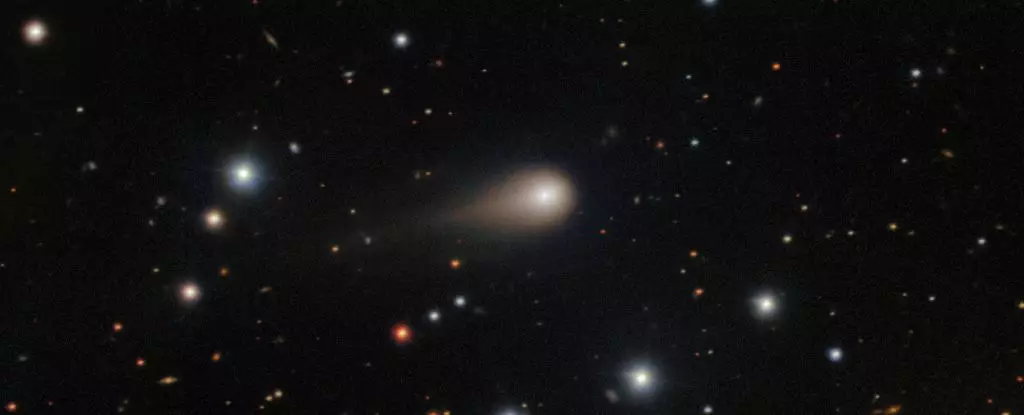
The recent series of images capturing comet 3I/ATLAS marks a significant milestone in astronomers’ quest to understand objects originating beyond our solar system. Unlike typical comets bound to our sun’s gravitational embrace, 3I/ATLAS is a true interstellar traveler—a cosmic visitor that defies the usual expectations of cometary behavior. The images from NOIRLab’s Gemini South telescope reveal a strikingly prominent tail, hinting at the comet’s dynamic activity as it races toward perihelion, the closest point to the Sun within its fleeting voyage through our stellar neighborhood.
From an observational standpoint, this event underscores the importance of high-powered telescopic imagery not just in cataloging celestial objects, but in unraveling the intricate processes that define their nature. The growing tail signals an active sublimation process, whereby heat from the Sun causes frozen ices on the comet to vaporize and release dust and gases. This behavior, especially for an interstellar object, pushes the boundaries of what we know about comet composition and activity outside the familiar environment of our solar system.
Challenging Our Solar System Assumptions
The distinguishing features of 3I/ATLAS make it a particularly intriguing subject. Unlike close relatives ‘Oumuamua and Borisov—whose behaviors have puzzled scientists with their odd shapes and unusual activity—3I/ATLAS shows a more classic yet still unique profile. Its activation beginning at a distance beyond Jupiter’s orbit, where most solar system comets are dormant, hints at an unusual internal makeup. The high concentration of carbon dioxide ice, which sublimates at lower temperatures than water ice, suggests that this comet is not just a visitor but a relic of a distant planetary system, possibly formed under conditions different from those in our own.
This discovery prompts us to reconsider the diversity of cometary evolution across different star systems. Could these interstellar comets carry clues to planetary processes elsewhere? The fact that 3I/ATLAS’s tail development appears to be intensifying points toward a rich chemical complexity, fueling speculation about the primordial materials that shaped distant worlds. Observations of the tail’s growth serve as a cosmic diary, chronicling a brief but profound moment in this interstellar object’s life cycle.
Deciphering the Composition and Chemistry
A major aim of the recent observations was to analyze the comet’s spectral signatures—a kind of chemical fingerprint—to better understand its molecular makeup. Early interpretations indicate that the coma, the fuzzy atmosphere encasing the nucleus, contains a mixture of dust and gases that differ from familiar solar system comets. The presence of a larger-than-expected dust tail suggests vigorous activity, possibly amplified by the sublimation of volatile compounds like carbon dioxide, which is less common in typical comets originating within our own system.
Understanding these chemical clues is more than academic curiosity; it’s a window into the formation processes of distant planetary systems. If 3I/ATLAS’s composition is indeed distinct, it could rewrite textbooks about how comets—and by extension, planets—form in varied cosmic environments. The ongoing spectral analysis promises to shed light on whether the building blocks of life or the raw materials for planetary development are universal or simply peculiar to specific stellar neighborhoods.
The Significance of Observation and Future Exploration
While the comet’s perihelion isn’t strikingly close—just within Mars’s orbit—this proximity is sufficient for astronomers to watch it in action. As 3I/ATLAS edges closer to the Sun, its activity is expected to increase, revealing more about its physical properties and even its internal structure. The broader scientific objective isn’t just to capture stunning images; it’s to understand an object that, by its very nature, challenges our preconceived notions about the boundaries of planetary systems.
The potential insights gained from 3I/ATLAS are profound. It provides a rare opportunity to analyze materials from another star beyond our solar system, effectively acting as a cosmic ambassador bearing clues about the diversity of planetary formation mechanisms. As it speeds away from the Sun toward interstellar space, the fleeting nature of this visit makes each moment critical—each image, each spectrum, each discovery könnte contribute to an expanding narrative that connects us to distant worlds and ancient cosmic processes.
In summation, 3I/ATLAS is not merely a comet; it is a beacon of mystery and discovery, challenging humanity’s understanding of the universe and reminding us of the vast, uncharted territories just beyond our reach.
Leave a Reply