
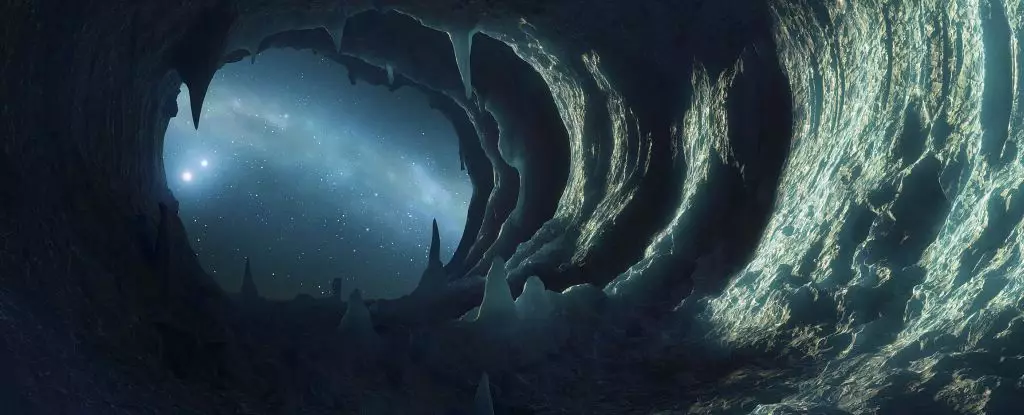
For centuries, water has been a symbol of life and a fundamental element shaping the Earth. Yet, as we extend our gaze beyond our planet, water reveals its enigmatic and multifaceted nature, especially in the far reaches of space. A groundbreaking revelation is reshaping how scientists perceive ice in the cosmos: space frozen water is not merely amorphous or disordered as previously assumed, but harbors tiny, intricate crystalline structures embedded within an otherwise chaotic matrix. This challenging discovery prompts a paradigm shift, urging us to reconsider the fundamental behavior of water molecules in extraterrestrial environments and their broader cosmic implications.
The core of this revelation is rooted in meticulous computer simulations complemented by laboratory experiments that replicate space conditions. Researchers have determined that the most prevalent form of ice within the universe likely contains nanoscopic crystalline inclusions—patterns so small that they span only a few nanometers—interwoven into an icy, glass-like matrix. This stands in stark contrast to traditional models which depicted space ice as smooth, amorphous, and featureless. The realization that tiny crystals are embedded within the ostensibly random frozen molecular structure suggests a complexity that could influence processes across a multitude of cosmic phenomena.
This nuanced understanding stems from the fact that space, with its extreme cold and vacuum, was thought to prohibit the formation of structured ice. Conventional wisdom held that icy worlds in space possessed largely amorphous ice because the low temperatures and rapid depositions prevented molecules from arranging themselves into orderly lattices. However, evidence from advanced simulations indicates that under certain conditions—such as specific freezing rates and direct vapor deposition—partial crystallinity can persist even in these frigid environments. This challenges the assumption that space ice is solely amorphous, prompting a re-examination of how water behaves under cosmic conditions.
The Hidden Complexity of Interstellar Water
The implications of crystalline modules hidden within space ice extend beyond mere curiosity. Ice plays a pivotal role in astrophysics, influencing how planets form, how dense molecular clouds evolve into stellar nurseries, and how matter is redistributed across galaxies. Crystalline regions within amorphous ice can serve as catalysts or repositories for complex molecules, perhaps even fostering the chemical precursors of life in alternative environments. Recognizing that space ice may not be a uniform amorphous blank slate opens new avenues for understanding the chemistry of the universe.
Moreover, the formation process of ice in space involves direct vapor deposition onto surfaces like space dust particles or asteroid surfaces, bypassing liquid phases entirely. Replicating these conditions, scientists observed that even with rapid freezing in simulated environments, tiny crystalline domains could nucleate and persist. When subjected to warming, the molecular order within these ice samples revealed telling signs of embedded crystalline structures, indicating that space ice is more equilibrated than previously believed. This “memory” of ordered arrangements amidst a disordered matrix implies that the universe’s iced landscapes could be mosaics of chaos and order, influencing how they interact with radiation, cosmic rays, and other particles.
From a practical scientific perspective, this insight impacts the interpretation of observational data. Techniques like X-ray diffraction, previously used to analyze the structure of extraterrestrial ices, might have underestimated the degree of crystallinity within icy bodies. Recognizing the existence of nano-crystals reframes how researchers analyze cometary nuclei, icy moons, and even the icy mantles of interstellar dust, providing a more accurate picture of their composition and history.
Revolutionizing Our Perspective on Cosmological and Material Science
This discovery reverberates beyond astrophysics, touching on fundamental questions about the nature of amorphous solids. Materials like glass and polymers share similar disordered structures, yet recent research reveals they can harbor tiny crystalline regions influencing their physical properties. The lesson here is clear: what appears disordered at the macroscale often masks an underlying order at the nanoscale. Recognizing this layered complexity demands that scientists refine existing models of these materials.
In the realm of technology, understanding the embedded crystallinity within amorphous substances could lead to innovations in material design. For example, in fiber optics, the performance of glass fibers depends heavily on their amorphous structure. If minor crystalline inclusions influence their durability or transmission qualities, then engineers might manipulate these features to craft superior materials. Similarly, the knowledge that cosmic ices contain such microstructures could inspire new synthetic materials that mimic their features for use in electronics, cryogenics, or data storage.
Furthermore, acknowledging that space-bound water is not uniformly amorphous but contains nanoscale crystalline domains invites a reassessment of celestial phenomena. The way ice interacts with radiation—its albedo, sublimation rates, and capacity to trap gases—could all be affected by this microstructure. Such factors are crucial in modeling the evolution of icy bodies, from comets traversing our solar system to distant icy moons harboring subsurface oceans.
In essence, this emerging understanding of space ice underscores a broader truth: the universe’s complexity often resides not in grand, observable structures but within the subtle, nanoscale patterns that shape their behavior. The recognition that microscopic crystal formations are embedded within cosmic ice challenges our previous perceptions and opens new frontiers in both scientific inquiry and technological innovation. It reminds us that even in the coldest corners of space, order persists, waiting to be uncovered by curious hearts and meticulous minds.
Leave a Reply