
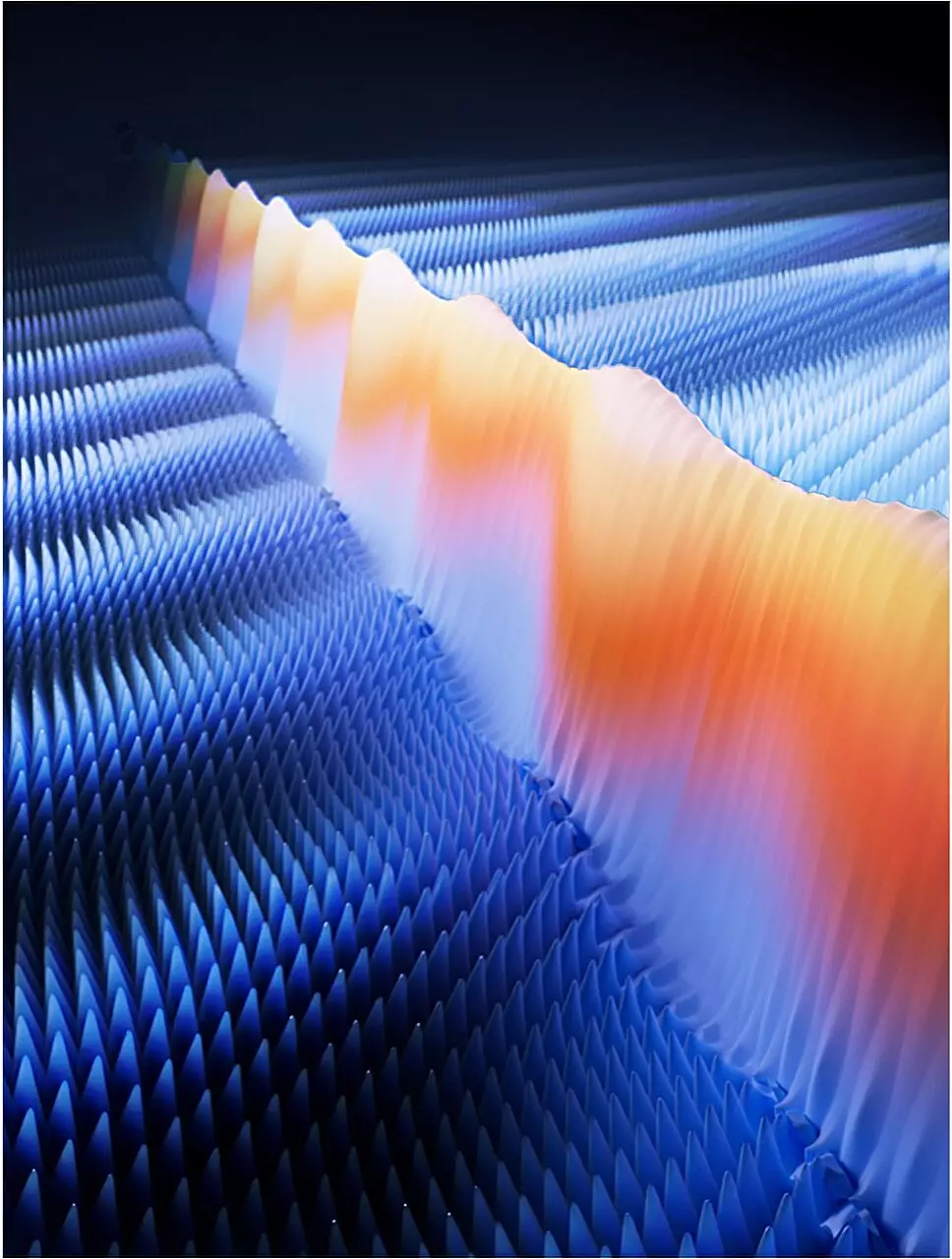
Charge density waves (CDWs) epitomize one of the most fascinating manifestations of quantum mechanics witnessed in condensed matter physics. These phenomena involve a periodic distortion in both the electron distribution and the atomic lattice, effectively weaving a complex tapestry of properties that challenge our understanding of the material world. While the exploration of these waves has burgeoned over the years—especially in materials like high-temperature superconductors—the experimental observation of boundary states associated with CDWs still remains an underexplored frontier. In a groundbreaking study from Princeton University and international collaborators, researchers have taken a significant leap by visualizing both the bulk and boundary modes of a charge density wave in the topological material Ta2Se8I.
Pioneers of Topological Innovation
Led by Maksim Litskevich, the research group’s mission focuses on unraveling the topological properties of quantum matter using advanced experimental techniques. Litskevich’s insights illuminate the enthusiasm surrounding Kagome materials, which meld geometry, topology, and electronic interactions into a rich fabric of physical phenomena. Notably, the group had paved the way in earlier studies by observing coexisting states of CDWs and edge modes in FeGe—another Kagome material. However, such observations often come with caveats; just because two states coexist does not mean one is a cause of the other. In the quest to link topological properties with CDWs, Litskevich and team redirected their efforts toward Ta2Se8I, a quasi-one-dimensional compound with intriguing topological characteristics that undergoes a CDW transition at low temperatures.
Bridging Topology and Charge Density Waves
The research marked a turning point as the scientists successfully visualized an in-gap boundary mode within the CDW state of Ta2Se8I using state-of-the-art scanning tunneling microscopy (STM). This powerful technique enabled them to probe the material at an atomic scale, revealing oscillations in the boundary mode’s spatial periodicity and phase directly tied to the characteristics of the CDW. Their findings provided compelling evidence for a profound relationship between the boundary mode and the charge density wave, effectively constructing a bridge between these two previously siloed phenomena.
This leap of understanding doesn’t merely elevate our grasp of Ta2Se8I; it propels us into the intricate dance of topology and CDWs in materials science. By confirming their hypotheses through both experimental data and theoretical modeling, the researchers unlocked a new realm where the boundaries of conventional physics blur, showcasing a novel topological boundary mode unlike anything seen in traditional quantum spin Hall materials.
The Robustness of Charge-Ordered States
One of the most striking outcomes of the study is the remarkable thermal stability of the insulating gap induced by the charge density wave, which persisted at temperatures up to 260 K. Such robustness contributes to a nascent technical potential, hinting at applications that could revolutionize quantum computing and nanotechnology. The researchers’ endeavor to understand the electronic states of Ta2Se8I also unveiled an intriguing distinction between the charge-ordered phase and the expectations surrounding axion insulators—a coveted class of materials that, until now, had been thought to fit a more rigid mold.
Md Shafayat Hossain, a key collaborator, has articulated the far-reaching implications of this work, suggesting that not only does it redefine our understanding of Ta2Se8I, but it also challenges existing theoretical frameworks. The study raises questions about the assumptions that have guided previous models of charge-ordered phases, potentially inspiring the scientific community to delve deeper into the myriad CDW phases lurking within other topological materials.
Future Explorations and Quantum Frontiers
The road ahead appears full of promise. With Litskevich, Hossain, and their team intending to explore further connections between CDWs and superconductivity, the implications for the future of quantum computing seem tantalizingly close. The potential intertwining of topological charge density waves could yield groundbreaking platforms for revolutionary quantum technologies—an area brimming with opportunity for innovation.
Moreover, plans to investigate other quantum materials exhibiting similar behaviors stand to widen the landscape of research, potentially unveiling additional exotic states of matter. As these scientists embark upon their quest to uncover further phenomena tied to quantum materials, the fusion of experimental insight and theoretical exploration promises a vibrant future in condensed matter research. The study of charge density waves, especially in connection with topological materials, is not just an academic exercise; it is the opening act in a larger performance that has the power to reshape our technological landscape, inviting the next generation of scientists to join in the exploration of quantum mysteries yet to be fathomed.
Leave a Reply