
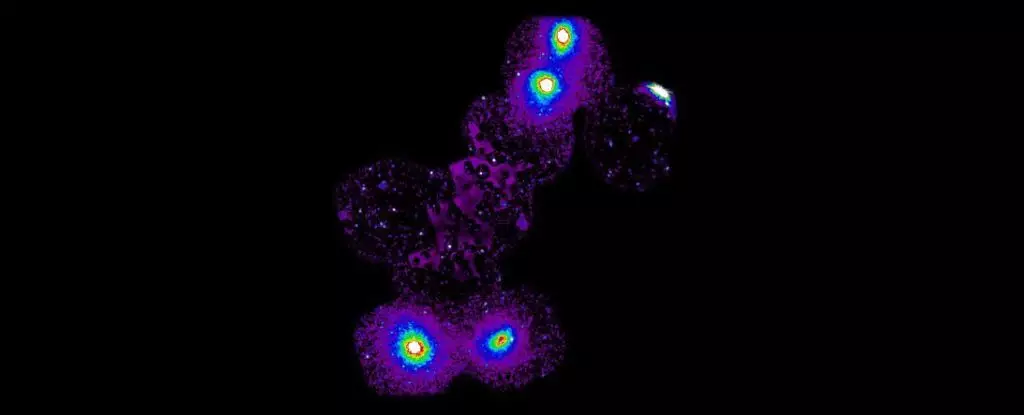
For centuries, humanity has gazed up at the night sky, pondering the mysteries of the universe. Yet, a profound enigma looms over our understanding: where is all the matter in the Universe? While we are well-acquainted with ordinary matter—comprising stars, planets, and galaxies—this visible matter constitutes only a mere 15 percent of the total. With roughly 85 percent shrouded in darkness—often dubbed as dark matter—the observations and theories surrounding our cosmic tapestry have raised significant questions. Thankfully, a breakthrough discovery in the Shapley Supercluster, a colossal cluster of galaxies, has shed light on the elusive filaments of matter that intertwine our Universe.
A Breakthrough in Cosmic Observation
Recent X-ray observations have unveiled a breathtaking filament of hot gas, an astounding 23 million light-years in length, nestled between four sub-clusters within the Shapley Supercluster. This monumental filament represents one of the largest local cosmic structures we’ve encountered, putting forth compelling evidence suggesting that much of the so-called ‘missing’ matter may reside in intergalactic space. According to Konstantinos Migkas, an astrophysicist from Leiden Observatory, this revelation aligns closely with existing models of the cosmos, providing a tangible link between theoretical simulations and empirical evidence.
Through the combination of data from two distinguished X-ray telescopes—the now-retired Suzaku and its successor, XMM-Newton—scientists have begun to map the invisible web that connects galaxies throughout space. Suzaku’s ability to detect faint X-rays spread over expansive areas allowed researchers to identify the filament’s glow, while XMM-Newton helped refine the data by filtering out more luminous X-ray sources, such as black holes. This synchronization of observational tools stands as a testament to how collaboration and innovation can push the boundaries of our understanding of the cosmos.
The Nature of the Cosmic Web
The discovery of this filament supports the theory of the cosmic web, which posits that the universe resembles a vast network of interconnected filaments composed of dark matter and gas. These filaments act as highways along which galaxies and matter traverse, creating a scaffolding of matter that is virtually undetectable by current imaging technologies. The filament discovered within the Shapley Supercluster is estimated to contain enough material to form ten Milky Way galaxies, heated to an astonishing temperature exceeding 10 million degrees Celsius.
The implications of this finding are monumental. It reinforces the hypothesis that much of the matter thought to be missing from the universe is in a diffuse state across vast expanses of intergalactic space. In recognizing these temperatures and distributions, we can begin to piece together a more complete picture of the Universe’s composition.
Impacts on Cosmology and Future Research
The implications of this research extend beyond mere academic curiosity. Understanding the role of this massive filament in the cosmic fabric allows for a deeper comprehension of universal evolution and structure formation. For instance, how did this gas accumulate? What role does it play in star formation across the universe? With further observations and technological advancements, astronomers could find clues that address these vital questions.
Moreover, this discovery sets a new benchmark for astronomers in detecting faint filaments in the cosmic web—a groundbreaking development that opens avenues for future investigations. As observational technology continues to evolve, the persistence to reveal these hidden structures will undoubtedly reshape our foundational understanding of the universe.
Through relentless curiosity and ingenuity, scientists are not just uncovering the secrets of the cosmos; they are redefining our place within it. This filament discovery not only illuminates the vast interstellar landscapes but also propels humanity toward an era of deeper cosmic understanding. In embracing both our triumphs and setbacks in this exploratory journey, we inch closer to unraveling the Universe’s grand design. Every observation serves as a stepping stone, guiding us through the mysteries of existence itself.
Leave a Reply