
Neutrinos are among the most elusive particles known to science, often described as the universe’s ghostly messengers. Capable of passing through entire planets without interacting, they hold keys to some of the biggest mysteries in physics. Despite decades of research, scientists still grapple with fundamental questions: How do neutrinos acquire mass? What is their exact mass hierarchy? And how do they oscillate—or change from one type to another—as they traverse cosmic distances? Recent experimental progress, exemplified by the NOvA collaboration’s latest findings, signifies an important leap toward answering these profound questions, despite the challenges that remain.
This new wave of data collection and analysis not only narrows down the possibilities for neutrino properties but also emphasizes the intrinsic complexity of these particles. The picture we have is both tantalizing and murky; each measurement illuminates, yet also complicates, the web of uncertainties. Comparing the normal versus inverted mass ordering, for instance, is a prime example. Is the hierarchy arranged in a way that aligns with most theoretical models, or does Nature choose an inverted arrangement? No single experiment has yet provided definitive proof, but the accumulation of evidence is steadily tipping the scales.
The Significance of NOvA’s Enhanced Dataset and Breakthroughs
The NOvA experiment, based at Fermilab and spanning hundreds of miles, plays a pivotal role in deciphering these mysteries. Since its inception in 2014, NOvA has continuously refined its approach, with recent results doubling its dataset and incorporating a new low-energy electron neutrino sample. This expansion of data, while seemingly technical, has profound implications: it enhances the experiment’s sensitivity to key parameters such as the neutrino mass differences and oscillation patterns.
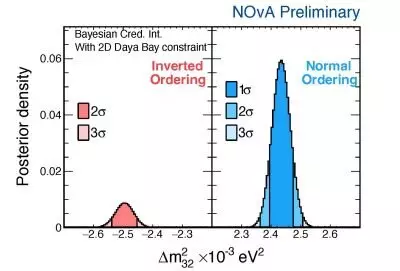
Importantly, NOvA’s improved precision makes the findings statistically more robust, pushing the boundaries of what’s possible with current technology. In particular, the data now favor the “normal” mass ordering more strongly than before. Although it doesn’t quite reach the threshold of certainty for a full-fledged discovery, the evidence points convincingly toward a hierarchy where two neutrinos are light and one is heavier. When combined with results from reactor experiments like Daya Bay and KamLAND, the odds further tilt towards the normal arrangement—approaching nearly 7:1.
This statistical reinforcement is crucial because it offers a potential glimpse into the neutrino’s mass structure, which, in turn, influences cosmological models and the evolution of the universe itself. The simplicity of the normal ordering aligns more naturally with predictions made by many theories, but the ambiguity—and the possibility of inverted ordering—remains, fostering an atmosphere of scientific curiosity and cautious optimism.
Persistent Ambiguities and the Path Forward
Despite these advancements, neutrino physics still faces significant riddles. One of the primary hurdles remains disentangling the effects of mass ordering from charge-parity (CP) violation—an asymmetry between matter and antimatter that might explain why the universe is dominated by matter. The current NOvA results reveal a moderate level of oscillation that can be interpreted under different assumptions about CP violation and hierarchy. As a consequence, the experiment cannot definitively determine which scenario is correct, underscoring the complexity of the phenomena under study.
Furthermore, the nuanced interplay between these parameters illustrates the importance of multiple, complementary experiments. No single experiment can unravel all the secrets alone; instead, the collective effort of diverse approaches—reactor-based, accelerator-driven, and astrophysical—is necessary. NOvA’s contribution is vital in this mosaic, providing data that refine our models, challenge existing assumptions, and guide future endeavors.
Looking ahead, the continuation of NOvA’s operation until early 2027 promises even richer datasets and sharper insights. The collaboration aims to double its antineutrino sample, which is essential for understanding asymmetries between matter and antimatter and could potentially confirm the presence of CP violation in neutrinos. These efforts are vital stepping stones toward what could someday be a paradigm shift in fundamental physics.
The Broader Impact: Toward New Physics and Cosmological Insights
The ultimate significance of these incremental but meaningful advances extends beyond particle physics. Neutrinos influence the large-scale structure and evolution of the cosmos, potentially unlocking clues about the Big Bang and the nature of dark matter. Precise knowledge about their mass hierarchy and oscillation behaviors could inform cosmological models, revealing how the universe’s earliest moments unfolded.
However, there remains a cautionary note: science cannot yet claim to have achieved certainty. The current results are valuable guideposts, but the delicate interplay of parameters means that future measurements—possibly from new generations of experiments like DUNE or Hyper-Kamiokande—are indispensable. It’s a reminder that physics at this frontier is a marathon, not a sprint, requiring patience, ingenuity, and collaborative effort.
Ultimately, while the neutrino puzzle still dominates the boundaries of our understanding, recent progress demonstrates a remarkable human feat: transforming one of nature’s most elusive particles from a mysterious ghost into a tangible key to unlocking the universe’s deepest secrets. The journey is ongoing, and each step brings us closer to deciphering the true nature of matter, energy, and the cosmos itself.
Leave a Reply