
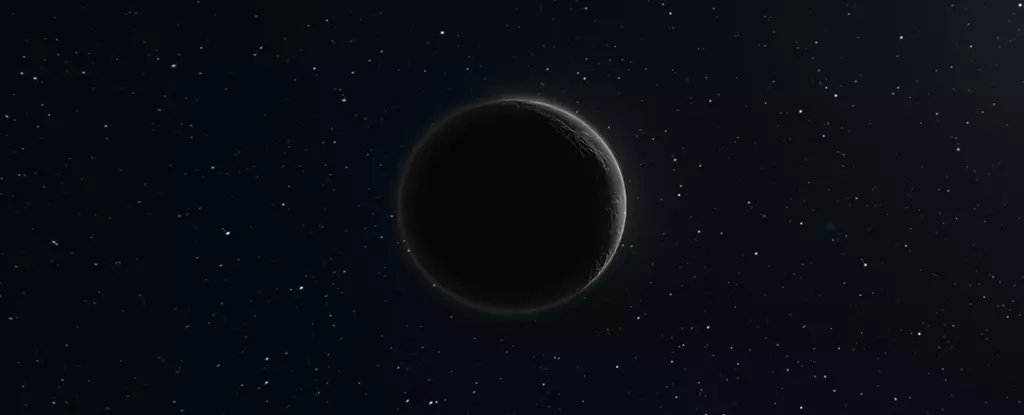
Despite the remarkable technological advancements of modern astronomy, the farthest reaches of our Solar System remain shrouded in mystery. The vast, cold, and dark expanses beyond Neptune challenge our understanding, not only because they are difficult to observe but also because they harbor clues to the very origins of our celestial neighborhood. These distant objects are faint, often only detectable through subtle gravitational tugs or ephemeral glimmers of reflected light, highlighting the limits of our observational capabilities and the resilience of cosmic secrets. The ongoing quest to explore this frontier is driven by a profound desire to decode the history and evolution of the Solar System, and every discovery—no matter how minute—brings us a step closer to understanding these distant worlds.
The challenge lies in the nature of these remote objects. They are remnants of a primordial era, essentially frozen fossils of the Solar System’s infancy, each orbiting the Sun in a manner that hints at influences both seen and unseen. These objects, known as Trans-Neptunian Objects (TNOs), often possess elongated, highly eccentric orbits that seem to defy simple explanations based solely on the gravitational pull of known planets like Neptune. Their behavior suggests a more complex gravitational environment, hinting at hidden forces or bodies that may have once shaped their paths—forces that could be remnants of the Solar System’s dynamic past or evidence of currently undiscovered celestial bodies.
The Quest for Planet Nine: A Hypothetical Giant in the Shadows
The possibility of an unseen ninth planet lurking in the outer reaches of our Solar System has captivated astronomers for years. Known colloquially as Planet Nine, this hypothetical object is invoked primarily to explain the peculiar orbital clustering of distant TNOs and Sednoids—an intriguing group of objects with extreme orbits, including Sedna and others with perihelia far beyond Neptune. These objects have orbits that appear to be shepherded or aligned in a way that suggests an unseen massive influence acting upon them. The most compelling evidence for Planet Nine comes from statistical analyses indicating that these orbital groupings are unlikely to be coincidental.
Recent discoveries, such as the detection of a new distant object dubbed 2023 KQ14—colloquially named Ammonite—add a fresh dimension to this debate. Found using the Subaru Telescope’s powerful HyperSuprimeCam, Ammonite is a Sednoid, orbiting at a distance that surpasses Neptune. Its discovery, complemented by follow-up observations from the Canada-France-Hawaii Telescope and data analysis spanning nearly two decades, provides a detailed look into the orbital dynamics of these remote objects. Remarkably, the orbit of Ammonite defies the patterns observed in the other Sednoids, suggesting a more complex gravitational history than previously thought. Such diversity in orbital configurations raises questions about the orbits’ origins and the forces that shaped them.
What makes Ammonite particularly intriguing is its position in a so-called “q-gap,” a region where no other distant objects with similar perihelion distances are currently known. This anomaly indicates that our understanding of the outer Solar System is incomplete. While some interpret these findings as evidence against the existence of Planet Nine, others see them as a new piece of the puzzle, hinting that the Solar System may have experienced events or influences beyond mere planetary gravity—perhaps interactions with rogue planets, ancient stellar encounters, or capture events from passing stars.
Implications and Theories: Rethinking Solar System Formation
The discovery and analysis of distant objects like Ammonite challenge the traditional models of Solar System evolution. The stability of their orbits over billions of years suggests that significant external influences must have played a role. If Neptune’s gravity alone cannot explain their current paths, then something else—possibly a massive planet—must have orchestrated these orbital patterns.
The most prominent hypothesis remains the existence of Planet Nine. This planet, if it exists, would be a massive, distant world, possibly the fifth-largest planet in the Solar System, yet so far away that it remains hidden from direct detection. Its gravitational influence would be subtle but discernible in the organized clustering of certain TNOs and Sednoids. Every new distant object discovery puts tighter constraints on where Planet Nine might reside, narrowing down the search area for astronomers and fine-tuning their models.
However, some scientists propose alternative scenarios. The peculiar orbits could result from past stellar encounters during the Solar System’s birth in its stellar nursery or from interactions with rogue planets ejected during planetary formation. These theories suggest a chaotic early environment, where gravitational disturbances during the Sun’s formative years left lasting imprints on the orbits of distant objects.
Upcoming astronomical surveys promise to shed more light on these mysteries. The Vera Rubin Observatory, with its state-of-the-art Legacy Survey of Space and Time (LSST), is poised to revolutionize our understanding of the outer Solar System. With its unprecedented ability to detect faint, fast-moving, or transient objects, it could finally reveal the elusive Planet Nine or uncover new populations of distant bodies. Such discoveries will undoubtedly challenge our current theories, pushing the boundaries of planetary science and astrophysics.
In essence, the distant reaches of our Solar System are not just a passive frontier of icy bodies and remnants—they are active archives of cosmic history. Every new detection, from tiny gravitational nudges to faint streaks of light, is a message from the early days of the Solar System. We are only beginning to decipher these messages, and the journey to uncover what lies beyond Neptune is far from over. The potential existence of a hulking, hidden planet or a record of ancient stellar interactions promises to transform our understanding of planetary formation and the dynamic history of our celestial neighborhood.
Leave a Reply