
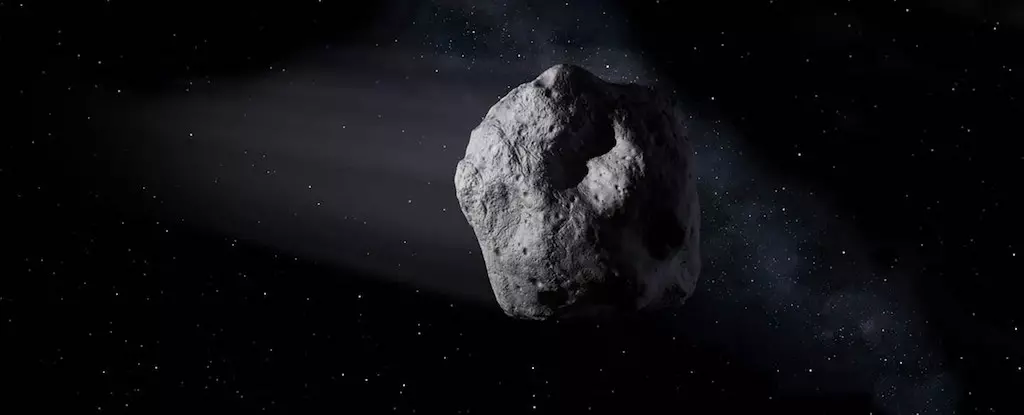
In the vast expanse of space, humanity’s curiosity often leads us to imagine the most extraordinary possibilities, especially when encountering objects that defy our immediate understanding. A recurring phenomenon is the tendency to interpret mysterious celestial bodies—particularly those with orbits resembling Earth’s—as potential alien probes or signs of extraterrestrial intelligence. This intriguing phenomenon is almost an unspoken cosmic law, where the unknown is often prematurely attributed to aliens, fueling speculation and science fiction fantasies. While these narratives captivate imaginations, scientific inquiry frequently reveals more terrestrial explanations that strip away notions of alien visitation, highlighting the importance of grounded analysis.
For decades, astronomers have cataloged numerous objects passing near Earth, including asteroids and comets. Some of these possess orbits that temporarily align with Earth’s path, prompting initial suspicions about their extraterrestrial origin. One of the early examples is 1991 VG, an asteroid discovered in 1991 by the Spacewatch Project. Its orbit was remarkably similar to Earth’s, leading to widespread speculation about its nature—some even mused it could be an alien spaceship. However, subsequent research clarified that it was a regular asteroid, part of a broader family now known as the Arjuna asteroids, a subset of Near-Earth Objects. Despite their Earth-like orbits and occasional close approaches, these bodies are purely natural phenomena, a fact that underscores the importance of scientific skepticism in the face of sensationalism.
Deciphering the Arjuna Asteroids: Natural Variations or Cosmic Riddles?
The Arjuna asteroids provide a striking example of how initial misinterpretations can cloud scientific understanding. Named after the legendary warrior from the Mahabharata, these objects have orbits that are in near resonance with Earth’s. This resonance means they come close to Earth repeatedly over time but aren’t bound gravitationally, unlike moons. This distinction is crucial: these bodies are classified as quasi-satellites because they share a similar orbital period with Earth but aren’t permanently orbiting us. Their paths resemble that of a relay race runner in synchronized motion, not a satellite or natural satellite like the Moon.
In recent years, astronomers have identified additional Arjuna-like bodies, such as 2025 PN7. This asteroid has been characterized as a short-term quasi-satellite, likely to remain in this orbital resonance with Earth for roughly 128 years—the blink of an eye when considering cosmic timescales. Its discovery exemplifies how our understanding of orbital dynamics continues to evolve, revealing a complex ballet of celestial mechanics rather than surprise extraterrestrial visitors. The work of researchers like Carlos de la Fuente Marcos and Raúl de la Fuente Marcos from Madrid’s Universidad Complutense emphasizes that most of these objects are natural and predictable, merely following gravitational rules set by our solar system.
What’s particularly compelling is how these so-called quasi-satellites can temporarily become mini-moons through gravitational capture, turning an orbital dance into a fleeting embrace. For example, 2024 PT5 was temporarily captured by Earth’s gravity, acting as a mini-moon before resuming its independent journey through space. This dynamic interaction demonstrates that celestial bodies are continually exchanging gravitational influence in subtle and intricate ways, far removed from science-fiction scenarios of alien probes lurking in our neighborhood.
The Broader Implications: Cosmic Patterns and Human Imagination
The presence of these objects underscores the importance of understanding natural astrophysical processes rather than succumbing to sensationalist explanations. Humans have an innate tendency to anthropomorphize or find extraordinary meanings in the unknown, which often primes us to see alien technology where there is none. However, the study of objects like the Arjuna asteroids reveals a universe governed by physical laws that are, while complex, ultimately comprehensible through scientific inquiry.
This ongoing research not only demystifies these celestial phenomena but also deepens our appreciation for the gravitational choreography of our solar system. Recognizing that these bodies are natural and predictable helps anchor humanity’s fascination with space in reality rather than fantasy. It also guides future exploration strategies, ensuring resources are allocated efficiently and with scientific rigor, rather than chasing after ghosts in the cosmic machine.
Astronomers and astrophysicists have a formidable task: to distinguish between phenomena that are truly extraordinary and those that simply seem so because of human perception. The case of the Arjuna asteroids and objects like 2025 PN7 exemplifies how advances in orbital modeling and observational technology are unraveling the mysteries of near-Earth space. In doing so, they reinforce an essential truth: that even in the vastness of space, the universe’s most remarkable features are often the most natural, patiently waiting to be uncovered through diligent science.
Leave a Reply