
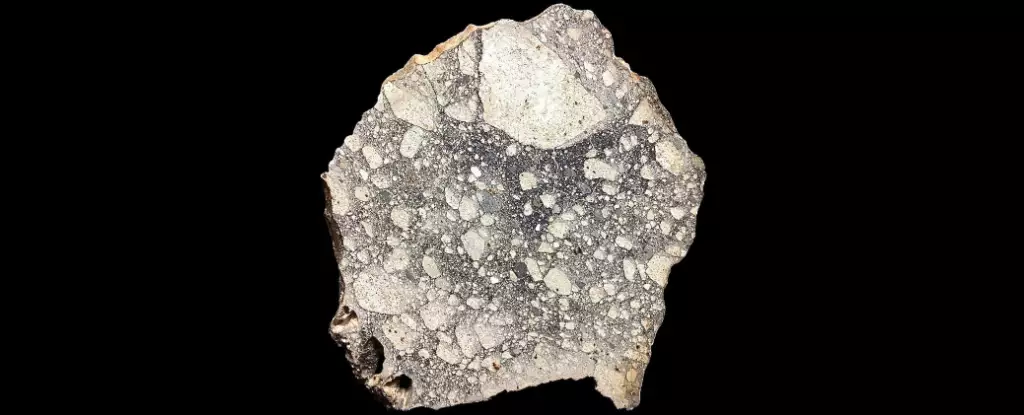
Recent scientific advancements have ushered in a new era of lunar exploration, challenging long-standing assumptions about the Moon’s volcanic history. The discovery of a rare meteorite—Northwest Africa 16286—represents more than just a piece of space debris; it is a key to unlocking the Moon’s mysterious and prolonged geological activity. Unlike previous samples obtained through moon landings, this meteorite offers an unfiltered glimpse into the deep interior of our celestial neighbor, revealing that lunar volcanic activity persisted far longer than established timelines suggest.
This meteorite’s significance lies not simply in its age, but in what its geochemical signature indicates. Its mineral composition, thermal history, and isotopic ratios paint a picture of ongoing internal heat and volcanic activity sustained over several billion years. This contradicts the earlier notion of a geologically quiet Moon after its initial formation, urging a reevaluation of lunar evolution models. The insight gained from this single piece of rock serves to deepen our understanding of planetary cooling processes, radioactive decay, and the long-term insulation of celestial bodies.
Rethinking Lunar Volcanism and its Duration
For decades, lunar samples from Apollo missions, Soviet Luna missions, and recent Chinese explorations painted a picture of a relatively early cessation of volcanic activity—primarily concentrated within the first billion years after the Moon’s formation. However, the discovery of NWA 16286 shatters this simplified timeline. Its estimated age, approximately 2.35 billion years, fills a crucial temporal gap, bridging the gap between older lunar rocks and those retrieved in more recent missions, such as China’s Chang’e 5.
This prolonged volcanic activity indicates that the Moon retained internal heat capable of melting and fostering volcanic processes far beyond initial expectations. The implications extend beyond mere timeline adjustments; it suggests that the Moon’s core and mantle maintained a degree of geothermal activity capable of sustaining volcanic eruptions long after its primordial epochs. Such a revelation forces planetary scientists to reconsider the thermal evolution models of not only the Moon but similar terrestrial bodies.
Moreover, the meteorite’s high uranium-to-lead ratio hints at sustained radioactive decay, which might have supplied the heat needed for ongoing volcanic activity. This opens new questions about the internal heat reservoir that could have persisted for billions of years, driven by radioactive elements or other internal heat sources. Effectively, the Moon was not the dormant, frozen world some once believed—its interior was more dynamic, with volcanic processes occurring in multiple phases, possibly affecting the lunar surface’s composition and geology to this day.
The Serendipitous Nature of Meteorites and Their Scientific Value
While space missions are meticulously planned endeavors, meteorites like NWA 16286 highlight the unpredictable but invaluable role that natural planetary samples play in advancing planetary science. Because meteorites can originate from anywhere on the lunar surface, they serve as scattered chronological markers, offering data points that complement the more localized findings from lunar landings.
This particular meteorite’s journey underscores an important aspect of planetary geology: impact events serve as natural excavations, propelling deep materials into space and ultimately to Earth. The shock features, melt pockets, and veins within NWA 16286 reveal the violent history of lunar impacts, which also complicates precise age dating—yet, the scientific community has made remarkable progress despite these challenges.
The narrative of this meteorite exemplifies the synergy of chance and scientific curiosity. Its discovery adds a crucial piece to the puzzle of lunar history while reminding us that some of the universe’s most profound secrets are accessible through humble rocks falling from the sky. This underscores a broader philosophical realization: exploration doesn’t always require complex, expensive missions—sometimes, nature’s own debris offers the most enlightening insights.
Implications for Future Lunar Research and Exploration
The revelation about prolonged lunar volcanism forces a reevaluation of lunar and planetary habitability models. If the Moon remained geothermally active longer than previously believed, it impacts theories about its internal structure, core dynamics, and potential past habitability (even if only in a geological sense).
Additionally, this discovery augments the significance of studying lunar meteorites alongside spacecraft missions. While landings provide detailed, site-specific data, meteorites scatter the story of lunar history across different regions and depths, giving scientists a broader and more diverse dataset. This multifaceted approach could be vital for future lunar exploration missions, especially as we prepare for sustained human presence on the Moon.
Furthermore, understanding the Moon’s long-lasting internal heat can shed light on other rocky bodies in our solar system—like Mercury or Mars—where similar processes might have extended volcanic activity periods. This knowledge could influence the design of future missions aimed at detecting long-term geological activity on distant worlds, ultimately expanding our perspective of planetary evolution.
In essence, the discovery of NWA 16286 is a compelling reminder of the universe’s intricacies and our ongoing quest to decipher them. It exemplifies how seemingly humble rocks can reshape entire narratives and challenge established scientific dogmas, pushing humanity closer to understanding not only the Moon but the fundamental processes that govern planetary bodies across the cosmos.
Leave a Reply