
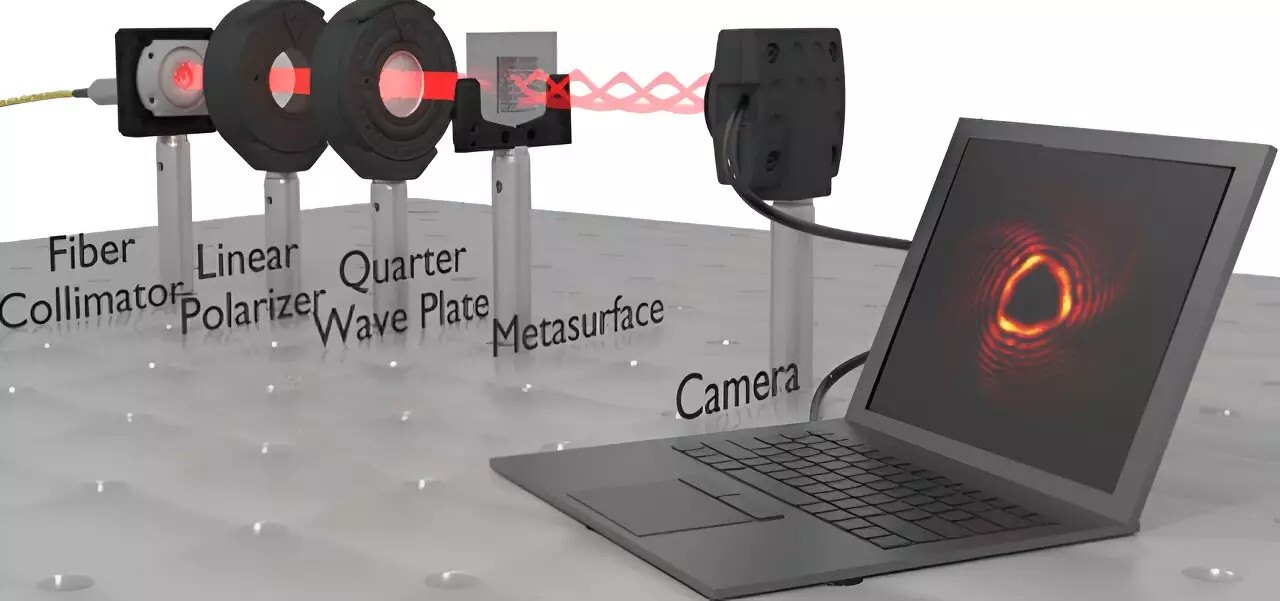
Recent advancements in photonics have taken a quantum leap forward with the groundbreaking work of researchers at the TMOS, particularly those associated with the ARC Center of Excellence for Transformative Meta-Optical Systems at the University of Melbourne. Their exploration into the realm of metasurface-enabled tractor beams, which harnesses light to actively pull particles, represents a significant stride from the realms of science fiction into tangible technological reality. This pioneering research, published in ACS Photonics, showcases a novel solenoid beam produced through an ultra-thin silicon metasurface—an innovation that could redefine how we think about optical manipulation.
Rethinking Traditional Models
Historically, the realm of optical manipulation has relied on bulky and cumbersome special light modulators (SLMs), which limited their application in portable and handheld devices. In contrast, the new solenoid beam generated by the Melbourne team is markedly more efficient. Their approach utilizes a metasurface that is a mere fraction of a millimeter thick, which not only eases the weight constraints but also enhances portability. This shift in methodology opens doors to innovative applications that were once relegated to the pages of sci-fi novels.
The Mechanics Behind Solenoid Beams
What sets solenoid beams apart from conventional beams is their ability to attract particles rather than repel them, akin to the action of drilling wood—pulling shavings into the chuck rather than pushing them away. The University of Melbourne team has managed to maintain the essential physical characteristics of solenoid beams while improving their operational flexibility. Unlike previous iterations, these new beams exhibit a versatility in input beam conditions and eliminate the need for SLMs. This fusion of effectiveness and efficiency in optical engineering is nothing short of revolutionary.
Fabrication Breakthroughs
The construction of the metasurface itself is a complex yet fascinating process. By employing electron beam lithography and reactive ion etching, the researchers meticulously patterned the silicon to create a phase hologram of the desired beam. The results are astonishing; approximately 76% of a Gaussian input beam transforms into the newly engineered solenoid beam, demonstrating unprecedented efficiency. This capability not only allows for the conversion of light but also facilitates unobstructed experimentation at distances of up to 21 centimeters.
Forward-Looking Applications
Lead researcher Maryam Setareh envisions a future where such compact and efficient optical devices could find applications beyond mere academic interest. In particular, one promising area of development is non-invasive medical biopsy techniques. Current methods often cause trauma to nearby tissues, a concern that could be mitigated through the use of these advanced light beams. This research epitomizes the intersection of innovation and practicality, firmly positioning itself as a harbinger of brighter horizons in both medical diagnostics and beyond.
The path ahead is riddled with potential, and the TMOS team’s achievements may soon pave the way for an array of applications, shaping the future of how we engage with and manipulate the microscopic world around us.
Leave a Reply