
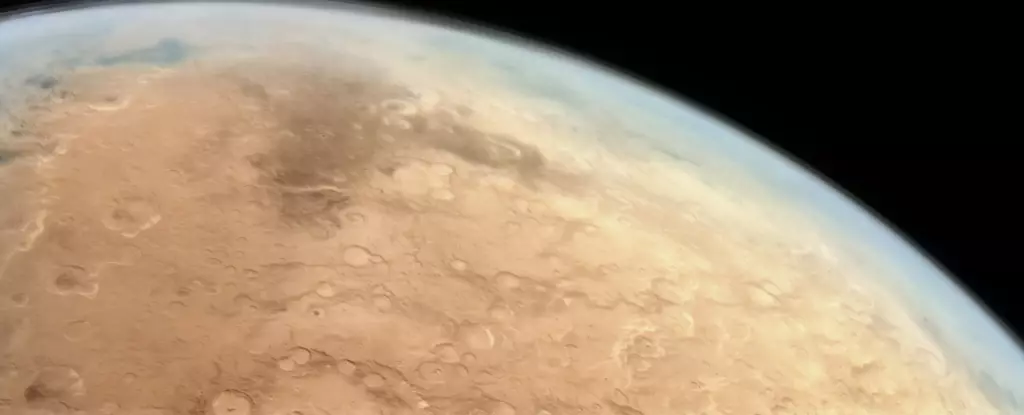
For centuries, humanity has gazed at Mars with curiosity and wonder, pondering why this neighboring planet remains a barren wasteland despite similarities to Earth. While both planets boast rocky surfaces and, in earlier times, the presence of water, Mars today is a stark, uninhabitable desert. This paradox invites a deeper examination into planetary evolution, climate dynamics, and the delicate balance that makes Earth a cradle for life. Recent discoveries from NASA’s rovers bring new insights, but they also highlight the profound mysteries that still loom over Mars’s inhospitable fate.
The core of this mystery lies in the role of water and atmospheric chemistry—key ingredients for life as we know it. Ancient Mars shows evidence of rivers, lakes, and perhaps even transient conditions capable of supporting microbial life. Yet, the planet’s current state suggests it was doomed to a dry, cold existence. On Earth, a complex carbon cycle, driven by volcanic activity, atmospheric gases, and liquid water, sustains a climate where life thrives. Mars, with its feeble volcanic outgassing and lack of a vigorous greenhouse effect, could not maintain such a hospitable environment, leading to its long-term desertification.
This disparity underscores an intrinsic weakness in Mars’s planetary makeup. Its insufficient volcanic activity failed to replenish atmospheric gases like carbon dioxide, critical for trapping heat and creating a warm surface. Consequently, Mars’s climate plunged into a frozen silence, extinguishing the fleeting windows of habitability that might have once existed. The evidence of ancient rivers carved into the Martian crust serves as a poignant reminder that water was once abundant, yet for reasons beyond mere water presence, the planet could not sustain life.
Recent findings have added layers to this complex puzzle. NASA’s Curiosity rover identified rocks rich in carbonate minerals—compounds that on Earth act as buffers or “sponges” for CO₂, regulating climate over geological timescales. Such mineral evidence suggests that at some point, Mars experienced localized or episodic conditions favorable to life. However, these hospitable periods were brief and sporadic, followed by what researchers describe as 100 million-year stretches of desolation. This intermittent habitability indicates a planet struggling against an inherent energetic deficit—its internal processes insufficient to maintain a stable, life-supporting environment over millions of years.
The key factor appears to be Mars’s inability to sustain a balanced greenhouse effect as Earth does. Without a vigorous carbon cycle driven by persistent volcanic activity, Mars could not retain its atmospheric warmth. Its atmosphere, predominantly thin and composed mostly of carbon dioxide, is fragile. As volcanic activity waned, Mars’s atmospheric pressure dropped, temperatures plummeted, and water retreated and froze, either evaporating into space or seeping into the subsurface. The planet’s inability to recreate the conditions necessary for a stable, warm climate is central to why life never took hold in any meaningful way.
Furthermore, the possibility of hidden pockets of liquid water deep beneath the surface sparks speculation that Mars might still harbor microhabitats shielded from the hostile surface environment. However, current technology offers limited confirmation. Missions like Perseverance have identified signs of carbonate minerals around ancient lakes, but definitive evidence of life—especially fossilized microorganisms—remains elusive. Sample return missions, on the horizon from NASA and China, could revolutionize our understanding by bringing pristine Martian rocks back to Earth for thorough analysis. These endeavors underscore a core scientific pursuit: to determine whether life ever took root on Mars or if it was forever denied the fundamental conditions necessary for biological processes to flourish.
The broader implications extend well beyond Mars itself. Our growing catalog of exoplanets reveals thousands of worlds, yet the rarity of planets with Earthlike histories underscores how unique our planetary conditions are. If Mars—which was seemingly close to being habitable—failed due to planetary scale deficiencies, it raises questions about the universal prevalence of life. Is Earth an extraordinary anomaly, or are habitable planets inherently rare, requiring just the right balance of volcanic activity, atmospheric retention, and liquid water? These questions sit at the heart of astrobiology and planetary science.
Criticism of current hypotheses, however, must be acknowledged. The assumption that volcanic inactivity sealed Mars’s fate may oversimplify the complex interplay of planetary processes. Other factors—such as magnetic field loss, solar wind erosion, or random catastrophic events—could have compounded the planet’s decline. The narrative that Mars’s inability to maintain a stable climate is solely due to volcanic dormancy might overlook these nuances. Even so, the emerging evidence continues to solidify the view that planetary habitability hinges on a fragile, interconnected system that can easily tip into desertification.
In attempting to answer whether Mars ever hosted life, scientists face the profound challenge of piecing together incomplete clues. The story of Mars is one of a planet that once flirted with habitability but ultimately succumbed to its internal shortcomings. Its long, harsh desert is a testament to planetary fragility—a reminder that Earth’s capacity to sustain life is a rare and precious gift, carefully balanced by geological and atmospheric dynamics that Mars lacked. As exploration progresses, the hope remains that coming discoveries will shed light on whether life was ever a fleeting spark or a persistent possibility that simply failed to ignite on Martian soil.
Leave a Reply