
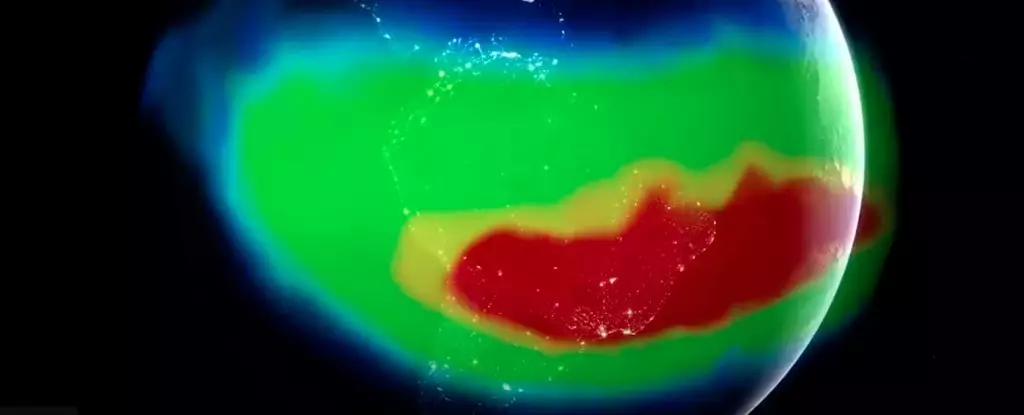
Earth’s magnetic field is often perceived as a stable shield that deflects solar radiation, shielding life from the harshest elements of space. However, lurking beneath this illusion of constancy is a complex and dynamic anomaly—known as the South Atlantic Anomaly (SAA)—that challenges our understanding of planetary magnetism. Situated between South America and southwest Africa, this vast region features a significant dip in magnetic strength, effectively creating a “dent” or “pothole” in Earth’s magnetic shield. While it might not seem immediately threatening to life on the surface, the SAA poses substantial risks to satellites and space missions, revealing a critical vulnerability in our planetary armor.
This anomaly’s existence signals deeper geophysical processes at play, hinting at an intricate and sometimes unpredictable interaction within Earth’s core. The anomaly’s evolution and behavior are not merely scientific curiosities but pivotal factors influencing space technology, satellite operations, and possibly even long-term planetary magnetic shifts. The SAA exemplifies the delicate interplay between Earth’s deep interior and the near-space environment—a relationship that’s more intertwined and susceptible to change than most realize.
The Geophysical Roots: A Deep-Seated Marvel of Planetary Dynamics
At the heart of the SAA lies Earth’s molten iron core, a relentless source of our planet’s magnetic field. The convective motions within this iron-rich zone generate electrical currents that produce the magnetic shield familiar to us. Yet, the process is neither uniform nor static; it’s shaped and disturbed by layers of dense rock deep beneath Earth’s surface. Specifically, the African Large Low Shear Velocity Province—an enormous reservoir of dense rock located thousands of kilometers underground—plays a crucial role in destabilizing the magnetic field in the region of the SAA. Its presence contributes to localized magnetic weakening, creating the “dent” that characterizes the anomaly.
Scientists suggest that the magnetic field in the SAA is also influenced by a local reversal of polarity, a phenomenon that results in a weaker, more vulnerable magnetic zone. This localized bias not only diminishes Earth’s magnetic strength in the affected area but seems to be evolving over time. Magnetic field lines are shifting, and the anomaly itself appears to be splitting into two distinct “cells,” each with its own minimum intensity point. This behavior indicates a highly dynamic system—one that could be indicative of larger geomagnetic processes at work.
Impacts on Space and Technology: A Persistent vulnerability
While the SAA does little to threaten life on Earth directly, it poses a significant hazard for objects orbiting within the affected region. Satellites, spacecraft, and the International Space Station routinely pass through this weakened zone, making them vulnerable to charged solar particles that can penetrate the diminished magnetic shield. These high-energy protons are capable of disrupting onboard electronics, causing temporary malfunctions or even permanent damage.
Consequently, space agencies like NASA take proactive measures by shutting down sensitive systems when passing through the SAA, preventing potential catastrophic failures. This defensive approach underscores the anomaly’s importance, not just as a scientific curiosity but as an operational hazard that demands ongoing vigilance. The risk of data loss, satellite malfunction, or permanent component damage underscores the urgent necessity of understanding this magnetic oddity.
More intriguingly, recent research suggests the SAA’s behavior could be a window into Earth’s broader magnetic dynamics. Its gradual drift, recent splitting, and historical recurrence hint at a complex, long-term pattern—one that might be a part of Earth’s natural magnetic life cycle rather than an isolated freak event.
Decoding the Anomaly’s Evolution: A Clue to Earth’s Magnetic Future?
Recent studies reveal that the SAA is far from a static feature. Instead, it exhibits a slow but definitive movement around the planet, drifting across the South Atlantic region over decades. Moreover, scientists have observed that the anomaly appears to be splitting into two separate areas of weakened magnetic strength—forming what can be envisioned as two “poles” within a larger depression.
This fracturing and migration could be signs of Earth’s magnetic field undergoing significant reconfiguration. Some experts argue that the SAA may not be a temporary phenomenon but a recurring feature that has persisted in Earth’s history for millions of years. Evidence from geological records suggests similar events date back at least 11 million years, implying that magnetic weakening in the region is an integral part of natural planetary processes—not an abnormal anomaly to be feared outright.
One of the more provocative aspects of this ongoing research is the idea that the SAA isn’t necessarily a precursor to a magnetic pole reversal. Such reversals—where Earth’s magnetic poles flip—occur infrequently over geological timescales. The behavior of the SAA may instead be a manifestation of the Earth’s magnetic field fluctuating and reorganizing, akin to a nervous system rebalancing rather than signaling imminent catastrophe.
The Road Ahead: Navigating the Unknown in Earth’s Magnetism
Despite decades of data collection and advanced observations, many questions about the South Atlantic Anomaly remain unanswered. Its current behavior—movement, splitting, and long-term recurrence—suggests a system in flux, demanding continuous monitoring. NASA and other space agencies have prioritized tracking the anomaly’s changes, recognizing that its evolution could influence future spaceflight safety and satellite longevity.
While some see the SAA as a curiosity or even as a benign feature of Earth’s magnetic dance, others recognize that it provides a rare glimpse into the planet’s unseen core processes. The anomaly’s existence underscores the importance of understanding the deep geophysical forces that shape our world. It may also serve as a bellwether for larger geomagnetic phenomena, including potential pole reversals or other planetary magnetic shifts that could have profound implications for life on Earth.
Ultimately, the SAA exemplifies the dynamic nature of our planet—a reminder that beneath the surface, terrestrial processes are always at work, reshaping the magnetic environment in ways that we are only beginning to comprehend. As research progresses, it is clear that this magnetic “pothole” holds vital clues not only about Earth’s interior but also about the fragile interplay between planetary magnetism and space technology, informing the future of exploration and planetary science alike.
Leave a Reply