
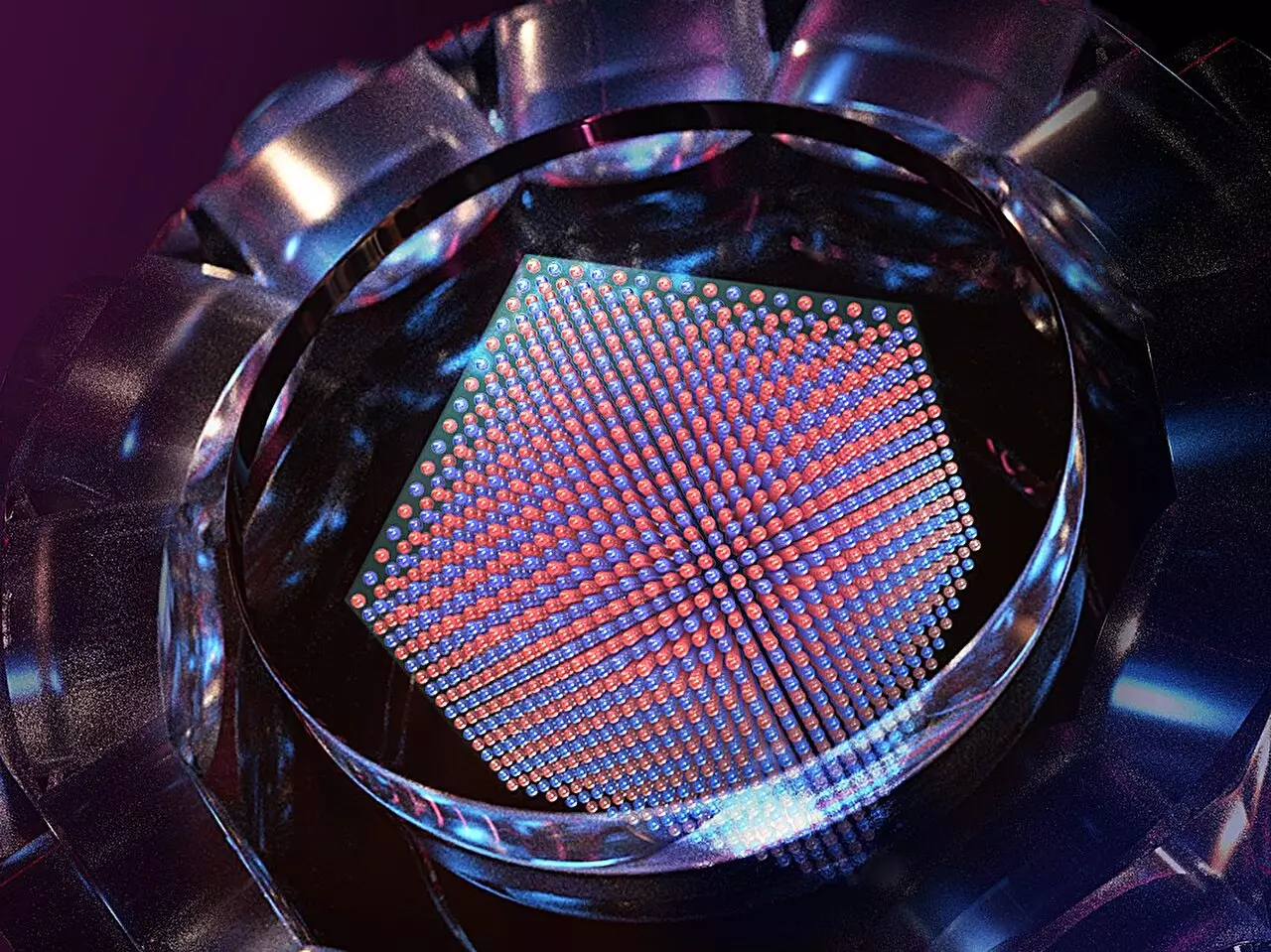
In an unprecedented leap for quantum physics, researchers have successfully observed the antiferromagnetic phase transition within a large-scale quantum simulator of the fermionic Hubbard model (FHM). This significant advancement, detailed in a study featured in *Nature*, underscores the burgeoning potential of quantum simulation techniques. Conducted by a team spearheaded by prominent scientists from the University of Science and Technology of China, including Profs. Pan Jianwei, Chen Yuao, and Yao Xingcan, this groundbreaking work sets the stage for unraveling complex phenomena that have long eluded understanding.
Understanding Quantum Magnetism
The findings promise to unravel the obscure mechanisms that underpin high-temperature superconductivity—a phenomenon that could transform energy efficiency globally. High-temperature superconductors, which conduct electricity without resistance at relatively elevated temperatures, hold immense scientific and economic potential. Yet, the intricacies of their behavior remain enigmatic, creating hurdles not only for theoretical models but also for practical applications. The fermionic Hubbard model, an abstraction of electron interactions in a lattice configuration, serves as a cornerstone for exploring these complexities, embodying various phenomena pertinent to strong correlation effects observed in exotic quantum materials.
Challenges in Quantum Simulation
Despite the theoretical promise of models like the FHM, the path to a comprehensive understanding is fraught with challenges. The model lacks a definitive analytical solution in both two- and three-dimensional frameworks. Additionally, the limitations of classical computational approaches prevent an exhaustive exploration of the model’s parameter space. Theoretical analyses have indicated that even the most advanced digital quantum computers may struggle with the intricacies involved. These complications pave the way for the necessity of quantum simulation to penetrate the depths of these phenomena, particularly through the employment of ultracold fermionic atoms organized in optical lattices.
A Leap Forward in Experimental Techniques
The successful observation of the antiferromagnetic phase transition marks a pivotal achievement in this journey. Achieving this milestone involves two fundamental aspects: first, creating a uniform optical lattice that ensures consistent Hubbard parameters across the experimental setup, and second, lowering the system’s temperature beneath the Nél temperature—the critical point for antiferromagnetic transitions. Interestingly, traditional methods faced significant hurdles due to the difficulty in cooling fermionic atoms effectively, compounded by the inhomogeneities introduced by standard lattice laser configurations.
To overcome these barriers, the research team innovatively enhanced their quantum simulator by integrating the methodology for crafting a homogeneous, low-temperature Fermi gas contained within a box potential with a flat-top optical lattice structure. This advanced configuration boasts approximately 800,000 lattice sites, offering a remarkable scalability far beyond earlier endeavors restricted to mere dozens of sites. This unique setup features uniformly distributed Hamiltonian parameters and operates at temperatures significantly reduced from the Nél threshold.
Results That Illuminate the Path to Progress
Utilizing this sophisticated apparatus, the team meticulously adjusted interaction strengths, temperatures, and doping levels to approach critical thresholds, ultimately attaining irrefutable evidence of the antiferromagnetic phase transition. They observed a pronounced power-law divergence in spin structure factors, a pivotal indicator of quantum magnetic correlation, aligning with the critical exponent derived from Heisenberg-like behavior. This empirical observation not only advances the theoretical frameworks surrounding quantum magnetism but also establishes essential groundwork for delving deeper into the FHM and deriving its low-temperature phase diagram.
Implications for the Future of Quantum Research
The implications of this groundbreaking work are profound. Emerging from clearly delineated experimental results, the advancements showcased exceed the capabilities of contemporary classical computing technologies, manifesting the competitive edge of quantum simulations in resolving pivotal scientific challenges. As research moves forward, the detailed examination of quantum magnetic fluctuations will likely become instrumental in elucidating the arcane secrets of high-temperature superconductivity. This study is not merely a step forward; it is a powerful leap into the realms of quantum discovery, promising a future marked by new technologies empowered by a deeper understanding of quantum materials.
Leave a Reply