
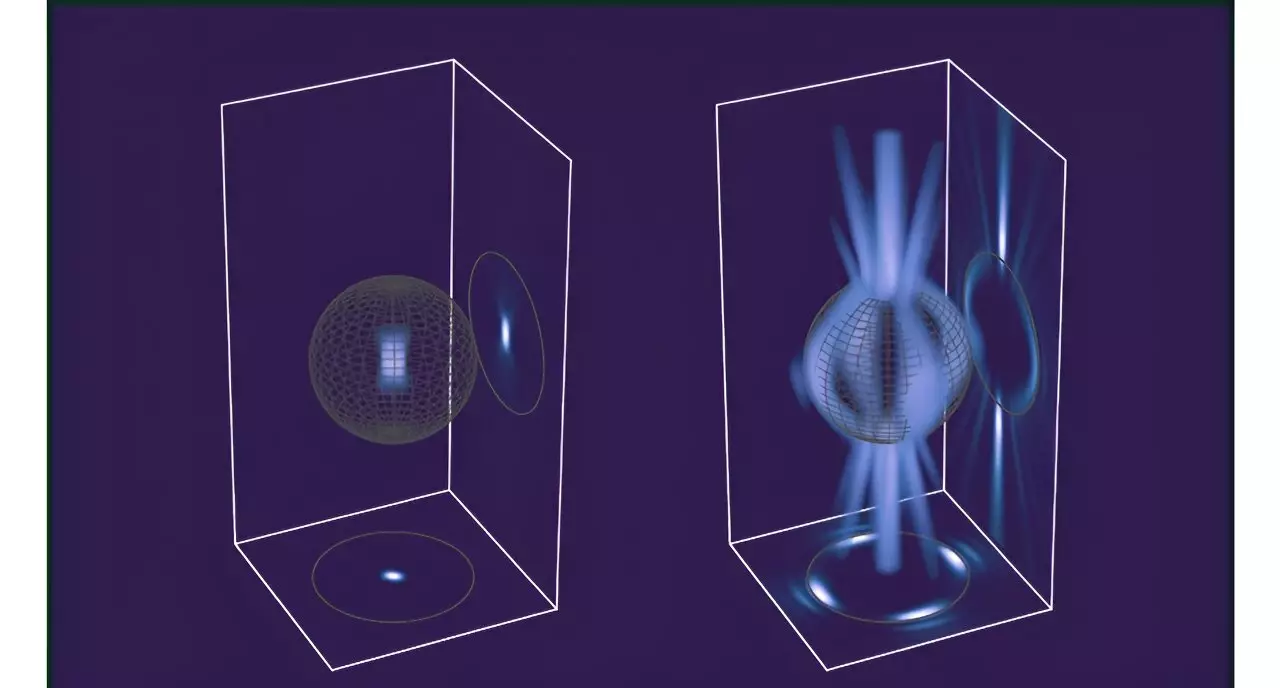
Optical tweezers have long been celebrated as a groundbreaking tool for manipulating microscopic particles with precision using focused laser light. Since their inception in the 1980s, these tools have enabled scientists to study biological cells, DNA strands, and small particles without physical contact—reducing contamination and mechanical damage. However, despite their usefulness, classical optical tweezers face intrinsic limitations, especially when it comes to larger particles or those requiring more refined confinement. The fundamental challenge has been the uneven distribution of light interaction across the particle’s surface, which diminishes the trapping efficiency for bigger objects. This obstacle has spurred researchers to rethink how light itself can be engineered to form more effective and adaptable traps.
Innovative Wavefront Shaping Ushers in a New Era
Building upon the Nobel-winning work of Arthur Ashkin, recent advances involve manipulating the wavefront of laser light to tailor the electromagnetic field precisely. A team led by Dr. David Phillips at the University of Exeter has pioneered this approach, combining theoretical modeling with experimental validation to create what they term “photon-efficient optical tweezers.” Unlike traditional methods that focus light on a tiny spot and rely on the particle’s internal interaction, this new technique envelops the entire particle with a customized light pattern. The result is a more robust and stable confinement, effectively giving particles a “tight embrace.” This is particularly transformative because it overcomes the size-related inefficiencies inherent in earlier designs, enabling stronger trapping forces that are less dependent on particle surface properties.
The Complexity of Customization and Future Possibilities
One of the most fascinating aspects of this progress is the necessity for individualized light patterns. There is no universal design; instead, each particle’s shape, size, and even composition demand a bespoke wavefront configuration. Achieving this level of precision demands sophisticated mathematical, numerical, and experimental techniques—an interdisciplinary effort involving collaborations across institutions in Scotland and Austria. While this complexity might seem daunting, it underscores a vital insight: the future of optical trapping lies in personalized, adaptable solutions. Such tailored control opens doors to manipulating a wide array of particles, from biological cells to synthetic nanostructures, in ways previously thought impossible.
This development signals a paradigm shift, emphasizing that the real power of light in science is yet to be fully harnessed. As research continues to refine and simplify these wavefront shaping techniques, the potential applications are enormous—from targeted drug delivery systems and advanced nanofabrication to quantum computing. Ultimately, these innovations mark a significant leap toward fully controllable, high-precision manipulation tools that could redefine the boundaries of microscopic science and engineering.
Leave a Reply