
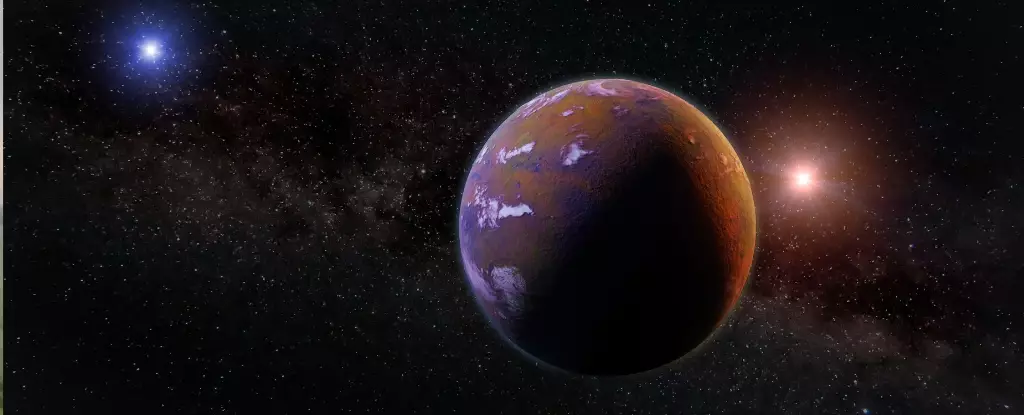
The field of exoplanet research is on the cusp of a transformative era, driven by technological advancements and bold scientific inquiries. Traditional methods, which often rely on indirect evidence like transit dips or radial velocity shifts, have their limitations. Now, the ability to capture actual images of planets in formation—especially around stars that have cleared their immediate environments—marks a significant leap forward. The recent discovery of a young giant planet orbiting a star with a clear, dust-free environment challenges previous assumptions about planet formation timelines and mechanisms. It underscores that planet formation may continue in varying environments, even after a star has largely ceased accreting material from its surrounding disk.
This particular finding disrupts the long-standing notion that the disappearance of protoplanetary disks marks the end of planet formation. Instead, it suggests that planet formation might be a more staggered and enduring process, possibly spanning several million years. By directly imaging this sun-like star’s planetary companion, astronomers amplify their confidence that planets can exist in diverse stellar stages—ushering in a new era where visual confirmation becomes more commonplace and informative.
The Significance of a Dust-Free Environment
One of the key insights from this discovery lies in the environment of the primary star. Unlike its companion, which still hosts a vibrant, dust-laden disk ripe with signs of ongoing planet formation, the primary star’s disk has been fully cleared. For years, astronomers have struggled to directly image planets around stars with prominent disks, simply because the dust clouds obscure potential planetary companions. The clearing of dust effectively acts as a natural spotlight, illuminating planets that would otherwise remain hidden.
This scenario reveals a crucial insight: stars transition through different stages of planetary system evolution more swiftly than previously understood. The primary star’s lack of protoplanetary material indicates it is in a mature phase, yet it still harbors a relatively young giant planet. This underscores that planet formation can occur early and be efficiently completed, even as the stellar environment evolves into a less obscured state. Such a realization prompts a reevaluation of models, emphasizing the importance of timing, local disk conditions, and the star’s mass in planetary development.
Unveiling a Young Giant in a Mature System
The discovery of the planet itself is nothing short of remarkable. Orbiting at approximately 15-20 astronomical units (AU) from its star, the planet—dubbed HD 135344 Ab—reaches a mass comparable to around ten Jupiter masses. Its estimated age of under 12 million years positions it among the youngest directly observed gas giants, making it an exceptional astrophysical laboratory for understanding early planetary evolution.
What makes this object particularly fascinating is its formation environment. The planet’s likely birthplace near the snow line—where volatile compounds like water and methane condense into icy solids—provides compelling evidence that giant planet formation predominantly occurs in this coveted zone. The surfaces of dust and ice in this region facilitate the rapid accretion of material, accelerating planet formation. Observing a planet that likely formed near this region helps confirm long-standing theories and provides real-world data about the process.
Furthermore, this detection challenges the prevalent view that wide-separation giants are scarce, especially at distances beyond 20 AU. The rarity of such detections has often been attributed to observational biases or limitations. Yet, this discovery strongly suggests that such planets may be more common than we thought, especially around stars that recently cleared their disks. It propels the scientific community to reconsider the frequency and distribution of planetary bodies relative to their host star’s evolutionary stage.
Advances in Technology: The Gateway to Direct Imaging
Capturing direct images of exoplanets, particularly those close to their parent stars, remains an extraordinary technical challenge. The recent success owes much to the prowess of the Very Large Telescope (VLT) equipped with the SPHERE instrument—an advanced system designed explicitly for high-contrast imaging of exoplanets. Over four years of dedicated observation, the team meticulously tracked the planet’s motion, confirming it as a bound companion rather than a background star—a process that underscores the importance of patience, precision, and equipment sophistication in modern astronomy.
This breakthrough is also heavily dependent on the precision of astrometric data from missions like Gaia. High-accuracy measurements allow astronomers to distinguish between objects that are physically associated and those that merely lie along the same line of sight. As Gaia continues to release improved datasets, the likelihood of discovering similar planets at closer separations and lower masses will inevitably increase. The next decade promises a surge in direct imaging capabilities, especially as we prepare for new telescopes with unparalleled sensitivity.
Implications for Future Planetary Science
Understanding how and where giant planets form is fundamental to deciphering not just our own Solar System’s history but the diversity of planetary systems galaxy-wide. This discovery hints that young, massive planets may frequently develop near the snow line, a hypothesis that future surveys will test. The potential abundance of such planets around stars in various evolutionary phases could reshape theories of planetary system development.
The advent of next-generation observatories like the Extremely Large Telescope (ELT), set to come online in 2029, promises to elevate direct imaging to new heights. With these instruments, scientists hope to analyze planetary atmospheres, compositions, and even weather patterns—transforming remote sensing into a detailed scientific dialogue with distant worlds. Each new detection feeds into a broader narrative: that planetary systems are not uniform, but wildly varied, with some planets forming rapidly and stabilizing early, while others take longer and evolve amidst more chaotic, dusty environments.
By continuously pushing the boundaries of observational technology and theoretical modeling, astronomers inch closer to understanding the fundamental processes that give rise to planets—whether we’re peering into a star’s final chapters of disk dispersal or catching a nascent giant still cradled in the glare of its parent. This discovery exemplifies the profound scientific and technological progress that transforms distant
Leave a Reply