
In the vast realm of scientific discovery, the ability to observe the minutest units of matter—single molecules—has always been a coveted achievement. Now, a pioneering development emerges that promises to reshape how researchers understand the fundamental interactions that govern everything from biological functions to material properties. The University of Wisconsin–Madison’s latest technological breakthrough embodies an extraordinary leap forward: a method capable of detecting and profiling individual molecules without relying on fluorescent labels. This innovation isn’t just a feat of engineering; it signifies a paradigm shift, unlocking new avenues in drug discovery, materials science, and our fundamental grasp of molecular interactions.
Traditional techniques have often depended heavily on fluorescent labels—molecular tags that illuminate specific entities and make them visible under microscopes. While invaluable, these labels come with inherent limitations. They can alter the natural behavior of molecules, introduce artifacts, or even impede the molecules’ genuine interactions. Recognizing this, the UW–Madison team took an audacious step toward an unadulterated view—a method that sees molecules as they are, in their true, unmodified state. This leap is akin to moving from listening to a song with a noisy microphone to hearing it in crystal-clear clarity.
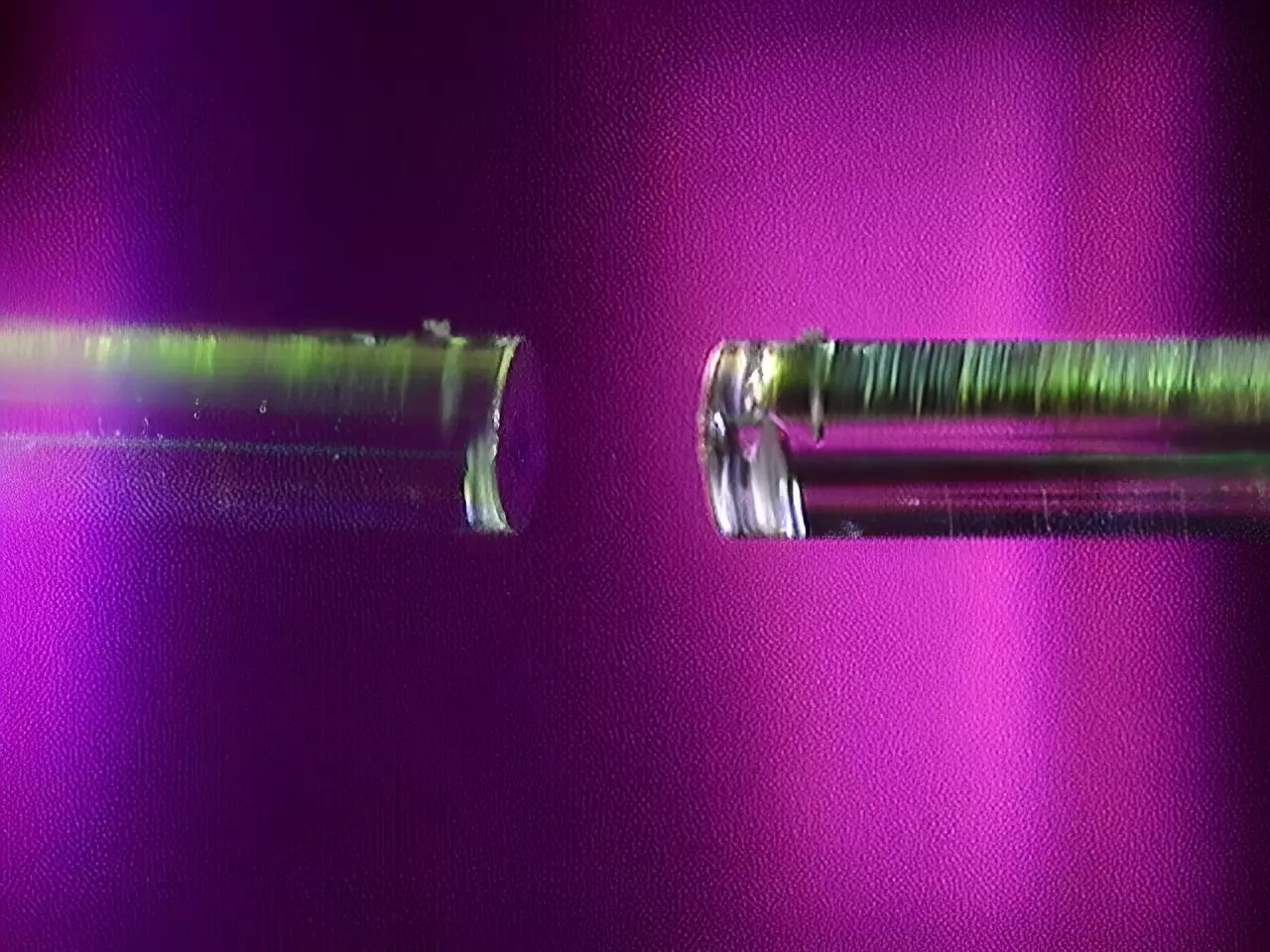
This new detection approach harnesses the power of resonant optical microcavities—tiny, meticulously engineered structures capable of trapping light within an infinitesimal space. These microcavities are crafted from ultra-fine mirrors deposited directly on fiber optic cables, creating a confined environment where light can bounce back and forth millions of times within nanoseconds. When a molecule enters this microcavity, it subtly influences the behavior of the trapped light. Unlike conventional methods, where fluorescence tags are used to mark molecules, this technique detects molecules directly through their interaction with the resonant light, offering a label-free and highly sensitive detection capability.
The implications of such a tool are profound, especially within biological and chemical research. For instance, understanding how proteins change shape—what scientists call their conformation—is pivotal in drug development. Many pharmaceutical compounds target specific conformations of biomolecules; if researchers can observe these conformational shifts in real-time and with high sensitivity, drug design can become more precise and efficient. Instead of relying on large samples and lengthy experiments, this method could allow scientists to observe interactions within seconds, dramatically accelerating the pace of discovery.
Moreover, by providing an unadulterated snapshot of molecules in their natural environment, this technology enriches our comprehension of complex systems. For example, in materials science, examining how molecules assemble or how contaminants interact at the molecular level can inform the creation of more resilient and innovative materials. In medicine, unraveling the real behavior of biological molecules helps clarify mechanisms underlying diseases, potentially leading to groundbreaking therapeutic strategies.
The inventive spirit driving this technology is rooted in a cross-disciplinary mindset. The team, led by Randall Goldsmith, has integrated concepts from physics, chemistry, and engineering, hailing a fresh approach to long-standing scientific challenges. This approach echoes the pioneering work of W.E. Moerner, a Nobel laureate who first visualized single molecules using light. Building upon this legacy, Goldsmith and his colleagues have designed an apparatus that magnifies our capacity to see the invisible—single molecules—without distorting their natural state.
Despite its remarkable sensitivity, the microcavity system is designed to be rapid and efficient. It allows scientists to detect and analyze molecules within seconds, a stark contrast to traditional methods that often require extensive sample preparation and prolonged analysis times. As the team continues to refine their device, they anticipate broadening its applications beyond structural analysis to include spectroscopy, real-time reaction monitoring, and even single-molecule manipulation.
The capstone of this achievement is not merely technical prowess but the opening of countless new possibilities. Immediate future prospects include tailoring this technology for high-throughput screening in pharmaceuticals, environmental monitoring, and potentially, in vivo analysis. Its ability to observe molecules in their pristine form could revolutionize how we understand interactions at the most fundamental level, ultimately leading to smarter, more effective medicines, stronger materials, and a deeper comprehension of the molecular fabric that weaves together all of nature.
While skeptics might highlight remaining challenges—such as scalability, specificity, or robustness—the potential outweighs these hurdles. This breakthrough paves the way for an era where the molecular universe is accessible in unprecedented detail, free from the distortions of labels and cumbersome procedures. It signifies a bold step toward observing the natural dance of molecules with clarity, precision, and speed, fundamentally enhancing our scientific toolkit and illumination of the microscopic world.
Leave a Reply