
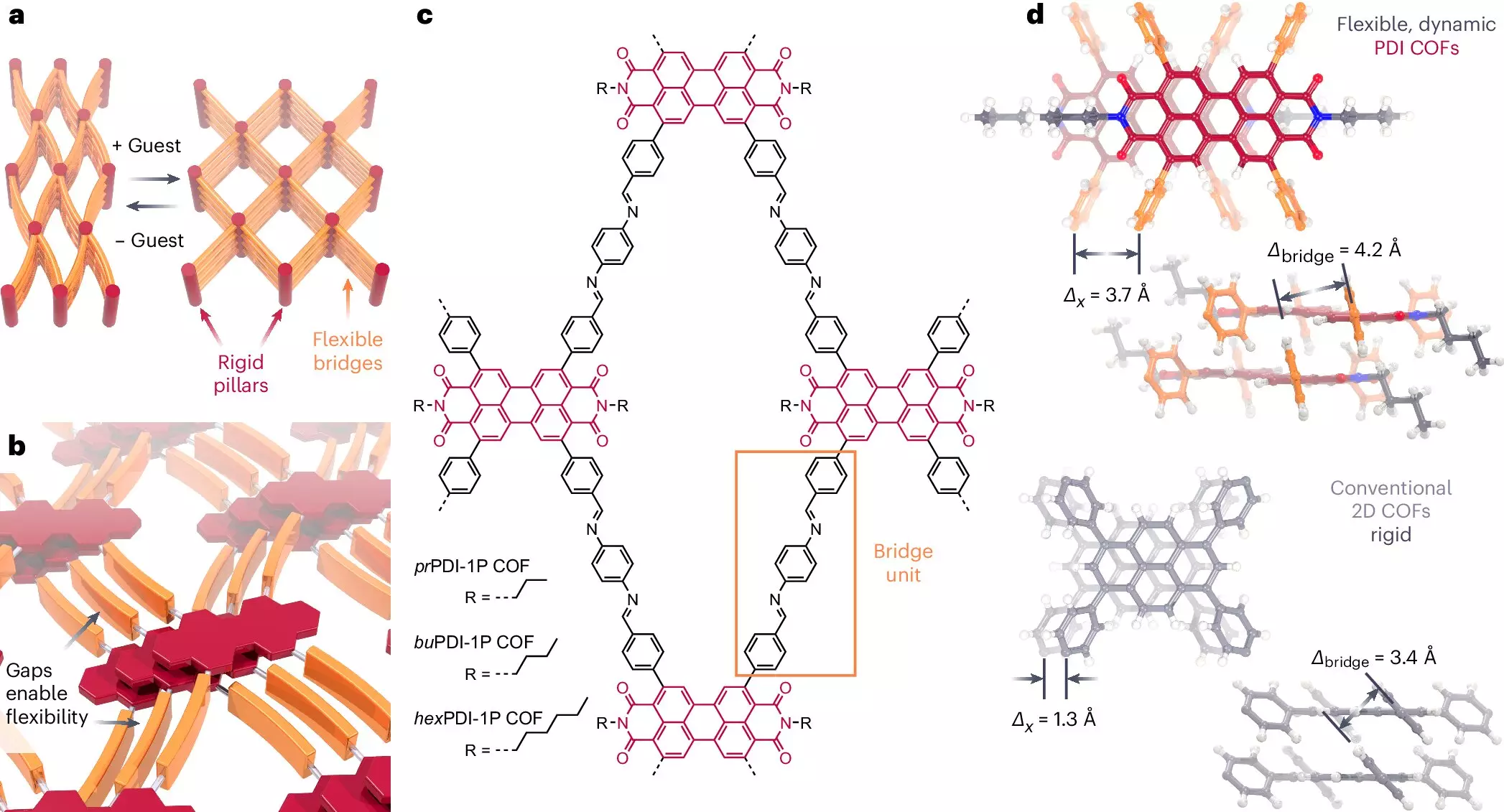
In an era defined by rapid advancements in material science, the development of covalent organic frameworks (COFs) has emerged as an exciting new frontier. Led by Dr. Florian Auras from Dresden University of Technology (TUD), a team of international researchers has made significant strides in this field, creating a novel type of two-dimensional polymer with the ability to toggle its properties in a controlled and reversible manner. Such dynamic capabilities are not merely a scientific novelty but could reshape applications in electronics and quantum technology.
What Sets Dynamic COFs Apart?
Traditionally, COFs have been characterized by their highly ordered, static structures. These porous materials, formed by organic molecules linked through covalent bonds, have shown immense promise in various realms—from gas storage to sensor technology and catalysis. However, past research predominantly concentrated on rigid configurations, which ultimately limited their versatility. The breakthrough by Dr. Auras and his team introduces a revolutionary design model that incorporates dynamic features, allowing these COFs to function similarly to a sponge, with the ability to open and close pores based on external stimuli.
This innovative approach not only allows for structural potential but also brings about reconfigurable optical properties, such as variations in color and fluorescence. Imagine a material that can adapt its functionality based on slight changes in environmental conditions—a concept once relegated to science fiction but now within the grasp of modern science.
The Implications for Quantum Technologies
One of the most promising aspects of this research is its potential to advance the field of quantum technology. Dr. Auras articulates a vision where stimuli-responsive polymers could lead to the realization of switchable quantum states—a significant leap forward in computing and communications. The ability to manipulate both the structure and optoelectronic properties of a material suggests applications in data storage, information transfer, and even in building more efficient quantum computers.
The meticulous control over molecular arrangements featured in these COFs presents an unparalleled opportunity to redefine how we understand and utilize materials at a quantum level, potentially leading to inventions that resonate well beyond current technological boundaries.
Challenges and Future Directions
Despite these thrilling advancements, the journey is not without challenges. The complexity of these dynamic frameworks requires not only robust scientific understanding but also potentially innovative engineering techniques to translate lab successes into practical applications. The path to market maturity for COFs, akin to the trajectory observed with metal-organic frameworks (MOFs), will be long and fraught with challenges. However, the foundational work laid by Dr. Auras and his team provides a critical waypoint in this evolving narrative.
As the field of covalent organic frameworks continues to expand, it is clear that there remains much more to explore. Researchers will need to tackle the intricacies of integrating these materials into existing technologies while also refining their production methods for scalability. The excitement surrounding these innovations in dynamic COFs could spark a wave of research, leading to unforeseen applications and collaborations across disciplines.
The future of material science looks exceptionally bright, teeming with possibilities that could redefine our approach to technology and its integration into everyday life.
Leave a Reply