
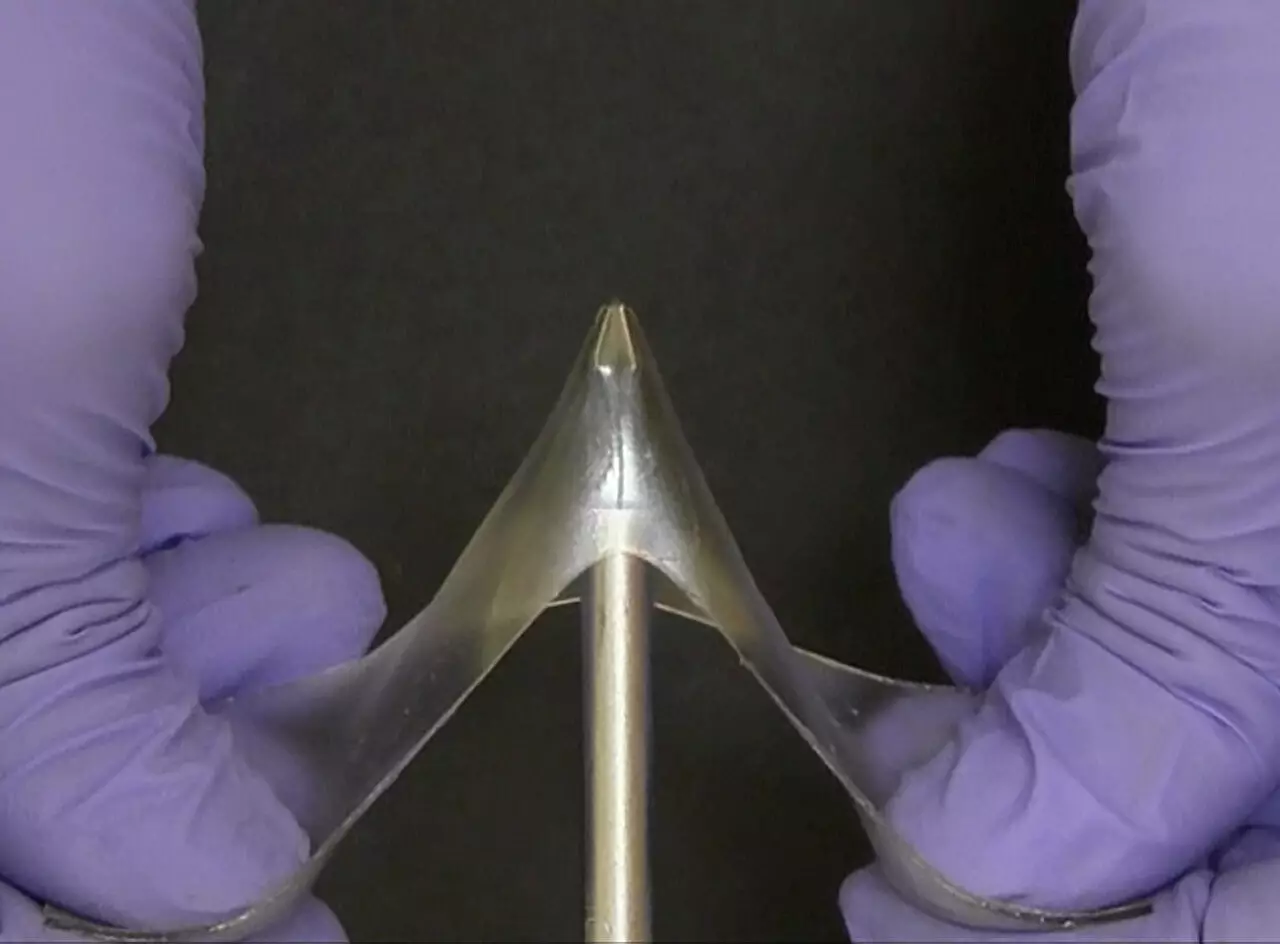
In the realm of material science, the emergence of “glassy gels” marks a paradigm shift, bridging the seemingly incompatible worlds of glassy polymers and soft, stretchable gels. Traditionally, brittle glassy polymers such as those used in structural components have been rigid and prone to cracking under stress, while flexible gels like contact lenses are soft but fragile. The synthesis of glassy gels defies these conventions by offering a composite that is simultaneously exceptionally hard and remarkably stretchable. This breakthrough not only calls into question longstanding assumptions but also promises to inspire a new generation of durable, adaptable materials.
These innovative materials exhibit an extraordinary combination of properties: they are over 50% liquid yet possess the rigidity and hardness of glassy polymers. What truly differentiates them is their resilience—they can deform significantly without fracturing, and revert to their original shape when heat is applied. Furthermore, their adhesive surface characteristics pave the way for applications where tough, sticky interfaces are crucial. The versatility embedded within these materials suggests they could transcend niche uses, impacting industries ranging from consumer electronics to aerospace engineering.
The core of this breakthrough lies in the clever manipulation of molecular interactions. By integrating ionic liquids—charged, water-like solvents—into polymer precursors, researchers have crafted a material that maintains high liquid content without sacrificing strength. The ions in the liquid strongly attract the polymer chains, preventing the typical mobility that causes softening, yet still permit stretchability due to molecular spacing. It’s an elegant balancing act: the ionic interactions render the material glass-like in hardness, while the solvent’s spacing allows for significant elastic deformation.
Technical Ingenuity: A Simple Yet Powerful Manufacturing Technique
One of the most compelling aspects of glassy gels is their manufacturing process, which combines simplicity with scalability. Unlike conventional high-performance plastics that often require complex processing and transportation, these gels can be produced swiftly through curing in molds or even via advanced 3D printing techniques. This simplicity hints at an economically viable path for mass production, sidestepping many logistical hurdles associated with traditional polymer manufacturing.
The process involves pouring the liquid mixture—comprising the polymer precursor and ionic liquid—into a mold and then exposing it to ultraviolet light to initiate polymerization. Once cured, the resulting glassy gel can be removed from the mold and retains its characteristics. This method’s versatility opens the door to creating intricate shapes and structures customized for specific applications, allowing for rapid prototyping and integration into existing manufacturing workflows. The ability to manufacture complex geometries easily significantly enhances the potential for adoption across various industries.
What makes this process even more promising is the potential for using different polymers and ionic liquids, providing a customizable platform for tailoring properties to specific needs. However, not all polymers lend themselves to this transformation; those with polar or charged groups tend to establish stronger attractions with the ionic liquids, making them better candidates. This opens an avenue for further research into molecular design and optimization, aiming to expand the range of usable materials and optimize properties such as tensile strength, elasticity, and adhesion.
Potential Impact: Challenging Prior Limitations
The true significance of glassy gels extends beyond their remarkable properties. They challenge the entrenched notion that hardness and flexibility are mutually exclusive. This realization could herald a new era where durable, resilient, and adaptive materials become commonplace, fundamentally altering how devices, vehicles, and infrastructure are designed.
For instance, in electronics, the high conductivity of these gels facilitates the development of stretchable, self-healing circuits and sensors—an essential step toward foldable or wearable technology that can endure daily wear and tear. The adhesive quality raises fascinating possibilities for medical applications, such as tough yet biocompatible patches or surgical adhesives that can withstand mechanical stresses without failing.
Moreover, the stability of these gels in high-liquid content environments defies conventional expectations, as most similar materials tend to dry out or evaporate over time. This durability enhances their appeal for long-term applications, including bioelectronics or environmentally exposed devices. The fact that these materials can be heated to return to their original shape also hints at self-healing capabilities—a trait highly coveted in resilient materials design.
Despite the mind-boggling properties, the scientific community must critically consider potential limitations. Questions regarding the material’s long-term stability, environmental impact, and safety remain open, demanding rigorous testing and validation. The economic feasibility at scale also warrants careful evaluation, especially in highly competitive markets where cost and manufacturability are critical factors for commercialization.
In essence, these glassy gels represent a bold step toward reimagining what materials can achieve. They aren’t just incremental improvements but a radical departure from classical classifications, urging us to think bigger about the future of resilient, multifunctional materials. While optimism is justified given their promising features, a dose of skepticism remains necessary—challenging ourselves to explore their constraints and ensure realistic expectations for their integration into everyday applications.
Leave a Reply