
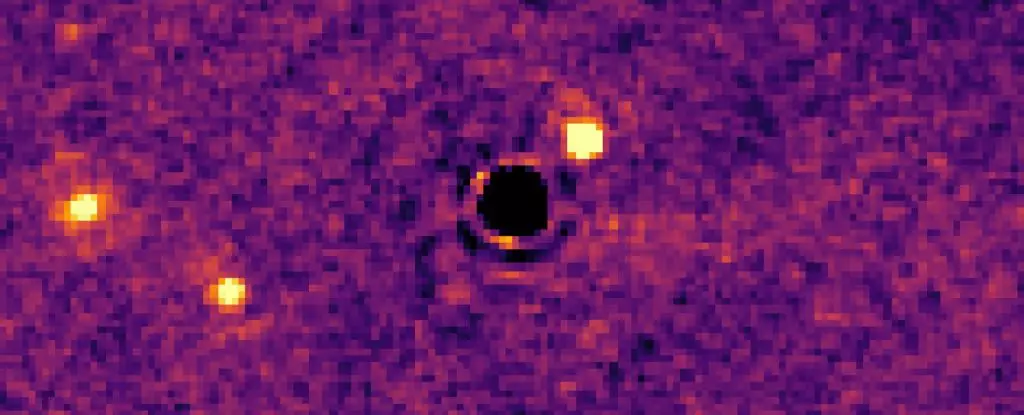
The advent of the James Webb Space Telescope (JWST) has initiated a transformative chapter in our understanding of the cosmos. In a groundbreaking achievement, JWST has unveiled its first exoplanet, TWA-7b, situated a mere 111 light-years from Earth. This discovery not only marks a significant milestone in the annals of astronomy but also challenges our perceptions of what constitutes a detectable exoplanet. While TWA-7b is classified as a cold gas giant, its relatively diminutive size—approximately one-third that of Jupiter—positions it as the smallest exoplanet directly imaged to date.
The implications of this breakthrough extend far beyond a mere addition to the roster of confirmed exoplanets. TWA-7b’s significance lies primarily in its orbit: a staggering distance of 52 times that of Earth from the Sun, placing it in the farthest reaches of our Solar System, akin to the Kuiper Belt. The JWST has transcended previous limitations in exoplanet observation, proving its capabilities not only in identifying such worlds indirectly but also in providing direct visual evidence of their existence.
Deciphering Planetary Formation
The significance of TWA-7b reaches deeper into the mechanics of planetary formation. The research team led by astronomer Anne-Marie Lagrange has leveraged this discovery to corroborate existing paradigms about the birth and evolution of planets. The observations made possible by JWST’s Mid-Infrared Instrument (MIRI) have opened a new frontier for studying sub-Jupiter-mass exoplanets. The data suggest that this instrument could potentially detect even lighter planets, down to about 25 to 30 Earth masses.
The young age of the host star TWA-7, estimated at 6.4 million years, provides a unique environment for examining planetary formation processes. This star is still surrounded by a protoplanetary disk, a reservoir of material from which planets are formed. The dynamics within this disk are compelling; as matter coalesces and orbits, it creates gaps, areas cleared by emerging planets. The distinguishing features observed in this disk offer tantalizing clues about how planetary systems might evolve. While Lagrange and her team have yet to visually confirm planets shaping these gaps, the indirect evidence of their existence forms a foundational premise for future research.
The Power of Direct Imaging
The methodology employed in discovering TWA-7b stands apart from traditional indirect techniques commonly used in exoplanet research. Most known exoplanets were identified through transit methods, wherein the diminutive shadow cast by a planet on its star is interpreted as a signature of its presence. In contrast, JWST’s direct imaging approach captures the light emitted by the planets themselves, revealing features that indirect methods can obscure.
This technique has dramatically broadened the scope of what astronomers can study. TWA-7b’s stark visibility amidst the complex backdrop of its protoplanetary disk allows for a new kind of observational analysis. The research team’s success in pinpointing the planet’s location—1.5 arcseconds from the star—is a testament to JWST’s precision and sophistication. With TWA-7b, direct imaging not only confirms the existence of the planet but also opens avenues for detailed dynamical modeling of its interactions with surrounding materials.
Charting New Horizons
The discovery of TWA-7b is not merely a standalone achievement; it signifies the dawn of a new era in exoplanet exploration. As researchers harness JWST’s power, the potential to observe even lighter and smaller exoplanets looms large. The existing catalog of nearly 6,000 confirmed exoplanets may soon expand further, thanks to this remarkable technological advancement in astronomy.
Moreover, TWA-7b offers unique opportunities for in-depth studies on disk-planet interactions. The distinct arrangement of material around its host star presents a rich field for further exploration, potentially leading to groundbreaking discoveries about how planets interact with their environments. Such research may reshape our understanding of planetary system formation and the conditions conducive to life beyond Earth.
In essence, TWA-7b embodies the future of astronomy—bold, ambitious, and filled with astonishing possibilities. The JWST is not just an instrument for observing the cosmos; it stands as a beacon of human curiosity and ingenuity, reminding us just how much there is still to learn about our universe.
Leave a Reply