
The frontier of material science is constantly expanding, but recent breakthroughs suggest that light—something we often consider a mere carrier of information—can actually serve as a powerful tool to manipulate the fundamental properties of materials at unprecedented speeds. A pioneering study from EPFL reveals that by carefully tuning the wavelengths of light shone upon magnetite, scientists can induce distinct, non-equilibrium states, opening new pathways for developing ultra-responsive electronic components. Such discoveries challenge traditional notions of phase changes, promising a future where devices could be tuned on the fly by light, rather than relying solely on thermal or electrical stimuli.
This research shifts our understanding of how materials can be controlled, emphasizing that light’s role isn’t limited to illumination or communication. Instead, it becomes a dynamic agent capable of swiftly transitioning materials into “hidden phases”—states that don’t occur naturally under common laboratory conditions. Recognizing and controlling these transient states could revolutionize how we conceive storage, sensors, and even quantum computing platforms, where speed and precision are paramount.
Deciphering Non-Equilibrium and Hidden Phases
At the core of this breakthrough lies an intricate dance of atoms and electrons driven by electromagnetic stimuli. Under normal circumstances, materials tend to settle into equilibrium states—stable configurations where forces balance, much like water settling into a glass. Phase transitions, such as water freezing or boiling, usually follow predictable pathways dictated by temperature or pressure adjustments. However, when far-from-equilibrium conditions are artificially imposed, the landscape changes dramatically.
In these scenarios, the material’s internal forces are no longer balanced, leading to the emergence of exotic “hidden phases.” These are transient states often inaccessible through conventional methods but can hold unique properties, vastly different from the material’s typical phases. The ability to induce, observe, and eventually stabilize such states unlocks a new dimension in material engineering—one where properties can be dynamically tailored with ultrafast precision.
Crucially, these hidden phases are not just scientific curiosities but could serve as foundational elements in next-generation technologies. For instance, they provide a means to modulate electrical conductivity, magnetic behavior, or optical characteristics on timescales previously thought impossible, effectively allowing a material to perform multiple functions or optimize performance dynamically.
Magnetite: A Model System for Light-Driven Phase Manipulation
Magnetite, a mineral long studied for its intriguing electrical and magnetic properties, stands out as an exemplary candidate in this field. Its classic Verwey transition—a temperature-driven metal-to-insulator shift—has fascinated scientists for decades. The complexity rooted in its crystal structure and electron interactions makes it an ideal playground for exploring how external stimuli like light can influence a material beyond traditional thermodynamic boundaries.
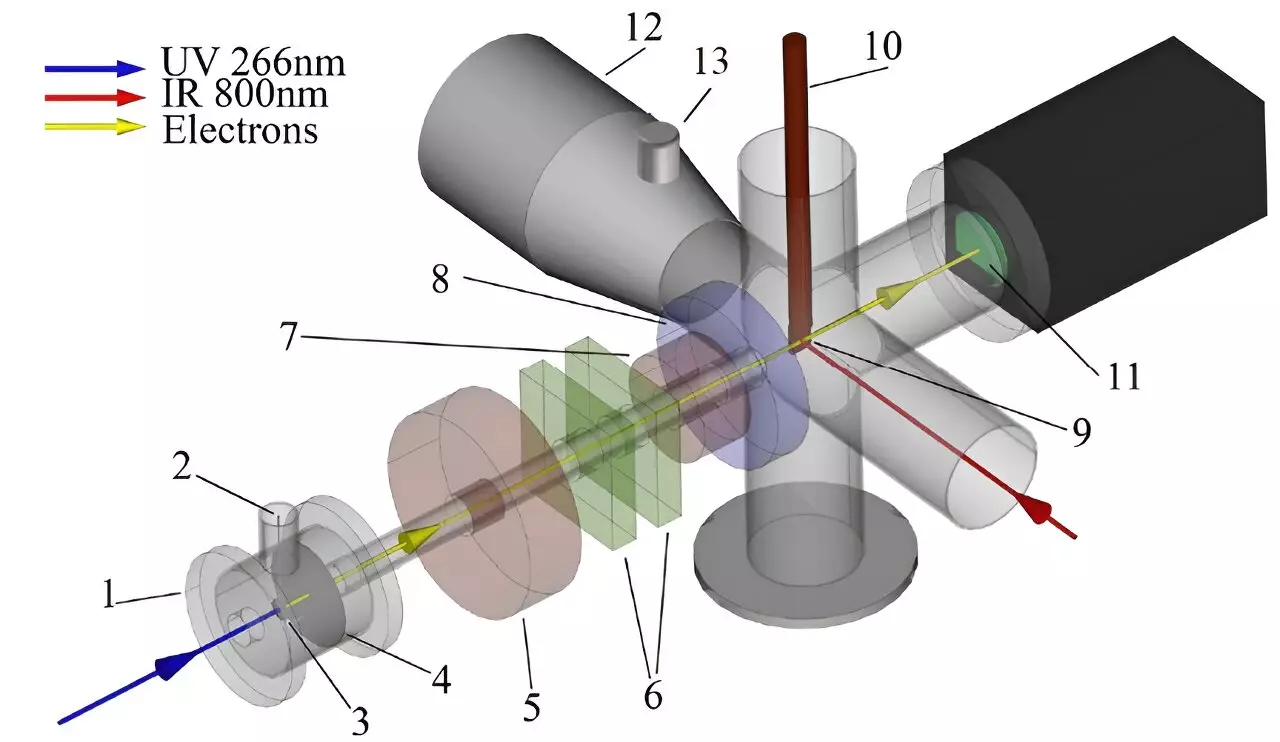
EPFL’s research illuminates that shining specific wavelengths of light can modulate magnetite’s internal structure profoundly. The team employed ultrafast electron diffraction to monitor atomic motions within the material at an incredibly precise timescale—on the order of picoseconds. The results are startling: different wavelengths, near-infrared (800 nm) and visible (400 nm), produce distinctly different transformations.
The 800 nm light causes the crystal lattice to compress and approach a cubic symmetry—an alteration that implies the material becomes more metallic and less ordered, mimicking a phase similar to a fleeting, non-equilibrium metallic state. Conversely, the 400 nm light stabilizes the lattice in an expanded, ordered configuration, reinforcing its insulating properties. These divergent responses underscore a vital insight: by selecting the right photon wavelength, researchers can customize the electronic and structural state of magnetite on ultrafast timescales.
This controlled manipulation shifts the paradigm. It’s no longer about gradual heating or electrical stimulation but about finesse—using light as a switch capable of toggling between different, non-equilibrium phases rapidly and reversibly. Moreover, these findings imply that the macroscopic properties of materials can now be viewed as dynamic, tunable features rather than static characteristics.
Implications for Future Technologies
The practical repercussions of these insights extend far beyond academic curiosity. Imagine electronic devices that can change their behavior in milliseconds, reacting to environmental needs or computational commands with unparalleled speed. Data storage might shift from static hardware to light-controlled, metastable phases that encode information in transient states. Sensors could become more sensitive and selective, responding to specific wavelengths of light for real-time diagnostics.
Furthermore, the ability to induce hidden phases suggests potential routes toward more energy-efficient electronics. Instead of relying on high-power electrical currents, devices could employ targeted photons to switch states swiftly, reducing heat dissipation and extending device longevity. The concept of “phase choreography”—precisely orchestrating atomic and electronic configurations—becomes a tangible goal, pushing toward a future where materials are no longer fixed entities but dynamic, programmable systems.
However, turning these scientific revelations into practical applications requires addressing significant challenges. Achieving stabilization of hidden phases beyond transient times remains a critical hurdle. Moreover, translating laboratory-scale phenomena into scalable, mass-producible components calls for innovative engineering solutions. Despite these obstacles, the core idea remains compelling: the strategic use of light could redefine the landscape of electronics, making devices smarter, faster, and more adaptable.
A New Era of Material Control and Innovation
This research exemplifies a broader technological philosophy—one centered on mastery over matter at its most fundamental level. By harnessing the interplay between light and crystalline structures, scientists are stepping into an era where the boundaries between different states of matter blur. The previously rigid transition lines between insulators and conductors can now be traversed seamlessly, opening opportunities for programmable, ultrafast switches and logic elements embedded directly within the materials themselves.
In essence, the ability to access, manipulate, and stabilize hidden phases on demand could lead to a paradigm shift comparable to the advent of semiconductors. It transforms our perception of the material world: instead of static, unchangeable substances, we see a landscape alive with possibilities—responsive, adaptable, and deeply interconnected with the energy we introduce into it.
As this frontier unfolds, it’s clear that light—once merely an illuminator—will become a central tool in engineering the next wave of intelligent, efficient, and innovative electronic systems. The potential for breakthroughs in computational speed, energy efficiency, and device miniaturization positions this approach as a cornerstone of future technological development—one driven not just by electrons, but by photons orchestrating the dance of atoms.
Leave a Reply