
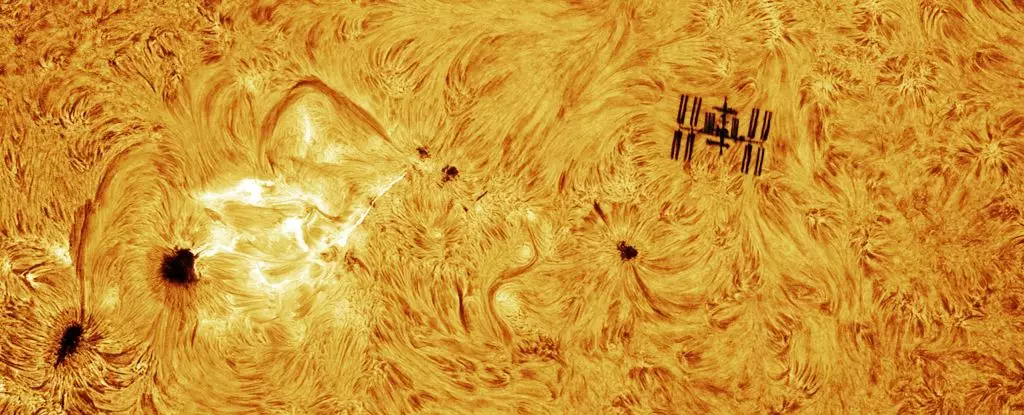
In the world of astrophotography, few moments rival the thrill and precision required to capture the International Space Station (ISS) as it streaks across the face of the Sun or Moon. But Arizona-based astrophotographer Andrew McCarthy managed to seize something truly extraordinary—an ISS transit framed by a sudden solar flare eruption—creating a remarkable image that speaks volumes about the dynamic and sometimes unpredictable nature of our solar environment. This event represents much more than a simple snapshot; it’s a profound illustration of human ingenuity intersecting with the raw power of the cosmos.
The Challenge of Timing and Technique
To photograph the ISS passing in front of a celestial body demands exceptional timing, precise equipment setup, and no small amount of luck. Traveling approximately every 90 minutes in low Earth orbit at about 400 kilometers altitude, the ISS offers only a fleeting opportunity for transit shots, often lasting mere seconds. McCarthy’s success in capturing not only the transit but also a medium-sized solar flare in the background underscores his mastery of astrophotography discipline. His work involved shooting tens of thousands of individual images and meticulously stacking them—a process requiring both patience and technical prowess—to produce such an intricate view of the Sun’s surface.
What sets McCarthy apart is his understanding and adaptation to environmental challenges. Operating in the harsh heat of the Sonoran Desert, he used innovative cooling methods to maintain his equipment’s optimal performance, deploying ice packs and coolers to stave off the punishing desert temperatures. This attention to detail is crucial for astrophotography, where even minor temperature fluctuations can distort image quality.
Beyond a Pretty Picture: The Science Behind the Solar Flare
McCarthy’s image gained wider attention not just for its aesthetic merit, but also for the scientific intrigue it captures. The fleeting solar flare—a burst of radiation and energetic particles on the Sun’s surface—occurred simultaneously as the ISS zipped across the solar disc, a coincidental but visually spectacular juxtaposition. While dazzling, it’s important to clarify that the flare posed no danger to the ISS or its crew. Despite solar flares raising radiation levels temporarily, the station’s orbit keeps it far removed from the Sun’s immediate environment.
Still, these solar flares are significant cosmic events. They can disrupt satellites, affect radio communication, and increase radiation exposure to astronauts, reminding us of the delicate balance required to operate technology in space. Images like McCarthy’s offer not only stunning visuals but also raise awareness about the constant space weather dynamics that affect our civilization’s growing presence beyond Earth.
A Work of Art and an Ode to Human Advancement
The picture, aptly titled “Kardashev Dreams,” pays homage to Nikolai Kardashev, the Soviet astronomer who conceptualized a scale for measuring a civilization’s technological advancement based on its energy consumption. McCarthy’s image subtly suggests humanity’s early, hopeful steps toward becoming a more advanced civilization capable of harnessing astronomical energies—perhaps one day reaching the stellar energy levels Kardashev described.
To create this masterpiece, McCarthy didn’t stop with capturing the transit alone. He composed a mosaic, stitching images together to reveal the Sun in extreme detail far beyond the transient moment of the ISS crossing. Interestingly, some composited elements from the upcoming 2024 eclipse were incorporated, enhancing the contrast and narrative power of the image by visually representing the Sun’s chromosphere against an artificially darkened backdrop. This artistic choice underscores the dual nature of astrophotography: it is both scientific documentation and profound visual storytelling.
Igniting Inspiration for Future Astrophotographers
For those inspired by McCarthy’s work and keen to try their hand at capturing the ISS during a transit, tools like the Transit Finder website can help anticipate when these rare moments will occur. But make no mistake—beyond technological assistance, success demands a deep understanding of celestial mechanics, steady hands, and the willingness to spend hours under unpredictable skies.
Andrew McCarthy’s achievement is a testament to what can be accomplished when human persistence meets the grandeur of the universe. More than just a photograph, it’s a symbol of exploration, technical excellence, and the awe-inspiring beauty waiting to be discovered right above our heads.
Leave a Reply