
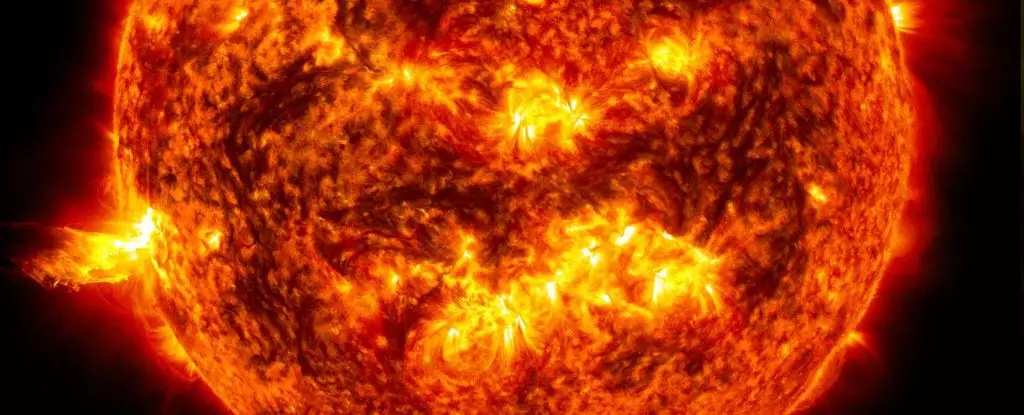
For decades, scientists have relied heavily on predictable patterns to understand our star, the Sun. The 11-year solar cycle, marked by fluctuating sunspot activity, has served as a celestial metronome guiding expectations. Yet, recent events defy long-held assumptions. The predictions for Solar Cycle 25, rooted in a trend of diminishing activity, predicted a gentle, subdued phase resembling its predecessor. Instead, the Sun has delivered a stunning reversal—its activity has surged beyond expectations, revealing a dynamic and unpredictable nature that challenges our understanding. This unexpected strength suggests that the Sun is beginning a new phase of heightened activity, potentially signaling the start of a more tumultuous period that could have profound implications for Earth’s space environment.
The Illusion of Normalcy and the Complexity Beneath
The Sun appears as an ordinary, steady presence in our sky, but beneath this calm façade lies a turbulent, ever-changing engine. Solar cycles, every approximately 11 years, are a surface-level glimpse into its complex internal processes. During solar maximum, the Sun exhibits an impressive display of sunspots, solar flares, and massive ejections of plasma—coronal mass ejections—each capable of impacting our technological infrastructure and space operations. Conversely, during solar minimum, activity wanes. Historically, these fluctuations have been meticulously documented through sunspot counts, serving as proxies for solar behavior. Yet, the unpredictability inherent in the Sun’s internal mechanics—driven by magnetic fields, differential rotation, and deep solar dynamics—renders precise forecasting an elusive goal. The episodes of prolonged solar minima, such as the Maunder Minimum, remind us that these changes can be profound and prolonged, with entire periods of solar quietude potentially altering Earth’s climate and space weather regimes.
Long-Term Trends and the Enigma of the Maunder Minimum
The history of solar variability is fraught with periods that defy conventional expectations. The Maunder Minimum, spanning from roughly 1645 to 1715, saw a stark absence of sunspots, coinciding ominously with the “Little Ice Age,” a time of global cooling. Similar minima, like the Dalton Minimum in the late 18th and early 19th centuries, highlight the Sun’s capacity for extended quiet phases. Still, scientists grapple with understanding the internal mechanisms driving these transitions. The lack of sunspot activity during these minima complicates models, emphasizing the necessity of expanding the data spectrum beyond surface observations. As our datasets grow, the picture of the Sun shifts from a predictable clock to a chaotic, if patterned, phenomenon—one that requires more sophisticated models and broader observations to decode fully.
From Weakness to Potential Turmoil: The Surprising Resilience of Solar Cycle 25
The preceding solar cycle, Cycle 24, was notably weak, with sunspot numbers and flare activity falling to historic lows. Expectations for Cycle 25 mirrored this subdued trend, leading many to anticipate a quiet period. However, recent research indicates a different story unfolding. Data shows a steady increase in the solar wind’s strength—measured across multiple parameters such as speed, density, and magnetic field intensity—since 2008. This upward trend suggests that the Sun is gradually “waking up,” gearing up for a period of intensified activity that could resemble or surpass past tumultuous phases. This rise challenges the narrative of a uniformly declining solar output and hints at the potential for stronger solar storms, increased particle radiation, and unpredictable space weather phenomena that may impact satellites, power grids, and communication systems on Earth.
Deciphering Solar Mysteries Through Cycles
Understanding the Sun’s behavior demands recognizing the intricacies of its cyclical patterns. The Hale cycle, extending over 22 years, delineates a complete magnetic polarity reversal—two linked solar cycles forming one full magnetic cycle. Evidence suggests that this magnetic cycle might hold the key to better predicting solar activity, as each cycle is only half of this larger pattern. Currently, the solar wind’s increasing strength indicates that we might be entering a phase where the Sun exhibits more vigorous behavior, with magnetic fields and plasma emissions intensifying. Still, the variability within these cycles means predictions remain tentative. Continued monitoring is essential, not only to track immediate space weather threats but to refine models that seek to forecast the Sun’s long-term behavior more accurately.
Implications for Humanity and the Solar System
The revelations about the Sun’s recent surge in activity are more than academic—they have tangible implications. As our reliance on space-based technology grows, so does our vulnerability to intense solar storms. A more active Sun could unleash powerful flares and coronal mass ejections capable of disrupting electricity grids, navigation systems, and communication networks. Furthermore, this unexpected behavior warns us of the limits of current predictive tools, emphasizing the need for broader, more comprehensive observation systems that include magnetic field mappings, plasma diagnostics, and deeper internal studies. In a broader context, these findings underscore an undeniable truth: the Sun is an unpredictable, living entity, whose rhythms can shift suddenly, reminding us that our understanding is but a thin veneer over a complex, dynamic star that still holds many secrets.
Leave a Reply