
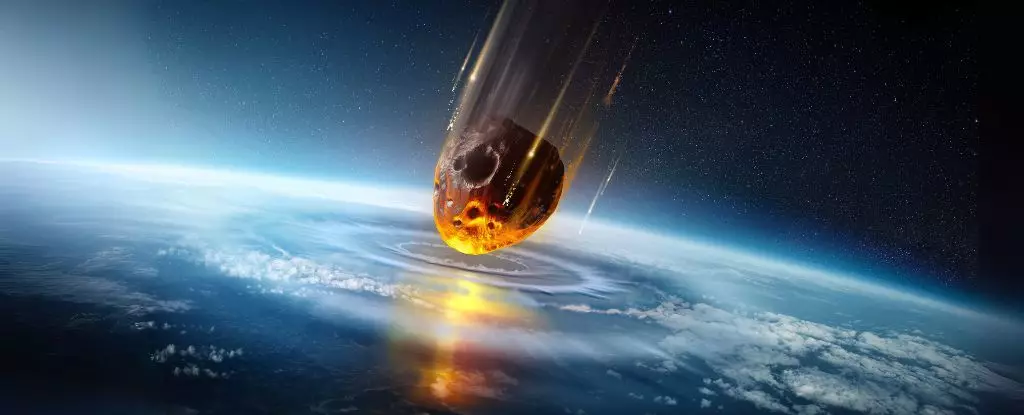
Throughout Earth’s tumultuous history, seemingly destructive events have paradoxically played a crucial role in shaping the very foundations of life. Among these are asteroid impacts — violent collisions that carve scars into our planet’s surface. One of the most compelling revelations from recent research is that these catastrophic events do not simply erase life; rather, they can create niches where life can emerge and persist. When a 1.6-kilometer asteroid plummeted into what is now Finland 78 million years ago, it formed a massive crater, but it also set the stage for microbial colonization deep within fractured rocks and heated waters. This discovery challenges the old perception of impacts solely as extinction-level events and illuminates their potential as cradles for microbial life.
Science has often viewed impact craters as dead zones, abandoned ecosystems, or relics from ancient times. However, groundbreaking studies now suggest that beneath these fractured surfaces, hydrothermal systems—hot, mineral-rich waters heated by the immense energy of impacts—become habitats for microorganisms. These microbes, some of the simplest forms of life, exploit chemical energy sources like sulfate reduction, thriving in extreme environments that threaten to annihilate other life forms. Such findings imply that the aftermath of cosmic collisions isn’t just about destruction; it’s also about transformation, creating new ecological niches under conditions previously deemed too hostile.
This understanding reshapes the narrative of how life can arise in extreme environments and hints at the resilience of life on Earth. Impact-generated hydrothermal systems could serve as analogs for similar processes on other planets and moons, suggesting that life might not only survive on planets like Mars but might even originate in impact craters similar to Lappajärvi. These insights deepen our appreciation for the non-linear pathways to life’s emergence—where chaos and destruction act as catalysts for biological innovation.
Precise Dating Reinforces the Impact-Led Genesis of Microbial Life
A defining element of this recent discovery is the precise dating of microbial colonization post-impact. Using advanced isotopic and radioisotope techniques, researchers succeeded in pinpointing when microorganisms began inhabiting the hydrothermal system under the crater. Their analysis revealed that microbial activity, especially sulfate reduction—an anaerobic process vital to Earth’s sulfur cycle—occurred roughly 73.6 million years ago, just under 5 million years after the impact event.
What makes this finding revolutionary is not just the evidence of life, but the ability to chronologically connect its appearance directly to the impact event. Previously, scientists could only hypothesize about whether microbes colonized impact sites soon after formation or much later, owing to the limitations of dating techniques. Now, we know that life took advantage of the transient hydrothermal environment relatively shortly after the impact, suggesting that life is remarkably adaptable and quick to colonize newly created habitats.
Furthermore, this precise timing suggests that impact craters act as temporary but viable ecosystems for microbial life over extended periods, sometimes spanning tens of millions of years. The gradual cooling of the system allowed microbes to persist, adapt, and carry on their metabolic processes long after the initial chaos. The discovery of mineral signatures associated with microbial sulfate reduction, such as pyrite depleted in sulfur-34 and microbial-mineral precipitates like calcite, offers irrefutable biosignatures. This detailed temporal and chemical correlation not only validates the impact-driven colonization hypothesis but also empowers future research in astrobiology.
Implications for the Origins of Life and the Search Beyond Earth
The implications of these findings ripple well beyond our understanding of Earth’s history. If impact craters can host life for millions of years, possibly providing early habitats for emerging life, then the role of asteroid impacts in life’s origin story becomes more nuanced. Earth may have benefited from these violent processes, not just as moments of mass extinction but as opportunities for life to take root amidst the chaos, in the fractured, heat-rich environments that follow.
More provocatively, the research underscores the potential of impact sites on other planetary bodies to harbor or even generate life. Planets and moons such as Mars and icy moons like Europa may have experienced their own impact events, creating transient hydrothermal systems capable of supporting microbial communities. Since asteroids often carry organic molecules and amino acids—the building blocks of life—these impacts could simultaneously deliver necessary ingredients and create habitable niches.
Furthermore, the methodologies showcased—combining isotopic biosignature analysis with geochronology—offer invaluable tools for future missions. For instance, sample return missions from Mars or asteroid mining efforts could analyze impact-related minerals to uncover signs of past or present life. These approaches could verify whether life emerged solely through planetary processes or was influenced by exogenous factors like asteroid impacts, shedding light on the universality or rarity of life in the cosmos.
In essence, understanding how impact craters foster microbial life challenges the simplistic view of cosmic impacts as mere destructive events. It frames them instead as dynamic agents of ecological change and molecular complexity, potentially integral to the story of life itself—both on Earth and across the universe. This research compels us to reconsider not just the history of our planet, but also the cosmic conditions that could cradle life elsewhere, turning the destructive power of celestial objects into a force of biological rebirth.
Leave a Reply