
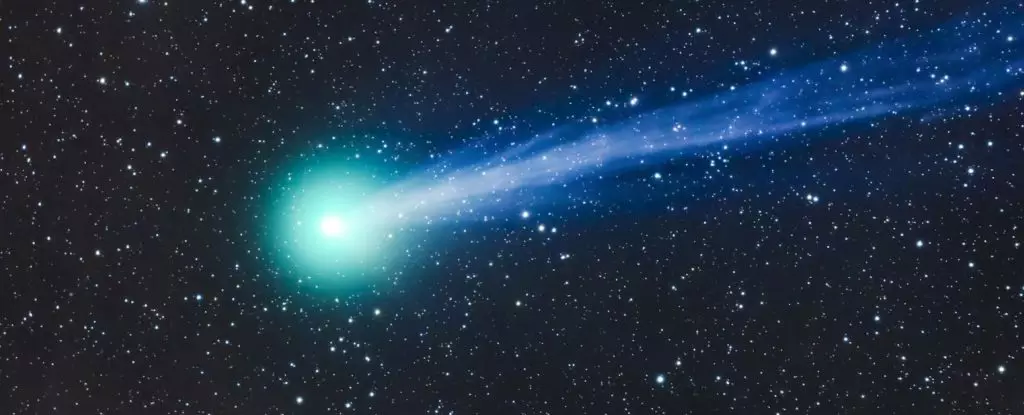
The recent images capturing interstellar comet 3I/ATLAS during the September 7 total lunar eclipse have sparked both fascination and intrigue among astronomers and skywatchers alike. The most striking feature observed is its greenish hue—an attribute that naturally draws comparisons to typical comets. But beneath this visual similarity lies a perplexing puzzle: the chemical composition of 3I/ATLAS defies expectations. While many solar system comets emit a characteristic green glow from the presence of dicarbon (C2) molecules, evidence suggests that this molecule might be absent or at least undetectable in 3I/ATLAS. This raises a fundamental question—what is responsible for its vibrant green emission?
The fact that 3I/ATLAS’s spectrum shows a deficit of C2 molecules is revolutionary. Such molecules are usually abundant in comets that display a green glow because they fluoresce when excited by solar radiation. Their absence implies that either the molecules are present but hidden below detection thresholds or that an entirely different chemical process or molecule is responsible for the coloration. This anomaly hints at a chemical environment that is truly unique, potentially shaped by the comet’s interstellar origins—something that could challenge established cometary models. The composition possibly includes unconventional molecules or archaic materials from other star systems, making it an artifact of interstellar matter rather than familiar solar system comets.
Implications of a Composition That Defies Expectations
The discovery of 3I/ATLAS’s peculiar chemistry does more than add a curious detail to its characterization; it begs fundamental questions about the nature of interstellar objects. For decades, our understanding of cometary chemistry has been grounded in observations within our own solar system. Typical comets contain a mixture of water ice, carbon-based molecules, and various dust particles. Yet, 3I/ATLAS seems to break this mold, displaying an abundance of carbon dioxide, nickel, and cyanogen, but lacking the molecules we usually associate with green fluorescence.
This unexpected chemical inventory suggests that interstellar comets might be born in environments markedly different from those of our solar system. The strong depletion of carbon-chain molecules, particularly C2, implies that 3I/ATLAS originated from a star system with a vastly different chemical evolution path or was subjected to processing in a manner unfamiliar to us. Its composition could reflect an age or stellar environment where typical organic molecules were scarce, or where different astrophysical processes have sculpted its makeup. Such insights could revolutionize our understanding of planetary system formation and interstellar chemistry.
Furthermore, the presence of molecules like cyanogen and nickel hints at complex chemical processes possibly occurring in the comet’s progenitor environment. These molecules’ prominence, juxtaposed with the absence of typical green-emitting molecules, invites speculation about alternative fluorescence mechanisms or unknown compounds that may fluoresce under solar radiation. The current detection limits mean that C2, if present, might be lurking just below the threshold of our instruments, or perhaps the green hue arises from a different molecule altogether.
The Path Forward: Deciphering Cosmic Secrets
While the puzzle intensifies, it underscores a powerful truth: our universe remains a vast laboratory of surprises. The upcoming approach of 3I/ATLAS to Earth in December offers a critical window for further exploration. Enhanced observational campaigns, leveraging advanced spectroscopic instruments, could shed light on the comet’s true chemical secrets. A thorough analysis might reveal hidden molecules or complex organic compounds that challenge our existing chemical paradigms.
This interstellar visitor serves as a reminder that the cosmos often defies our expectations, reminding us of how much we still have to learn. The anomaly of 3I/ATLAS’s chemistry may forever alter our understanding of cometary phenomena and the diversity of chemical processes taking place across different stellar nurseries. As scientists race to decipher its secrets, one thing remains clear: the universe’s capacity for astonishing complexity is beyond our current comprehension, and each discovery pushes the boundaries of our knowledge. The enigmatic green glow of 3I/ATLAS beckons us to look deeper, think broader, and embrace the cosmic unknown.
Leave a Reply