
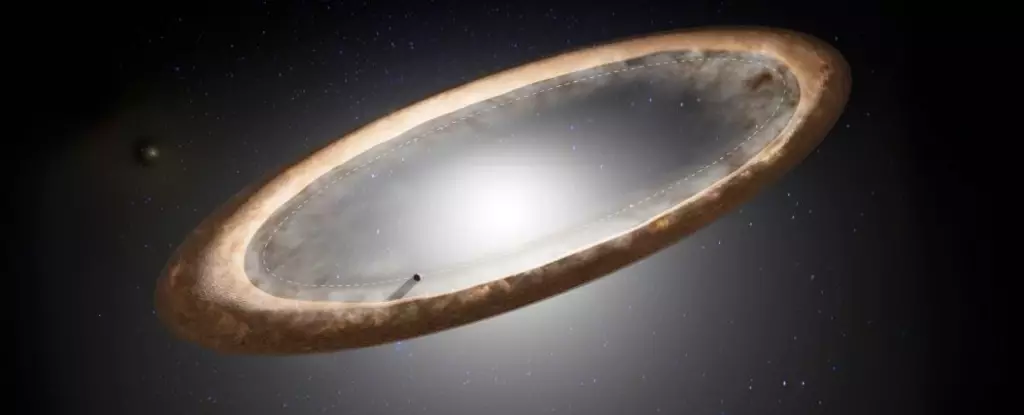
Fomalhaut stands out as one of the most luminous stars gracing our night sky, captivating astronomers with its proximity and brightness. Situated approximately 25 light-years from Earth, its relative closeness offers unparalleled opportunities for high-resolution observations, making it an ideal laboratory to study early planetary system development. Despite its brightness, what truly piques scientific curiosity is the bizarre behavior of its surrounding debris disk. Unlike the relatively symmetrical disks observed around other stars, Fomalhaut’s disk exhibits pronounced eccentricity and intricate structures that seem to defy simple explanations.
This peculiar morphology suggests the gravitational influence of unseen celestial objects. The concept of a warped or eccentric debris disk is not just a random quirk; it’s a cosmic whisper hinting at complex interactions within the system. The prevailing hypothesis centers around the gravitational tug of an orbiting planet—yet, ironically, this planet remains elusive to our direct detection techniques. The disk’s unusual shape, especially its warping and asymmetries, serve as indirect evidence, signifying the gravitational choreography of planets that shape their environment even before they are directly observable.
Deciphering the Disk’s Dynamic Structure
Recent advances have allowed astronomers to peer into Fomalhaut’s disk with remarkable clarity, revealing a nuanced picture of its eccentricity that varies with distance from the star. This gradient—what scientists term a ‘negative eccentricity gradient’—means the parts of the disk closer to Fomalhaut are more elongated, while the outer regions transition into a more circular form. This gradient disrupts previous assumptions that debris disks maintain uniform eccentricity and suggests a more dynamic, evolving system.
The discovery of such eccentricity variation challenges existing models and indicates that the influence of unseen planets could be more complex than previously thought. By meticulously analyzing the disk’s radial profiles and brightness patterns, researchers have identified subtle yet significant differences between the eastern and western sides of the disk. For instance, a noticeable asymmetry in the width of the ring hints at gravitational sculpting, likely caused by planetary bodies embedded within or near the disk.
Furthermore, these observations underscore the importance of high-resolution imaging—enabled by instruments like ALMA (Atacama Large Millimeter/submillimeter Array) and JWST (James Webb Space Telescope)—in unveiling the intricacies of young planetary systems. They provide a window into the processes that govern planet formation, migration, and the evolution of circumstellar material, offering a glimpse into the infancy of planetary architectures similar to our own solar system.
Implications for Planet Formation and System Evolution
One of the most tantalizing questions surrounding Fomalhaut is whether these disk features are the signatures of an orbiting planet. Based on modeling and observational data, astronomers have proposed scenarios involving planets at different distances—some situated around 70 to 75 astronomical units (AU), within the inner edges of a newly identified intermediate belt, and others possibly orbiting at 109–115 AU, directly influencing the main debris ring.
These models suggest that a planet’s gravitational influence can induce the eccentricity observed and create the observed asymmetries. The current limitations of detection methods, however, make it impossible to confirm these planets directly. The hypothesized masses and orbits fall below the sensitivity thresholds of existing telescopic technologies, leaving their existence as an elegant yet unconfirmed inference.
Despite this, the models support a broader paradigm: the dynamical interplay between planets and debris disks is pivotal in shaping planetary systems. The possibility that Fomalhaut’s current eccentric ring was ‘born eccentric’ challenges earlier notions of disks being dynamically circular or symmetrical. Instead, it hints at a history marked by planetary gravitational influences that have sculpted and maintained the disk’s distinctive shape for millions of years.
From an evolutionary perspective, these findings bolster the idea that planetary systems are inherently chaotic and heavily influenced by their initial conditions. The close relationship between disk morphology and unseen planetary companions underscores the importance of indirect observation techniques, hinting that future technological advancements may finally allow us to pinpoint these elusive worlds.
Looking Ahead: The Quest for Direct Detection
While current cutting-edge telescopes still lack the sensitivity to directly image these hypothesized planets, ongoing improvements in observational technology promise an exciting future. Each new dataset refines our models, gradually narrowing down the possible properties of these hidden worlds. The prospect of detecting planets that influence debris disks through their gravitational signatures is incredibly compelling, as it extends our understanding of planetary system formation beyond what is directly observable.
The importance of this indirect approach cannot be overstated: the subtle clues embedded in the disk’s eccentricity, width variations, and brightness asymmetries are invaluable. As telescopes become more powerful and data analysis techniques more sophisticated, the day may come when the planets shaping Fomalhaut’s disk reveal themselves directly—confirming their existence and illuminating the intricate dance between stars and their planetary companions.
Until then, Fomalhaut remains a cosmic detective story—an intricate puzzle whose pieces are scattered across the warped, uneven ring encircling a young star. Its story is far from over; in fact, it’s only just beginning as scientists continue to decipher the subtle clues that will unlock the secrets of planetary genesis in one of our closest stellar neighbors.
Leave a Reply