
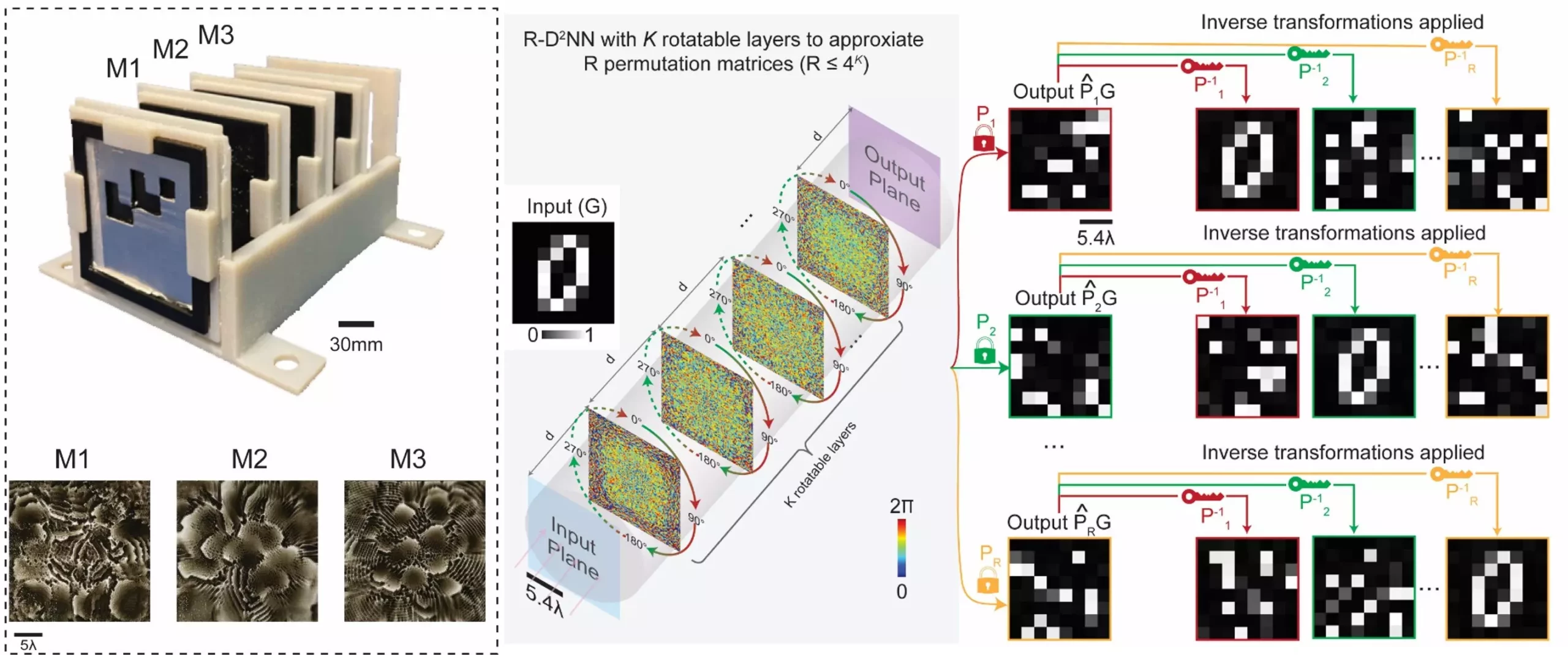
Traditional digital computing, largely dependent on electronic hardware, is reaching its physical and efficiency limits. As data volumes surge exponentially, the need for faster, more secure, and energy-efficient processing becomes urgent. UCLA’s recent breakthrough in optical computing signifies a paradigm shift, demonstrating that light’s inherent properties can be harnessed to perform complex operations at unprecedented speeds. This innovation pushes beyond the constraints of electronic circuitry, offering a future where data manipulation occurs predominantly in the optical domain, with enormous implications for encryption and high-speed data processing.
Harnessing Light for High-Dimensional Permutation Operations
The core achievement lies in a reconfigurable, diffractive optical network capable of executing high-dimensional permutation operations—a fundamental task in data encryption and telecommunications. Unlike electronic systems, which process permutations sequentially and consume substantial power, this all-optical approach performs these operations multiplexedly, leveraging the complexity of light’s interaction with structured materials. This multiplexed capability dramatically enhances scalability, providing a pathway to handle vast data streams simultaneously, a necessity for future communication networks.
Design Innovation and Flexibility in Optical Networks
At the heart of this advancement is a cleverly designed, reconfigurable multilayer system crafted through deep learning algorithms. The diffractive layers can rotate in four distinct orientations, allowing the entire network to execute up to 4K different permutation functions when combined with multiple layers. This design embodies versatility—each configuration can be tailored for specific security or processing needs, simply by mechanically reorienting the layers. The use of polarization degrees of freedom further magnifies the multiplexing capacity, showcasing a level of control and complexity previously largely confined to theoretical models.
Practical Demonstrations and Industry Implications
The UCLA team proved its concept through practical experiments utilizing terahertz radiation and 3D-printed diffractive materials, whose results aligned closely with numerical predictions. These trials underline the technology’s potential for real-world deployment in fields requiring swift and secure data management. Applications extend well beyond encryption; optical switching, high-speed communication, and scalable cryptography all stand to benefit. The mechanical reconfigurability suggests a future where optical devices can adapt on-the-fly to changing operational needs without extensive re-engineering.
Imagining a Future Driven by Optical Computing
This development is more than a scientific milestone; it signals a future where optical systems underpin secure, efficient, and scalable information technologies. As light-based computing matures, it promises to outpace traditional electronics in both speed and power consumption. The UCLA researchers have not only demonstrated a novel approach but also revealed a pathway toward smarter, faster, and inherently more secure networks, which could ultimately redefine how data is protected and processed in the digital era.
Leave a Reply