
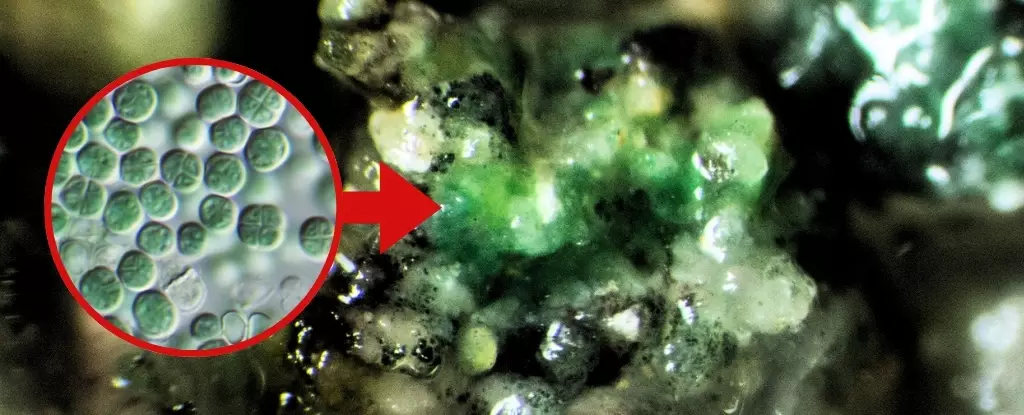
The exploration of space has always pushed scientists to confront the realities of extreme environments beyond Earth. Among the most fascinating discoveries are extremophiles—organisms that thrive where most life forms would perish. The cyanobacterium commonly dubbed Chroococcidiopsis, affectionately shortened to Chroo, exemplifies this resilience. Its extraordinary capacity to survive and even function in conditions akin to those found on other planets makes it an invaluable model for understanding how life might exist beyond Earth. Far from being mere curiosities, these microorganisms are pivotal tools in framing the possibility of extraterrestrial ecosystems and developing the necessary biological infrastructure for human exploration.
Chroo’s origins trace back to some of Earth’s most hostile landscapes—arid deserts and icy polar regions, including Antarctica. Despite these seemingly uninhabitable environments, Chroo has adapted to endure punishing dryness, high radiation levels, and temperature extremes. These adaptations have prompted a paradigm shift: instead of viewing space as an inhospitable void, astrobiologists recognize it as a potential habitat not only for life but also for biological engineering. Experiments exposing Chroo to space’s vacuum, radiation, and temperature fluctuations underscore the organism’s potential as a biological proxy in the quest to understand life’s boundaries.
The Space Experiments That Changed Our Perspective
The significant breakthrough came through experiments aboard the International Space Station (ISS), namely BIOMEX and BOSS—complex acronyms that hint at their scientific depth. Through the “Exposing Organisms to a Space Environment” (EXPOSE) module, scientists subjected Chroo to prolonged space conditions, including the intense solar ultraviolet rays that are among the most destructive forces known to biology. The results defied expectations: despite harsh UV irradiation, some Chroo cells remained viable, protected by simple biological or mineral layers acting as shields. For instance, a thin layer of regolith or the biofilm’s top cells sacrificed themselves to serve as a protective barrier for the underlying cells, demonstrating a primitive yet effective form of self-preservation.
What makes these experiments truly extraordinary is the organism’s ability to repair its DNA after such brutal exposure. When returned to Earth, Chroo demonstrated an impressive capacity for self-healing; its DNA repair mechanisms were so efficient that post-exposure mutation rates remained comparable to unexposed control samples. This ability to recover from space radiation—arguably one of the most challenging aspects of long-term space travel—promises a future where microorganisms could serve as biological support systems for astronauts or even extraterrestrial bases.
Earthbound Testing: Pushing Limits on Our Home Planet
While space experiments are compelling, terrestrial testing compounds our understanding of Chroo’s resilience. Researchers subjected the cyanobacterium to gamma radiation at levels thousands of times lethal to humans—up to 24,000 Gy. Remarkably, Chroo survived, although it did not turn green and bulky like a comic book Hulk; instead, it endured with its structural integrity largely intact. Even more telling, biological markers such as carotenoids persisted long after the organism’s death, hinting at the potential of Chroo to serve as a biomarker in the search for extinct or dormant life on planets like Mars.
In addition, it withstood frigid temperatures ranging down to -80°C, mimicking the icy crusts of moons such as Europa and Enceladus. During these tests, Chroo formed a vitrified, glass-like state—a dormant condition that could allow it to survive for eons until environmental conditions improve. This dormancy capability is crucial for future missions targeting icy worlds, where life might persist underground or within frozen crusts for extended periods.
Future Frontiers: Harnessing Extremophile Strength for Space Missions
The true promise of Chroo lies in its potential application to future space endeavors. Its ability to produce oxygen through photosynthesis is more than a biological curiosity—it is a vital step toward sustainable life support systems in extraterrestrial colonies. Furthermore, its resilience to perchlorates—hazardous chemical compounds found in Martian soil—reveals it can survive and function in environments that would otherwise be deadly for most Earth-based life forms.
Upcoming missions aim to explore these capabilities in greater depth. CyanoTechRider will investigate how microgravity influences Chroo’s DNA repair pathways, shedding light on how life adapts in reduced gravity environments. BIOSIGN will examine whether Chroo can harness infrared light—abundant around M-dwarf stars—expanding our understanding of photosynthesis under extraterrestrial lighting conditions. Success in these experiments could pave the way for engineered microbial systems that not only survive but thrive on other worlds, providing oxygen, food, and even aiding in terraforming efforts.
Chroo as a Gateway to the Universe’s Hidden Potential
In sum, the resilience, adaptability, and multifunctionality of Chroococcidiopsis position it as a cornerstone of astrobiology’s future. It challenges the long-held notion that extreme environments are devoid of life-supporting potential and offers tangible solutions to the logistical challenges faced by interplanetary explorers. The organism’s capacity for self-repair, dormancy, and even photosynthesis in harsh conditions suggests that life, in some form, can persist amid the universe’s most unforgiving landscapes.
As scientists continue to peel back the layers of what makes Chroo so extraordinary, it becomes clear that extremophiles are not mere biological oddities; they are the blueprint for resilience and survival in space. Harnessing their capabilities could be humanity’s most promising strategy for living among the stars—turning barren planets into new homes and opening a universe of possibilities that once only existed in dreams.
Leave a Reply