
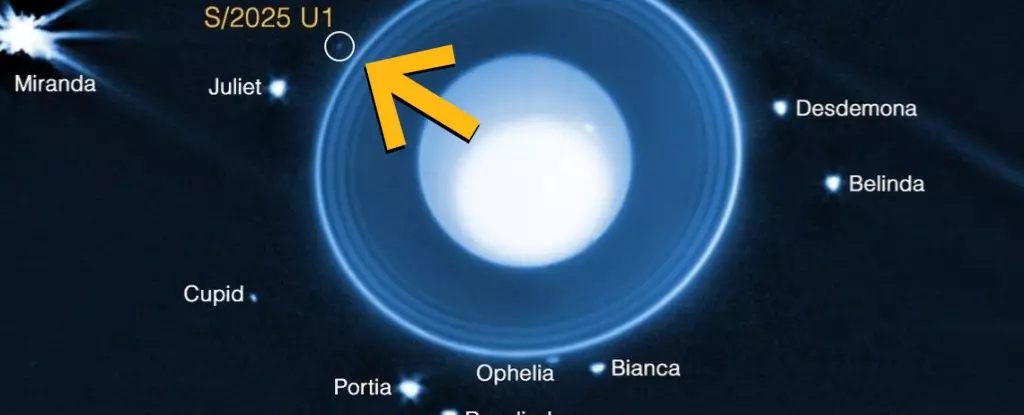
The recent discovery of a previously unknown moon orbiting Uranus marks a pivotal moment in planetary science. With this addition, the count of Uranus’s moons rises to an astonishing 29, underscoring the icy planet’s intricate satellite system. This small celestial body, designated S/2025 U1, is estimated to be a mere 10 kilometers across, yet its existence challenges long-held assumptions about the planet’s satellite environment. For decades, the Voyager 2 probe provided the sole close-up view of Uranus, revealing scant details. Now, with the James Webb Space Telescope (JWST), astronomers are peeling back layers of mystery, illustrating how much remains hidden in the depths of our solar system’s less glamorous worlds.
The discovery was made using JWST’s near-infrared camera, NIRCam, a state-of-the-art instrument capable of detecting faint objects amidst bright planetary backgrounds. The minute moon was spotted during a prolonged observation session on February 2, 2025, exemplifying the telescope’s extraordinary sensitivity. Its position within the planet’s complex ring-moon interplay offers vital clues into the formation and evolution of Uranus’s satellite system, especially since it orbits within a densely populated zone, nestled between two well-known moons, Ophelia and Bianca.
The Mysteries Encased in an Almost Circular Orbit
What makes S/2025 U1 particularly intriguing is its nearly circular orbit around Uranus, situated at approximately 56,250 kilometers from the planet’s center. Its placement within the inner satellite ring, close to the planet, suggests a potential origin from material that either coalesced naturally in situ or resulted from collisional debris. Since it resides in an area where moons and rings appear to overlap, its existence blurs the traditional boundaries between these orbital structures and hints at a chaotic, dynamic history that challenges simplistic models of planetary satellites.
Furthermore, the moon’s diminutive size and faint appearance imply that there might be a multitude of other small, yet-undetected objects within Uranus’s system, waiting for the right technological breakthrough to reveal their secrets. The preliminary nature of its classification also raises exciting questions about the processes that govern moon formation, especially around planets with complex gravitational interactions and ring systems like Uranus.
Implications for Planetary Science and Future Missions
The discovery of S/2025 U1 isn’t an isolated event; it represents a broader trajectory of scientific progress driven by advancing technology. It is a testament to how modern observatories like JWST are revitalizing interest in the outer solar system, an arena often overshadowed by more dynamic planets like Jupiter and Saturn. As Maryame El Moutamid from the Southwest Research Institute notes, humanity has only begun to scratch the surface, and upcoming missions could further unravel these cosmic mysteries.
Such findings also press the case for renewed exploration. While orbiters like Voyager 2 provided invaluable initial insights, the detail and depth offered by JWST could propel us toward more dedicated missions to Uranus. Understanding these tiny moons is not just about cataloging celestial bodies; it’s about piecing together the history of planetary system formation, the dynamical interactions of moons and rings, and the broader narrative of planetary evolution.
In essence, every new moon uncovered demonstrates that Uranus’s system is far more evolved and intricate than previously thought. The faint glow of S/2025 U1 acts as a reminder that our solar system still harbors countless secrets, waiting patiently for curious explorers to uncover them, illuminating not only Uranus but also the broader processes that shaped our cosmic neighborhood.
Leave a Reply