
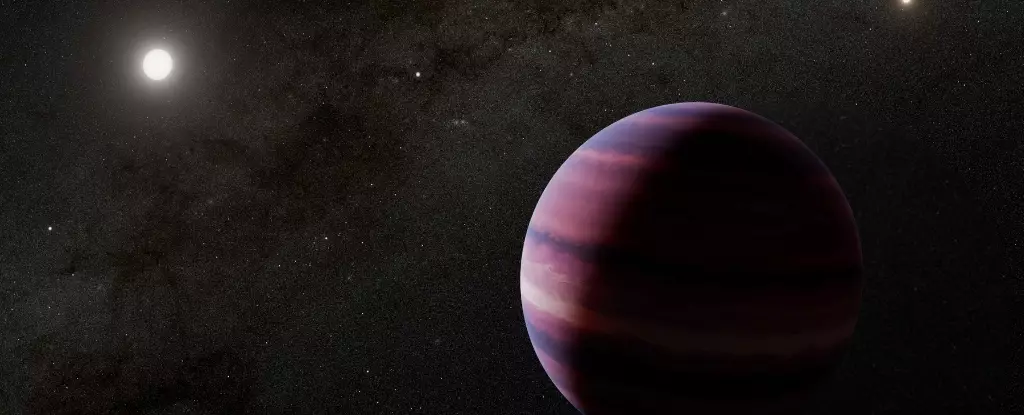
The universe continues to surprise us with its boundless capacity for wonder, and recent advancements have propelled humanity closer than ever to understanding the cosmos. The detection of a possible large planet orbiting Alpha Centauri A—the Sun’s closest stellar neighbor—marks a pivotal moment in astronomical exploration. This potential discovery, hinting at a gas giant nestled within the star’s habitable zone, challenges preconceived notions about planetary formation and the potential for life beyond Earth. The profound implications of this find stretch current scientific paradigms, inviting us to reconsider what constitutes a “habitable environment” and how such worlds could exist within complex multi-star systems.
While this potential exoplanet, tentatively named Alpha Centauri Ab, remains under investigation, its very possibility ignites a sense of excitement and curiosity. For decades, astronomers have relied on indirect methods—tracking dips in starlight or gravitational tugs—to locate worlds orbiting distant stars. Now, the use of the James Webb Space Telescope’s direct imaging capabilities signifies a remarkable leap forward. By directly capturing faint light signatures amidst the glare of Alpha Centauri A, scientists are moving into uncharted territory—getting closer than ever to witnessing alien worlds in their true form, not just inferred shadows.
This breakthrough bridges the gap between theoretical models and observational evidence, injecting fresh optimism into the quest for habitable planets. The proximity of Alpha Centauri makes it an ideal candidate for detailed study—a nearby cosmic laboratory where long-standing questions about planetary habitability and formation can be addressed with unprecedented clarity. If confirmed, this discovery will be a testament to how technological innovation can illuminate worlds that were once thought to be beyond our reach, redefining the possible boundaries of life in the universe.
The Complexity of a Triple Star System
Alpha Centauri’s unique structure complicates the pursuit of understanding its planetary companions. Comprising two Sun-like stars—Alpha Centauri A and B—and a more distant red dwarf, Proxima Centauri, this triple system presents a chaotic gravitational environment that would challenge any planet’s survival. Yet, paradoxically, this complexity makes the possible discovery of a planet orbiting Alpha Centauri A all the more extraordinary.
Previous efforts to detect planets in this system have faced significant hurdles, primarily due to the brightness and close proximity of the stars, which tend to drown out faint planetary signals. The red dwarf Proxima Centauri, which hosts known exoplanets—including one within its habitable zone—has provided some insights, but the central binary teeters on the edge of observational difficulty. The fact that scientists have now identified a candidate planet around Alpha Centauri A underscores just how advanced our detection methods have become and how much potential remains in even the most challenging stellar environments.
Moreover, the discovery gyrates around a core question: Could a massive gas giant exist comfortably within the habitable zone of a Sun-like star in such a turbulent neighborhood? The notion might seem counterintuitive. Gas giants are typically inhospitable, but their potential moons—if sufficiently Earth-like—could harbor life. This widens the scope of habitability and emphasizes that life’s precursors might exist on moons surrounding worlds like Alpha Centauri Ab, turning our focus to the satellite systems rather than the planets themselves.
Implications and Future Prospects
The potential identification of Alpha Centauri Ab not only raises tantalizing questions about planetary formation but also hints at a universe where habitable worlds might be more common than previously assumed. If such a planet exists, its characteristics—a gas giant roughly the size of Saturn, orbiting at a distance that allows for liquid water—suggest that the concept of habitability must extend beyond terrestrial planets to moons and subsurface environments.
The scientific community is cautiously optimistic. The findings, detailed in recent astrophysical journals, are preliminary, with follow-up observations needed to confirm its existence. The challenge lies in the planet’s elusive nature: direct imaging shows a faint signal that disappears in subsequent observations, which suggests that the planet might be either transient or difficult to detect due to the star’s brightness or complex orbit. This “vanishing act” adds a layer of mystery, prompting astronomers to refine their models further.
Most crucially, this discovery nudges us to rethink planetary formation theories in multi-star systems. How does a gas giant form in such a chaotic gravitational dance? How can it maintain a stable orbit within the habitable zone? These questions could force us to revise existing models, possibly recognizing that planetary systems are more resilient and diverse than current frameworks suggest.
Beyond scientific curiosity, this opens up broader philosophical debates: Is life more likely to find a foothold around stars that are similar to our Sun? Could nearby worlds like Alpha Centauri host thriving ecosystems, hidden beneath thick atmospheres or icy shells? As we push forward, no doubt future missions and technological advancements will bring these questions into sharper focus, revealing whether this promising candidate will stand as a pioneering discovery—an analogy to Earth’s own cosmic mirror—or remain elusive, a tantalizing glimpse into worlds yet to be confirmed.
Leave a Reply