
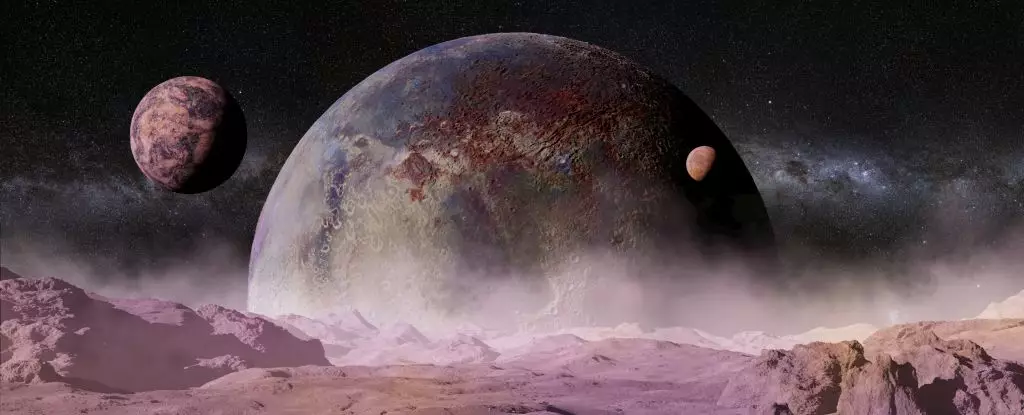
In the vast emptiness of our galaxy, countless celestial wanderers traverse the cosmic sea—these are the free-floating, planetary-mass objects, often dubbed rogue planets. Unlike planets bound to a star, these enigmatic bodies drift aimlessly in the dark, starless regions, silently carrying a wealth of secrets about planetary formation and cosmic evolution. The recent insights gleaned from the James Webb Space Telescope (JWST) challenge traditional perceptions, suggesting that even these solitary wanderers harbor the potential to develop complex satellite systems akin to miniature planetary communities. Such revelations force us to reevaluate our understanding of planetary genesis, blurring the lines that once separated stars, planets, and moons.
Disks in the Darkness: Evidence of Formation in Isolation
The JWST’s unprecedented sensitivity has enabled astronomers to peer into the veiled environments surrounding these rogue bodies. In the Orion Nebula, an array of studies focused on eight free-floating planetary-mass objects, each possessing about five to ten times the mass of Jupiter. Astonishingly, they discovered that several of these objects are encircled by dusty disks—remnants that mirror the protoplanetary disks observed around nascent stars. The composition of these disks is especially intriguing. The presence of crystalline silicate grains, alongside hydrocarbon materials, indicates processes of dust growth and crystallization similar to those that mark planet formation around young stars.
This evidence suggests that these objects are not mere cosmic missiles drifting without purpose but are dynamic systems capable of fostering their own planets and moons. The similarity in disk composition raises provocative questions: Are these free-floating bodies just late bloomers in planetary formation? Could they, in their own right, nurture conditions suitable for the emergent complexity of satellite systems? If so, they stand as miniature laboratories, offering a scaled-down glimpse into the processes that produced our own Solar System.
The Genesis of Miniature Planetary Systems
What transforms a drifting piece of cosmic debris into a cradle of moons and rings? The answer, according to recent research, appears to lie in the initial conditions of the disks surrounding these objects. The detection of dust grains with signs of growth and crystallization reflects ongoing processes that can eventually lead to planetesimal formation. In other words, these miniature disks might not only be cradles for tiny planets but could also spawn a variety of satellites—moons, rings, and other structures—much like those orbiting Jupiter and Saturn.
The possibility that these objects could develop such systems is both fascinating and imposing. With their relatively modest masses—comparable to several Jupiters—these rogue planets push the boundaries of planetary formation theories. If they do form moons or even ring systems, they would serve as proof that the universe is capable of nurturing planetary architectures in the most unlikely environments. Moreover, the implications extend beyond mere curiosity; they challenge our understanding of how common and diverse planetary systems might be in the universe. The concept that free-floating objects could host their own moons illuminates a new landscape of astronomical phenomena that we are only beginning to explore.
Implications and Future Prospects
While these findings ignite the imagination, many questions remain. For instance, do these disks evolve similarly to those around stars, or do extreme conditions in open space alter their capacity to form moons? The absence of a star’s gravitational pull undoubtedly influences the accretion and orbital dynamics within these disks. Yet, the evidence of complex dust processing hints at an inherent resilience and capacity for growth.
In contemplating the long-term evolution of these bodies, one can imagine a universe where moon systems form around objects once dismissed as isolated wanderers. These moons could harbor environments of their own, perhaps even with conditions suitable for life—albeit on a miniature scale. Each discovery underscores an essential truth: cosmic creation is an ongoing, boundless process.
Looking ahead, advancement in observational techniques promises to yield even more detailed insights into these mysterious objects. As our tools sharpen, the possibility of directly imaging moons or rings around rogue planets transitions from science fiction to plausible reality. The prospect of a universe teeming with tiny, isolated worlds—each an independent ecosystem—compels us to broaden our horizons and rethink the boundaries of planetary science. The dark corners of our galaxy might be more alive—and more diverse—than we’ve ever imagined.
Leave a Reply