
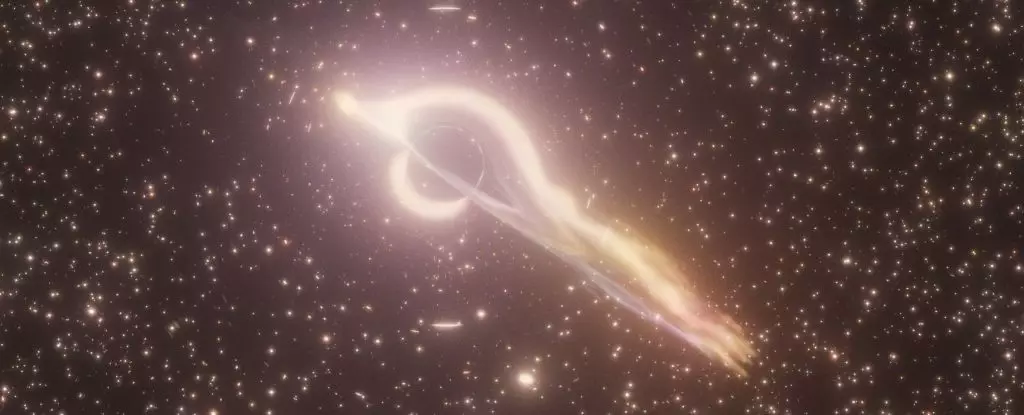
Black holes have long fascinated astronomers and the public alike, primarily because they push the boundaries of our understanding of physics and cosmic evolution. Traditionally, black holes are categorized into two dominant classes: stellar-mass and supermassive. Stellar-mass black holes are the remnants of massive stars that have undergone supernova explosions, typically weighing up to about 100 times the mass of our Sun. On the other end of the spectrum lie supermassive black holes, titanic structures with millions or billions of solar masses, anchoring the cores of most galaxies. Despite significant advancements in astrophysics, a glaring gap exists between these two regimes—a missing link that has stymied scientists’ efforts to map the evolutionary trajectory of black holes. That is, until recent evidence hinted at the existence of intermediate-mass black holes (IMBHs), whose elusive presence could redefine our understanding of cosmic growth.
The Rare Discovery That Challenges Conventional Wisdom
The recent detection of a peculiar luminous flare from a galaxy about 450 million light-years away marks a milestone in black hole research. This flare, believed to be caused by a black hole devouring a star, has sparked considerable excitement, especially because the black hole in question appears to occupy the intermediate mass range—neither a mere stellar remnant nor a gargantuan supermassive titan. It’s a game-changer, confronting the long-standing mystery of how supermassive black holes actually originate and evolve. This discovery suggests a possible evolutionary pathway where black holes can grow gradually, passing through intermediate stages that until now have remained mostly theoretical and observationally unconfirmed.
What makes this case particularly compelling is the brightness and the behavior of the X-ray emission associated with the event. Astronomers, led by Yi-Chi Chang, have deduced that the black hole’s mass is likely between 1,000 and 10,000 solar masses, definitively placing it within the intermediate range. Such an object was suspected to exist but remained undiscovered until now, making this a thrilling leap forward. The detection not only demonstrates that these mid-sized entities do exist but also opens the gateway to better understanding their formation, their growth mechanisms, and their role in the broader cosmic tapestry.
The Significance of Intermediate-Mass Black Holes in Cosmic Evolution
Understanding intermediate-mass black holes isn’t just an esoteric pursuit; it’s central to solving one of astronomy’s most enduring puzzles—how supermassive black holes form so early in cosmic history. If supermassive black holes grow from the merging and accretion of smaller black holes, then IMBHs act as the missing initial seeds—a crucial early step in the buildup process. Yet, until now, the scarcity of observed IMBHs has created a void in our models, forcing scientists to reconcile theory with limited evidence.
The discovery of HLX-1 and similar candidates acts like a cosmic keystone. They provide tangible proof that such objects exist, offering a window into the intermediate phases of black hole growth. This discovery hints that black holes might begin their lives as stellar remnants but have the potential to grow into IMBHs through accretion and mergers, eventually transforming into the supermassive giants that dominate galactic centers. Recognizing the existence of IMBHs also challenges long-held assumptions—sometimes, the universe is more nuanced than our simplified bifurcation of black hole categories. Their presence could mean that the universe employs multiple pathways to produce supermassive black holes, rather than a uniform, singular process.
The Road Ahead: Deciphering the Milestones of Galactic Evolution
The significance of these findings extends beyond cataloging exotic objects. Confirmed sightings of intermediate-mass black holes could revolutionize our comprehension of galaxy formation and evolution. Such black holes might act as cosmic building blocks, merging over cosmic timescales to form larger entities, or they could serve as laboratories to understand gravity in its most extreme form.
Nevertheless, skepticism remains. The detection of HLX-1 and other similar phenomena is a complex, delicate process—often relying on indirect inference from X-ray emissions and luminosity shifts. Critics emphasize the need for multiple observations, repeated flaring phenomena, and complementary data to definitively confirm their intermediate mass. The universe rarely offers straightforward answers, and the race to definitively identify and understand IMBHs will require patience, innovation, and meticulous scrutiny.
Despite these challenges, the discovery injects new vitality into a field often mired in theoretical dead ends. It reminds us that, even in the vastness of space, evidence abounds if we look carefully enough, and our cosmic quest is far from over. The mere possibility that middle-sized black holes serve as cosmic “missing links” ignites a fresh wave of curiosity, pushing humankind to unravel the intricacies of the universe’s most enigmatic objects. Ultimately, these insights could reshape our grand narrative of how the universe’s colossal structures came to be, illuminating a previously hidden chapter in the story of cosmic evolution.
Leave a Reply