
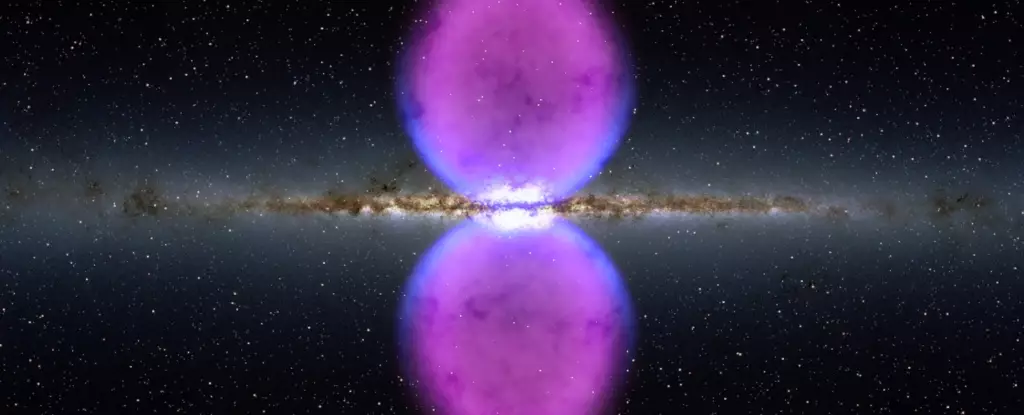
The recent discovery of cold hydrogen clouds lurking within the Fermi Bubbles has sent ripples through the astronomical community, challenging long-standing beliefs about the destructive environments near galactic centers. Traditionally, the immense energy and turbulent plasma that characterize these massive lobes of the Milky Way are thought to obliterate or disperse any semblance of cold matter. Yet, findings from an unprecedented radio survey indicate otherwise: pockets of relatively cool hydrogen gas, some potentially millions of years old, persist and thrive where destruction seems inevitable.
This revelation rewrites the narrative on galactic feedback mechanisms and the recycling of matter in galaxies. It demonstrates that even in the most extreme environments, nature finds a way to preserve and perhaps even generate cold structures. Such a paradigm shift compels astrophysicists to reconsider models of galactic evolution, the resilience of gas clouds, and the intricacies of matter outflows driven by supermassive black holes. The existence of these cold clouds isn’t just a curious anomaly; it could be a cornerstone in understanding how galaxies sustain themselves amidst chaos.
Challenging the Assumptions of Cosmic Destruction
In the cosmic scale, the conditions reigning within the Fermi Bubbles are akin to the heart of a superheated inferno—plasma temperatures soaring around a million Kelvin, outflows reaching millions of miles per hour. Under such conditions, hydrogen atoms should theoretically be obliterated or rendered invisible amidst the searing plasma. The discovery of neutral hydrogen clouds, therefore, looks paradoxical, if not outright impossible.
Yet, their survival critically depends on the dynamics of galactic outflows and the physical asymmetries—localized cooling, magnetic shielding, or thermal instabilities—that afford these clouds their existence. Their significant sizes, some spanning nearly a century of light-years, suggest they are not fleeting phenomena but enduring entities that have persisted through eons. Their presence raises profound questions about the robustness of cold gas in hostile environments and whether our previous understanding was limited by observational constraints.
Moreover, the clouds’ observed ages, aligning closely with estimates of the Fermi Bubbles’ formation period, imply a direct connection to the violent history of the galactic nucleus. If these clouds are remnants or fragments carried high into the halo by powerful outflows, then they serve as tangible tracers of the Milky Way’s tumultuous past. They are living relics, alive against all odds, whispering tales of violent ejections and complex interactions that defy simplistic models of destructive galactic phenomena.
Implications for Galactic Evolution and Cosmic Feedback
The implications extend far beyond merely cataloging an oddity in our galaxy. These cold hydrogen clouds are potentially key players in the ongoing cycle of matter between galactic core activity and the halo. Their presence suggests that the processes fueling supermassive black holes and the resultant energetic outflows might not be entirely demolition units, but could also foster environments where cold gas persists, condenses, and perhaps even precipitates new star formation.
Indeed, the idea that cold clouds can withstand or form within otherwise destructive outflows shines a new light on galactic feedback mechanisms. It underscores a level of complexity previously underestimated in models of galaxy regulation. Instead of a one-way street from star formation to black hole feeding and eventual destruction, the cosmos appears capable of a more nuanced dance—a recycling process where cold matter survives, adapts, and potentially influences subsequent generations of stars and galactic activity.
Additionally, this discovery has profound consequences for our interpretation of galaxy evolution on cosmic scales. By observing these clouds in our own galaxy, scientists gain insights applicable to distant, less accessible galaxies undergoing similar energetic processes. The resilience of cold gas amidst chaos opens new avenues for examining how galaxies grow, shed material, and maintain their gaseous environments over billions of years.
Questioning the Limits of Cosmological Stability
Perhaps most intriguing is what these clouds say about the stability—or instability—of matter in the universe. The existence of such cold structures within the searing plasma of the Fermi Bubbles suggests that the fundamental physics governing matter’s state may be more versatile than the simplistic models that have guided us so far. Thermal instability, magnetic fields, and local density fluctuations could be instrumental in creating sanctuaries for cold gas amidst the chaos.
Furthermore, their relatively short lifespans—lasting only a few million years—highlight the transient yet recurring nature of these phenomena. These clouds are fragile, constantly evolving or dissolving, yet their frequent formation indicates an ongoing process capable of defying destructive forces. This resilience exemplifies a critical lesson: chaos does not preclude order; even in the most turbulent locales, pockets of stability and complexity can emerge.
The discovery also prompts us to reconsider the role of thermal instability in galaxy dynamics. If localized cooling can produce these clouds amid extreme conditions, then perhaps other galaxies host similar hidden reservoirs of cold matter, waiting to be uncovered. It broadens our perspective on the life cycle of galactic matter and the intricate balancing act between energetic feedback and the preservation of cold gas.
Final Reflection: A New Dawn in Galactic Exploration
This breakthrough highlights a fundamental truth about the universe: there is always more to learn, and the cosmos often surprises us with its resilience and ingenuity. The notion that cold hydrogen clouds can exist amidst the superheated, turbulent environment of the Fermi Bubbles underscores the importance of pushing observational boundaries and questioning preconceived notions. Every discovery beckons us to look deeper, think broader, and accept that the universe’s complexity far exceeds our current models.
It is a testament to human curiosity and scientific perseverance that these cosmic “ice cubes” have come to light—reminding us that in the grand cosmic orchestra, even the faintest whispers of cold matter can resonate profoundly, revealing secrets about the universe’s true nature.
Leave a Reply