
Exploring the less-charted territories of nuclear physics, particularly the realm of heavy neutron-rich nuclei, is essential for pushing the boundaries of our understanding of the universe. These exotic nuclei, often residing far from the valley of stability, hold keys to deciphering the cosmic origins of elements and revealing the intricate structure of atomic nuclei. Their properties influence pivotal astrophysical phenomena such as the rapid neutron capture process (r-process), a fundamental mechanism believed to forge the universe’s heaviest elements. Without detailed knowledge of these nuclei, models of stellar evolution, nucleosynthesis, and cosmic chemical enrichment remain incomplete, or worse, speculative.
The study of these nuclei is not just an academic pursuit; it’s a quest to answer profound questions about the nature of matter and the evolution of the universe itself. Their elusive character and transient existence demand innovative experimental approaches. Conventional methods like fusion-evaporation or fragmentation often fall short in producing and studying these nuclei due to the extreme conditions required and the difficulty of reaching such exotic regions on the nuclear chart. This reality underscores the urgency to develop more effective techniques—one promising avenue involves multinucleon transfer (MNT) reactions.
Multinucleon-Transfer Reactions: A Revolutionary Tool
Unlike traditional reactions, MNT processes enable the exchange of multiple protons and neutrons between colliding nuclei, occurring near the Coulomb barrier—energies just enough to overcome electrostatic repulsion. This sophisticated dance allows scientists to produce and study nuclei that are otherwise inaccessible, especially neutron-rich heavy isotopes. By directing intense radioactive ion beams (RIBs) onto suitably chosen targets, researchers can generate a spectrum of neutron-rich fragments with high-spin states at relatively low excitation energies.
This approach offers a strategic advantage: it samples the nuclear landscape more efficiently and with higher selectivity than ever before. Instead of relying on chance interactions, MNT reactions provide a controlled environment to probe the structural nuances of these fleeting nuclei, shedding light on their shell configurations, deformation properties, and isomeric states. It’s a powerful route to explore terra incognita—parts of the nuclear chart where current models are often speculative or incomplete.
Progress and Insights from Contemporary Experiments
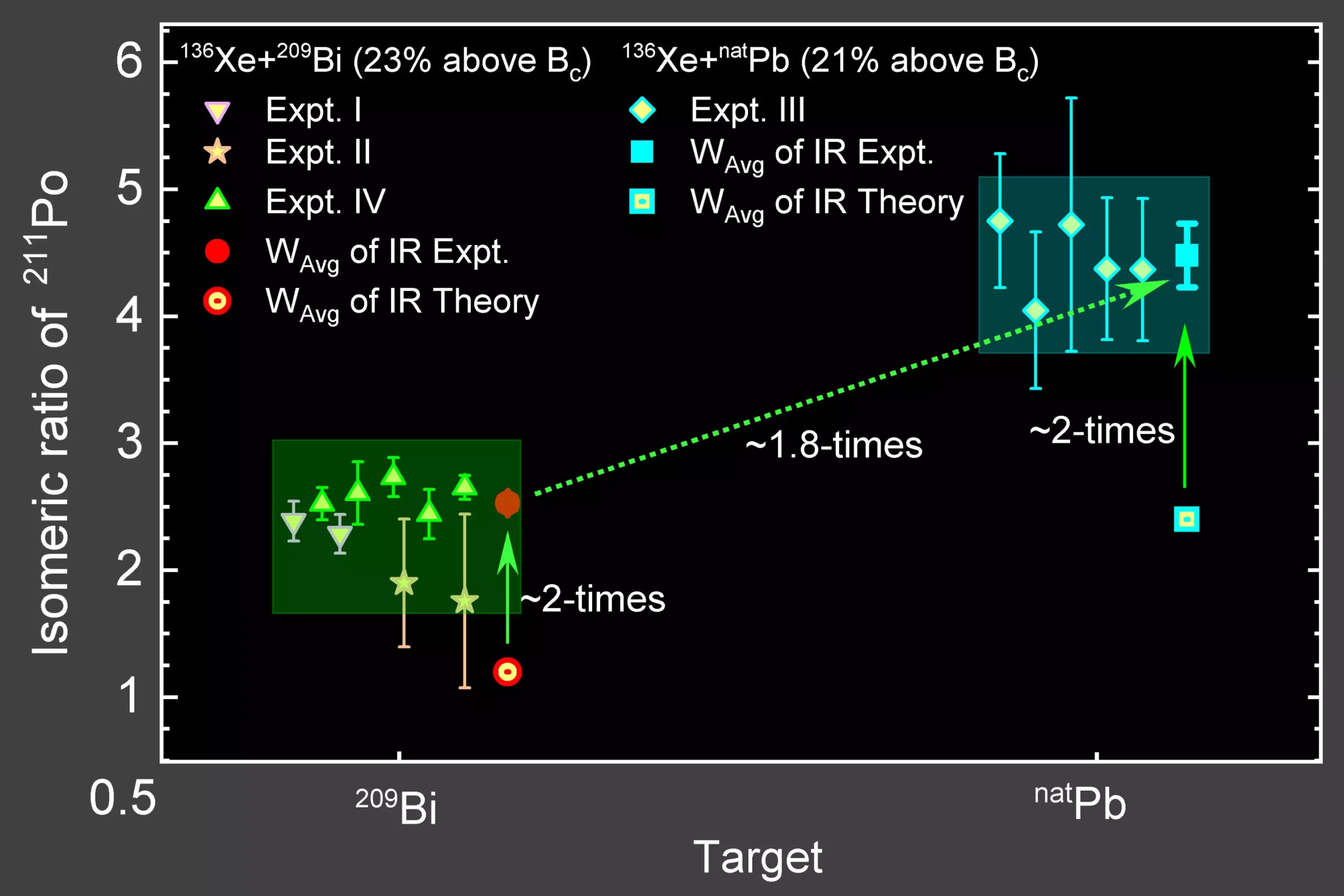
Recent experimental campaigns, such as those conducted at the Jyvaskyla University’s IGISOL facility, showcase the potential of MNT reactions to unlock hidden nuclear features. By bombarding neutron-rich xenon beams onto lead and bismuth targets, scientists have successfully populated neutron-rich isotopes, including intriguing isomeric states—long-lived excited states that serve as natural laboratories for studying nuclear structure.
Of particular interest were the production ratios of polonium-211 in its ground and isomeric forms. Observations indicated a substantial enhancement in the formation of isomeric states, especially when specific transfer channels, such as 2-proton transfer, were involved. These findings suggest that the initial transfer mechanisms and the entrance channel parameters—like projectile mass and transfer type—play a decisive role in determining the angular momentum and ultimately the population of high-spin isomers.
The experimental data align reasonably well with advanced theoretical models, such as Langevin-type calculations, which simulate the dynamics of multinucleon transfer. However, discrepancies highlight that our understanding remains incomplete. The models offer a qualitative picture but fall short of quantitatively capturing the complexities involved, especially for broad projectile mass ranges and diverse transfer modes. This gap signals the necessity for further experimental refinement and theoretical development to achieve predictive power.
The Path Forward: Challenges and Opportunities
The journey to produce and understand neutron-rich exotic nuclei is arduous yet profoundly promising. The delicate balance between experimental precision and theoretical modeling must be maintained, with each informing the other’s progression. The success of current methods hinges on improving detector systems, optimizing beam intensities, and deploying sophisticated gas-cell separation techniques to isolate rare isotopes amidst a sea of reaction products.
Looking ahead, scientists aim to extend these studies toward nuclei near the neutron shell closure at N=126—a region critical for understanding the r-process path and the origin of heavy elements. High-precision mass measurements in this region could refine nuclear models and contribute to our understanding of the stability and structure of these nuclei, with implications stretching from nuclear theory to astrophysics.
In the face of these challenges, the collaborative efforts of experimentalists and theorists are more vital than ever. These partnerships serve as catalysts for innovation, guiding the development of better models and experimental setups capable of painting a more comprehensive picture of the nuclear landscape. With each incremental discovery, we come closer to elucidating the role these exotic nuclei play in the grand cosmic narrative, transforming our speculative theories into concrete scientific understanding.
Leave a Reply