
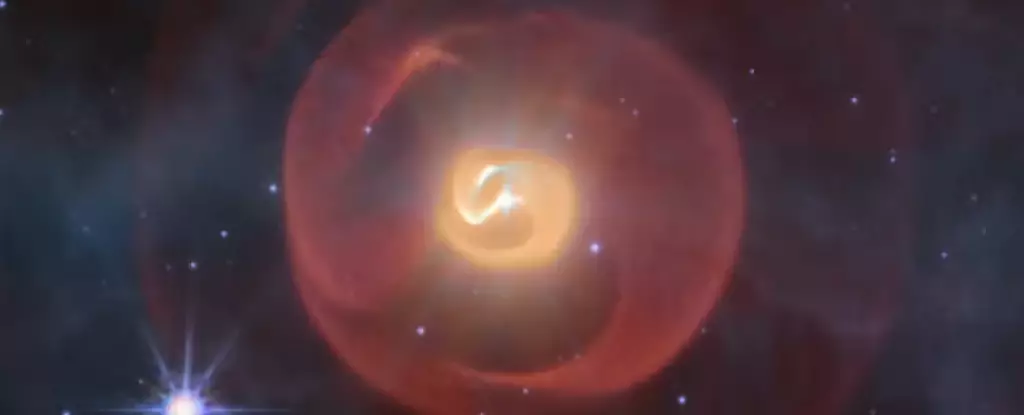
The universe’s final acts of destruction are as mesmerizing as they are profound, presenting a spectacle of chaos that ultimately seeds new beginnings. My journey into this cosmic theater took a pivotal turn right before my thesis examination, when my friend Joe Callingham, a dedicated radio astronomer, shared an image I had waited five years to see. This wasn’t just any picture; it was an infrared snapshot of a distant, enigmatic nebula known as Apep, named after the ancient Egyptian serpent god embodying chaos and destruction. The image revealed a spiraled allure so intricate and captivating that it seemed to mirror the universe’s paradoxical nature: destruction as a precursor to creation. Now, with the recent contribution of NASA’s James Webb Space Telescope (JWST), this celestial puzzle has become even clearer, challenging our previous understanding and opening new windows into the lifecycle of massive stars.
Apep’s Reimagined Identity: From Binary Expectations to Complex Realities
Initially, Apep was anticipated to resemble a classic pinwheel nebula, a predictable shape formed when stellar winds from massive stars carve out spiral patterns in the dust of space. Such structures, often associated with Wolf-Rayet stars, are cosmic fingerprints of their violent end stages, where stars shed their outer layers in spectacular gusts. These dying giants, enriched with heavy elements and carbon-rich byproducts, were thought to produce elegant, swirling formations akin to water sprinklers viewed from above. However, JWST’s advanced infrared imaging shattered this expectation. Instead of a simple spiral, the nebula revealed a stunning, wind-sock-shaped structure created by two Wolf-Rayet stars in close companionship, both wielding near-equal stellar winds. This discovery shifts our narrative: Apep isn’t a solitary star quietly dying, but a dynamic binary system engaged in a celestial tug-of-war, each star’s fierce winds colliding and creating complex, symmetric dust formations. Such insights challenge the traditional binary paradigm, emphasizing the importance of intertwining stellar wind interactions and orbital mechanics in aesthetic cosmic phenomena.
The Intricate Dance of Dust and Stellar Winds
What is particularly awe-inspiring about Apep is how its dust morphology challenges initial hypotheses. Early observations showed the dust moving slowly compared to expected velocities based on stellar wind models, hinting at more complex behaviors. The recent JWST data exposed multiple concentric dust shells—three in total—each cooler, fainter, and evenly spaced as if set in a finely orchestrated choreography. These shells, intertwined with swirling dust, suggest that Apep’s stars are farther away and intrinsically brighter than initially believed. This realization realigns our understanding of the star’s power and the nature of its winds—less about rapid rotation and more about the substantial gravitational influence of the system’s expanded size. The discovery of additional dust shells also points to episodic outbursts, akin to an ancient cosmic heartbeat, offering clues about the evolutionary timeline of such stars. JWST’s ability to decode these layers shifts the paradigm: stellar winds are not uniform, but subject to the intricate influence of multiple factors, including the gravitational and wind dynamics set by a third stellar companion.
The Revelation of a Third Stellar Player
Further analysis revealed an unexpected twist: Apep is not merely a binary. Evidence shows there’s a third star—a sibling factor weaving into this celestial saga. This third star, subtly hinted at by the shape of the dust shells and the distinct “bite” taken out of several shells, indicates a complex gravitational ballet involving multiple stars. The interaction among these massive entities, especially the third star’s wind carving into dust shells, illuminates how multiple stellar forces interact to craft these elaborate nebulae. These findings elevate the narrative from simple binary interactions to a multifaceted stellar family, each member contributing differently to the nebula’s intricate architecture. Recognizing the presence of multiple stars reshapes our models of how such explosive, dust-rich environments form, suggesting that stellar multiplicity is more common in star death than previously assumed. This discovery enriches our understanding, hinting at a universe where chaotic interactions and layered influences produce extraordinary cosmic artworks.
Implications for Cosmic Dust and Stellar Evolution
Apep’s complex structure does more than satisfy scientific curiosity; it deepens our grasp of cosmic material cycles. The dust produced by Wolf-Rayet stars, especially within binary or multiple systems, is the foundation of future planetary systems and life itself—since carbon dust from these fiery deaths eventually becomes part of nebulae, planets, and even living organisms. Understanding how these dust shells evolve, cool, and disperse informs our broader knowledge of the universe’s chemical enrichment. Moreover, the intricate dance of stellar winds and gravitational forces at play in systems like Apep offers a window into the processes that set the stage for supernova explosions, the ultimate death throes of massive stars. Such explosions forge the universe’s heaviest elements, dispersing them into space where they contribute to the cosmic tapestry of life and matter. The details revealed by JWST reinforce the idea that stellar death is both violent and creative—a paradox that drives cosmic evolution.
Reframing Cosmic Narratives with New Perspectives
In re-examining Apep through the lens of advanced observation and analysis, it becomes clear that our previous models were mere sketches of a much richer cosmic drama. The realization that multiple stars influence nebulae like Apep underscores the complexity of stellar evolution, particularly among the universe’s most massive and energetic stars. Rather than straightforwardly illuminating the death of a single star, Apep exemplifies a dynamic, layered choreography where gravitational and stellar wind interactions sculpt elaborate structures that stretch the fabric of our understanding. The nebula’s beauty, initially perceived as mere aesthetic, now embodies a complex history of stellar rivalry, teamwork, and cosmic craftsmanship. This narrative invites us to rethink not only how stars die but how the universe orchestrates its most violent yet creative acts, revealing that chaos often begets order in the most spectacular ways.
Leave a Reply