
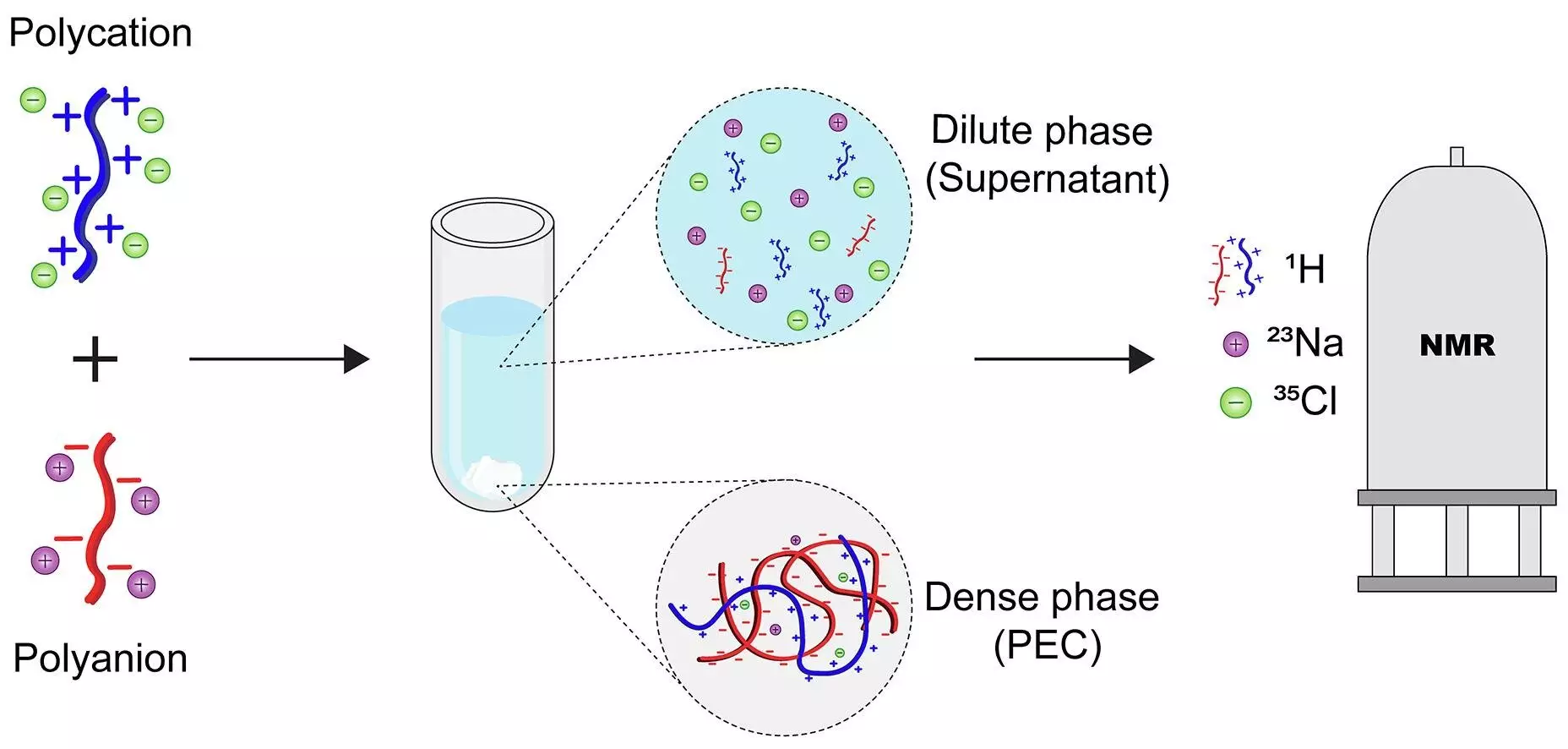
For decades, scientists have been captivated by the intricate dance of oppositely charged polymers—polyelectrolytes—that spontaneously assemble into complex structures. These complexes are fundamental in natural systems and have tremendous potential in engineering advanced materials. Yet, the true nature of how these charged components distribute themselves within mixtures has remained elusive. Traditional methods could only infer the macroscopic behavior, leaving the microscopic or molecular-level details shrouded in mystery. Consequently, this hindered the precise design and optimization of materials derived from such complexes.
However, recent research from the University of Twente offers a transformative perspective. The team introduces a novel application of nuclear magnetic resonance (NMR) spectroscopy that allows scientists to visualize, with unprecedented accuracy, how polyelectrolytes and their counterions distribute themselves after complex formation. This is more than a technical achievement; it represents a paradigm shift in the field of polymer chemistry, enabling scientists to peer into the microscopic world of these materials without invasive procedures.
A Quantum Leap in Material Characterization
The significance of this breakthrough lies in its ability to provide a complete, quantitative snapshot of all system components—both in the polymer-rich phase and the supernatant—within minutes. The method’s speed is particularly notable, as traditional analysis could take hours, limiting real-time monitoring of dynamic processes. By eschewing labels and invasive procedures, this approach preserves the integrity of delicate complexes, offering a genuine representation of their natural state.
This advance paves the way for rational design in industries that rely heavily on polyelectrolyte complexes. For instance, in water purification membranes, understanding the precise distribution of ions and polymers can inform adjustments that optimize filtration efficiency and durability. In biomedical applications, such as drug delivery systems, meticulous control over complex composition directly influences performance and biocompatibility. The ability to rapidly analyze and modify these complexes could dramatically accelerate innovation across sectors.
Bridging Nature and Engineering Through Quantitative Insights
Essentially, this development bridges a longstanding gap between natural phenomenon and engineered materials. Polyelectrolyte complexes are ubiquitous in biological systems—from cell walls to mucus—yet our scientific grasp has often been limited to theoretical models. By applying this robust NMR methodology, researchers can now delineate how natural complexes self-assemble and function, potentially inspiring biomimetic designs that mimic nature’s efficiency.
Furthermore, this technique challenges the traditional reliance on indirect or inferential methods of analysis. Instead, it offers a direct window into the molecular choreography happening within mixtures. This opens avenues for more nuanced control in material synthesis, allowing for bespoke properties tailored to specific applications. It also encourages a shift from trial-and-error approaches to precision engineering, guided by quantifiable data.
The Road Ahead: Beyond the Laboratory
What’s particularly compelling about this research is its broad applicability and the doors it opens for future exploration. While the immediate benefits are evident in material science and water treatment, the implications extend to biotechnology, environmental science, and even fundamental chemistry. By enabling scientists to decode the complex interactions at play, this methodology encourages the development of smarter, more sustainable materials.
Ultimately, the integration of advanced NMR techniques into the study of polyelectrolyte complexes marks a pivotal moment. It exemplifies how innovative analytical tools can reshape our understanding, turning longstanding mysteries into manageable design parameters. As researchers refine and expand upon this approach, the dream of creating highly tailored, efficient, and natural-inspired complex materials comes ever closer to reality.
Leave a Reply