
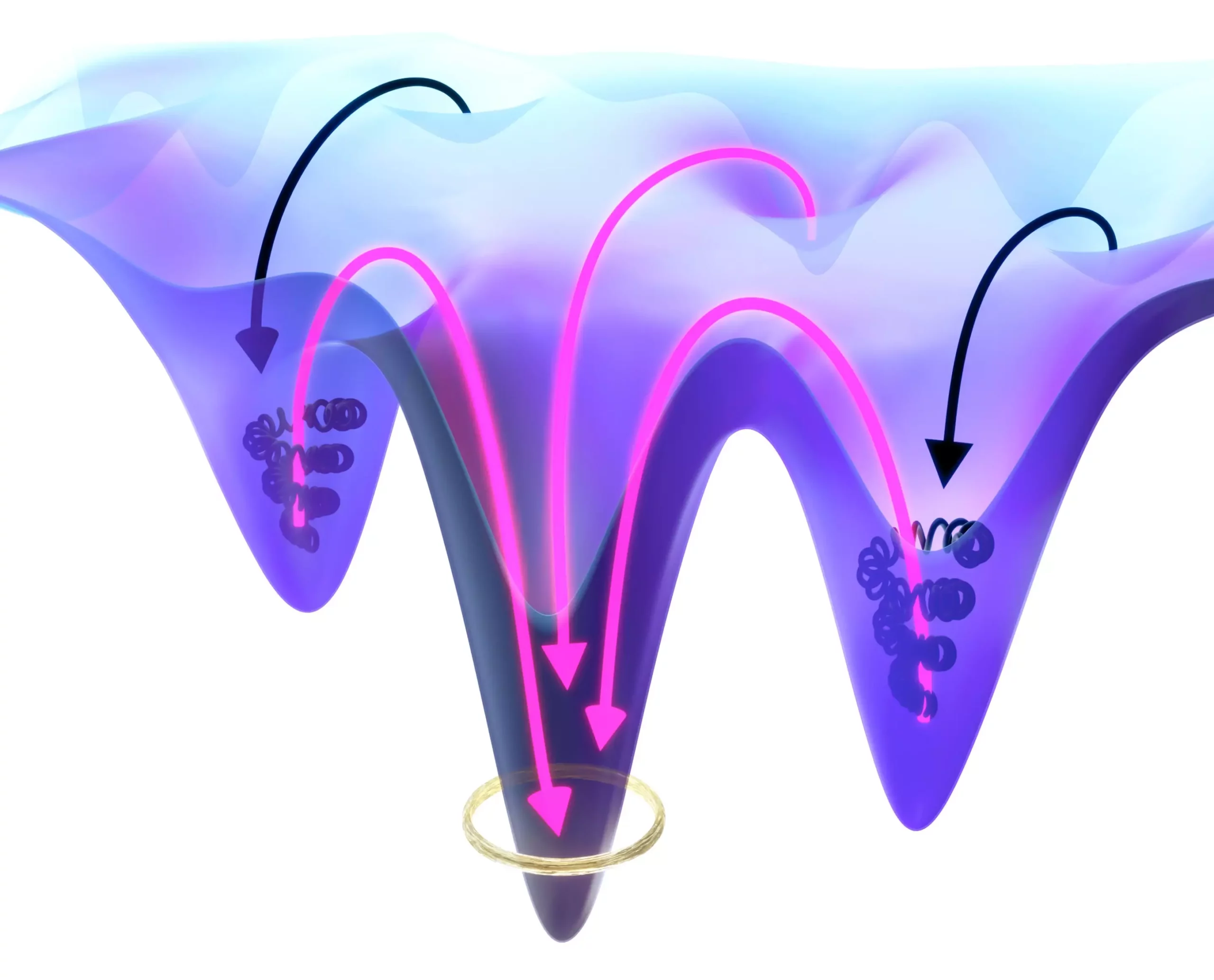
In the realm of complex physical and biological systems, the challenge of overcoming energy barriers is a fundamental obstacle that hampers progress toward optimal configurations. Traditional perspectives focus on energy minimization—much like a ball rolling into a hollow, unable to escape without additional energy input. This analogy highlights a persistent issue: systems often become trapped in local minima, preventing them from reaching their most efficient or functional states. The recent research by scientists at the Max Planck Institute for Dynamics and Self-Organization delves deep into this problem, offering a revolutionary approach rooted in the dynamics of non-reciprocal interactions.
The Power of Dynamic Imbalance
What makes this breakthrough especially compelling is the focus on non-reciprocal relationships between molecules—interactions that defy symmetry. Unlike typical mutual attractions, these interactions are unbalanced, often resembling predator-prey dynamics, where one entity influences another disproportionately. Such asymmetry creates a constant feedback loop that injects energy into the system, effectively breaking free from static traps. By harnessing these inherently directional interactions, systems can be coaxed into exploring beyond local energy minima, fostering self-organization and pattern formation that was previously thought unattainable without external energy sources.
Implications for Biological and Synthetic Systems
Biology offers a natural analogy: protein folding. Proteins often fall into misfolded states, stuck in local minima that impair their functions. Over billions of years, evolution has refined biological enzymes to navigate these energy landscapes efficiently—an optimization we aspire to emulate artificially. The research hints that designing synthetic molecules or molecular machines with built-in non-reciprocal interactions could replicate this biological feat, leading to innovations in nanotechnology and molecular engineering. Instead of brute-force energy input, systems influenced by these asymmetric interactions might achieve functional states more reliably and with greater efficiency, opening new horizons for medicine, nanorobotics, and active materials.
Transforming Theoretical Insights into Practical Solutions
Although the study is rooted in fundamental physics, its potential applications are enormous. By establishing a universal mechanism, the researchers demonstrate that overcoming energy barriers doesn’t necessarily require external energy—instead, it can be built into the interaction rules governing the system itself. This paradigm shift could lead to the development of autonomous molecular machines capable of self-assembly and repair, fundamentally changing how we approach the design of smart materials and biological mimetics. Moreover, this conceptual leap offers hope that complex systems—from cellular processes to nanomaterials—can be made more adaptable, resilient, and efficient through deliberate manipulation of their interaction dynamics.
In essence, this research challenges long-held assumptions about static energy landscapes, unveiling a powerful, elegant strategy inspired by nature’s own solutions. By embracing the asymmetry inherent in non-reciprocal interactions, humanity moves closer to mastering the art of energy management at the smallest scales, promising a future where complex systems can self-organize with unprecedented precision and purpose.
Leave a Reply