
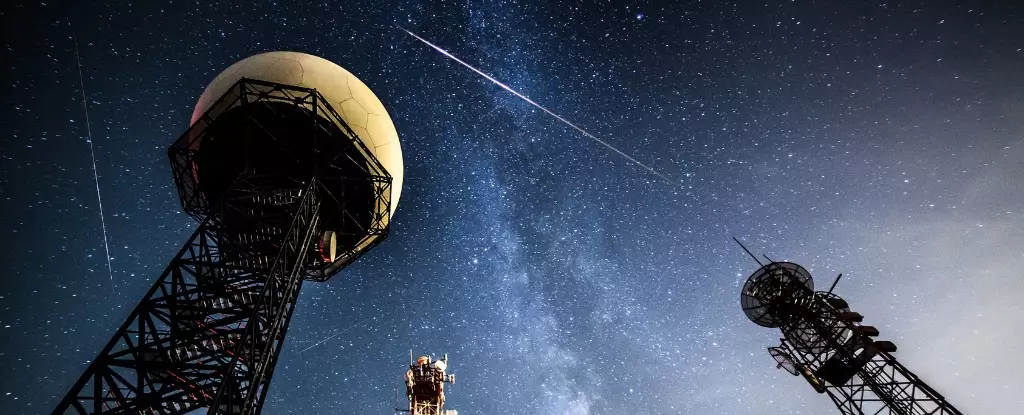
The summer months, particularly the latter half of July and the early days of August, present an unparalleled opportunity for enthusiasts and casual skywatchers alike to witness one of nature’s most awe-inspiring phenomena: meteor showers. Unlike the persistent glow of city lights and the hustle of daily life, the night sky during these months is painted with streaks of radiant fire and fleeting brilliance that serve as a reminder of our connection to the cosmos. For those who dare to look upwards, this period becomes a window into the universe’s dynamic poetry, offering moments of wonder that can often feel rare or inaccessible.
Furthermore, the combination of warmer nights and extended darkness in the southern hemisphere enhances visibility, allowing enthusiasts to indulge in this celestial ballet for longer stretches. The allure of meteor showers isn’t merely in their visual spectacle but also in their symbolic significance—each streak a piece of cosmic debris entering Earth’s atmosphere, a reminder of ongoing celestial activity beyond our planet’s boundaries. These natural displays invigorate curiosity, foster a sense of humility, and remind us of the universe’s vastness and endless possibilities.
The Unfolding Cosmic Performance: The Key Meteor Showers of Summer
Three major meteor showers dominate the sky during this period: the Alpha Capricornids, Perseids, and Southern Delta Aquariids, each with its own unique signature and timing. The Alpha Capricornids, observable from mid-July and peaking around July 29-30, are relatively modest in frequency but stand out because of their brilliance. Originating from the debris shed by the comet 169/NEAT—which completes its orbit every 4.2 years—these meteors often shine with a noticeable intensity that defies their modest numbers. Their radiant point in the constellation of Capricorn makes them a charming feature of northern summer skies, especially under dark, moonless conditions.
The Perseids, often dubbed the “Queen of Meteor Showers,” provide a more prolific and reliable spectacle, especially in the northern hemisphere. Emerging from comet Swift-Tuttle, which circles the sun every 133 years, the Perseids produce an impressive display—up to 75 meteors an hour during peak moments. Their radiant, in the vicinity of Perseus, offers an aesthetic treat for observers, particularly in the predawn hours. Despite the challenge posed by the waxing gibbous Moon this year, the Perseids continue to offer ample opportunities for awe, as their activity spans across the entire month of August. Their unpredictable beauty, combined with their historical significance, cements their status as a summer highlight.
Completing the trio, the Southern Delta Aquariids shine faintly but persistently from July 18, reaching their energetic peak around July 29-30. Originating from comet 96P/Macholz, which completes its orbit roughly every five years, this meteor shower offers a quieter but no less enchanting experience. Their subtle trails and lower brightness serve as a gentle reminder of the myriad celestial fragments crossing Earth’s path, offering potentially surprising displays—especially given that past observations have shown their capacity for extraordinary outbursts in certain years.
The Science Behind the Sparkle: Why Do These Meteors Drop From The Sky?
Understanding the science behind meteor showers elevates the experience from mere spectacle to a profound connection with cosmic processes. Each meteor is a fragment of debris, a tiny piece of icy or rocky material shed from comets or asteroids, that enters our atmosphere at staggering speeds—sometimes over 30,000 miles per hour. Upon contact with atmospheric gases, these particles ignite, burning brightly and creating the streaks we admire as shooting stars.
This debris trail is a cosmic breadcrumb trail left behind as comets travel around the Sun. Periodically, Earth’s orbit intersects with these trails, resulting in spectacular meteor displays. Notably, the brightness and frequency of meteors depend on the density of debris in Earth’s path and the observer’s local sky conditions. For example, the Alpha Capricornids, despite their limited number, impress with their brightness—a trait linked to the composition of their debris. In contrast, the Perseids’ abundance is due to the dense stream left by Swift-Tuttle, making them more consistently visible and spectacular.
What these phenomena reveal is the ongoing violent but beautiful recycling of materials within our solar system. Comets and asteroids shed material as they orbit, and Earth’s intersection with these trails results in fleeting, fiery displays. Each meteoroid’s fiery death is a visual testament to the dynamic interplay between celestial objects and orbital mechanics.
Why Should You Care About These Meteor Showers? Personal Reflection & Inviting Wonder
There is an inherent power in witnessing the universe’s fleeting spectacles. These meteor showers are reminders of the grand scale of cosmic activity, yet they also invite us to pause amid our mundane routines and marvel at the universe’s artistry. Engaging with these celestial events isn’t merely about collecting a pretty picture—though that’s an added bonus. It’s about reconnecting with a sense of curiosity, humility, and awe that transcends everyday experiences.
Furthermore, observing meteor showers encourages a broader reflection on our place in the universe. These tiny fragments hurtling through space and burning up in our atmosphere symbolize the continuous dance of matter and energy that sustains cosmic evolution. They challenge us to look beyond our immediate concerns and contemplate the vastness surrounding us—a perspective that can foster gratitude, inspiration, and a renewed sense of purpose.
In practical terms, the experience of watching meteor showers can be deeply personal. It’s an activity that requires patience, a bit of preparation, and a willingness to sit quietly under the night sky—elements that can provide clarity and serenity. Whether you are alone, with loved ones, or sharing your excitement with fellow sky enthusiasts, these moments foster a shared sense of wonder that reconnects us with the universe on a primal, intuitive level.
Through simply lying back on a blanket, gazing upward, and allowing your mind to drift with the streaks across the sky, you engage in an act of silent reverence—an acknowledgment that, in this universe of billions of stars and countless galaxies, even the smallest fragment can inspire the human spirit. These meteor showers are not just natural fireworks; they are a celebration of cosmic evolution, resilience, and the perpetual stir of celestial motion.
Leave a Reply