
For centuries, stars have been perceived as majestic yet solitary giants, their light and energy shining uniformly across the cosmos. Planets, on the other hand, were considered passive companions orbiting these luminous titans without much influence in return. Recent groundbreaking discoveries challenge this traditional perspective, revealing a surprisingly fierce dynamic where planets, especially those lurking perilously close to their stars, actively interfere with stellar activity. This revelation ultra-deepens our understanding of celestial mechanics, showing us that the dance between a star and its planet can be both intricate and destructive.
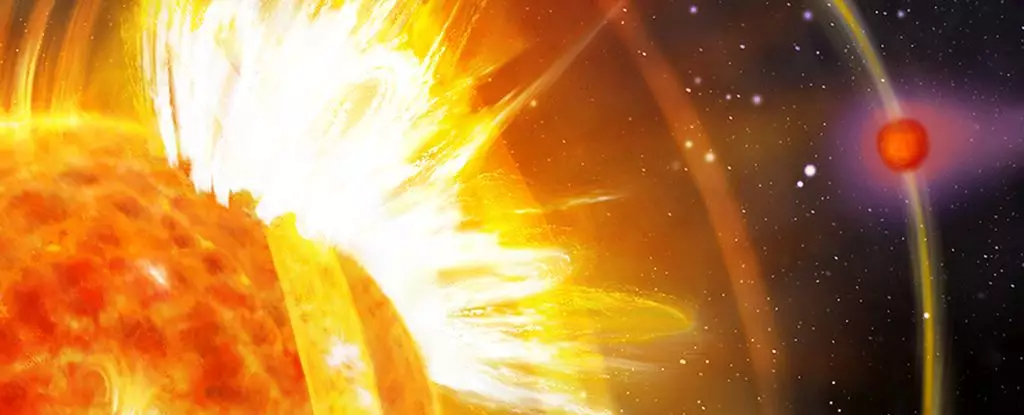
In a pioneering study, astronomers have observed a close-in exoplanet that appears to ignite violent stellar flares. This isn’t just a minor disturbance; it’s a direct feedback loop where the planet’s magnetic field interacts with the star’s magnetic environment, causing colossal eruptions that can strip away the planet’s atmosphere over cosmic timescales. Such a phenomenon suggests that planets are not merely passive spectators in their stellar systems but can be catalysts of stellar activity, fundamentally altering the astrophysical narrative. This insight could revolutionize our understanding of star-planet relationships, prompting us to rethink the role planets might play in the life cycles of stars.
Breaking the Myth of Stellar Independence
Previously, the scientific community operated under the assumption that stars were largely immune to the influence of orbiting planets—massive and energetic as they are, stars were thought to chase their own internal rhythms without external interference. This view was largely pragmatic, given the immense scale and energy differences. However, accumulating evidence from recent observations complicates this picture, suggesting a less isolated universe where planetary companions have tangible effects on stellar phenomena.
The case of HIP 67522 and its tiny, Jupiter-sized companion HIP 67522b exemplifies this paradigm shift. Located approximately 408 light-years away and just a fraction of the star’s age—only 17 million years—this system is a cosmic laboratory revealing dramatic interactions. Despite the planet’s comparatively small mass—merely five percent of Jupiter’s—the gravitational and magnetic tug it exerts is significant enough to distort the star’s magnetic field. The result? A series of powerful, energetic flares directly linked to the planet’s orbital position, as if the planet’s presence acts like an external trigger igniting stellar fury.
This challenges the long-held belief that star activity is primarily driven by internal magnetic processes. Instead, it suggests a scenario where planets can act as external catalysts, shaping the energy output of their hosts. Such interactions might not be rare anomalies but could be common in young, active star systems, changing the way astronomers interpret stellar behavior across the galaxy.
The Consequences for Exoplanetary Environments and the Cosmic Ecosystem
The implications of such interactions extend beyond academic curiosity—they directly impact the potential for planetary habitability and the evolution of planetary atmospheres. The observations show that the exoplanet HIP 67522b endures intense radiation bursts, receiving six times the normal stellar radiation it would if unperturbed. These explosive flares heat the planet’s gaseous envelope, causing it to puff up and leak into space. Over hundreds of millions of years, this relentless erosion could reduce the planet to a much smaller, barren remnant, perhaps transforming a once promising world into a desolate rocky core.
This process underscores a stark reality: planets in tight orbits are not safe havens but potential victims of their own proximity to stellar chaos. The energy unleashed during these flare events doesn’t just strip atmospheres—it can also influence planetary magnetic fields, surface conditions, and even the potential for hosting life. It raises profound questions about the longevity of sharply orbiting planets, especially in the turbulent youth of stars when magnetic fields and stellar winds are at their most vigorous.
Furthermore, the discovery hints at a universe where such intense star-planet interactions might be prevalent, especially in the early life stages of many systems. If young systems commonly undergo this kind of magnetic tug-of-war, the cosmic environment might be much more hostile for planet formation or sustainability than we previously believed. Detecting and understanding these phenomena in many systems will be crucial for forming a complete picture of planetary system evolution and for assessing the true diversity of worlds that populate our galaxy.
Challenging Preconceived Notions and Embracing a New Cosmic Reality
This revelation demands a reevaluation of long-standing assumptions in astrophysics. It suggests that the universe is more interconnected and dynamic than the neat, isolated models we once preferred. Planets are not just passive satellites; they are active participants in their stellar ecosystems, capable of shaping the behavior, lifespan, and even the habitability of their hosts.
The discovery of persistent magnetic interactions and energetic flares triggered by a planet’s presence shatters the illusion of stars as aloof orbs. Instead, it paints a picture of a vibrant, interconnected cosmic ballet—one where celestial bodies influence each other’s evolution in profound, sometimes destructive ways. Moving forward, astronomers must consider these interactions when studying star systems, especially those with close-in planets, as the framework for understanding their long-term stability and potential for supporting life.
This insight also opens new avenues for exploration. By identifying other star-planet systems where similar magnetic interactions occur, scientists can probe the mechanisms behind these phenomena, uncover their frequency, and better understand how they shape the architecture of planetary systems. Far from being a niche curiosity, this line of research promises to redefine our conception of the universe as an entangled web of forces, influence, and cosmic evolution.
Leave a Reply