
Since the launch of Sputnik 1 in 1957, humanity’s venture into space has been marked by groundbreaking achievements, often driven by national agencies like NASA or Roscosmos. However, in recent years, a transformative shift has occurred: the commercial industry now plays a pivotal role in orchestrating missions that carry more than just scientific instruments. Today’s payloads span everything from scientific experiments to human remains, reflective of our expanding ambitions and varied motivations to explore beyond Earth’s atmosphere. This evolution epitomizes a new era of accessibility, where even personal stories and individual memories find their place among the stars.
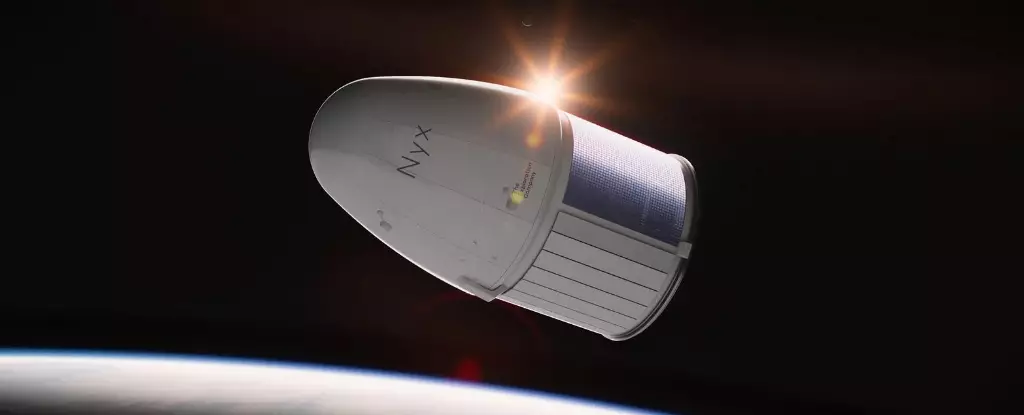
The case of the Nyx capsule exemplifies this cultural shift. Spearheaded by The Exploration Company, a German aerospace startup, the mission signifies a confluence of innovation, commercialization, and personal sentiment. Sending ashes and DNA of over 166 deceased people into space is an audacious attempt to make space not just a domain for exploration but also a space for remembrance. Although the mission encountered setbacks, the very act of integrating personal memorials into spacefarings underscores an emerging desire to connect individual lives to cosmic destiny. It is a powerful testament to how space technology now intersects with human emotion and personal history, transforming space travel from a distant, scientific enterprise into a deeply personal one.
Risks and the High Cost of Pioneering Space Commercialization
However, progress in this domain is fraught with risk, especially when venturing into uncharted technological territory. The recent Nyx mission, described by its creators as a “partial success,” highlights both the promise and peril inherent in pioneering efforts. The capsule successfully launched, orbited, and even re-entered Earth’s atmosphere—yet failed to deploy parachutes, resulting in the loss of valuable cargo in the Pacific. This incident, while discouraging, reveals the harsh realities of innovation: setbacks are inevitable, especially when operating at the technological frontier.
The implications extend beyond financial loss or technical failure—they strike at the core of trust. Families entrust their loved ones’ remains to these missions, often paying substantial sums for what is intended to be a respectful and dignified journey into space. The loss of cremated remains on this recent flight, as well as a previous incident involving astronaut Philip K. Chapman’s remains, underscores the fragility of this emerging industry. Such failures challenge the perception of space as an accessible domain for personal and commercial payloads and compel operators to prioritize reliability over ambition.
Furthermore, these incidents expose the thin margin for error inherent in commercial spaceflight today. As startups and private companies push technological boundaries quickly to stay competitive, the risk of failure escalates. The pursuit of rapid innovation—pushing record speeds, minimal costs, and quick turnaround times—sometimes comes at the expense of thorough testing and validation. This situation demands a reevaluation of the industry’s risk management principles if commercial space endeavors are to become truly sustainable and trustworthy.
The Promises of Future Missions and the Ethical Quandaries Ahead
Despite setbacks, these efforts are unequivocally laying the groundwork for a future where space becomes a routine part of human life. The upcoming demonstration to the International Space Station (ISS) in 2028, should support from the European Space Agency materialize, signals that the industry is eager to demonstrate its viability on higher-stakes platforms. The aim of transporting scientifically significant cargo—like plant seeds to study microbial resilience under microgravity—reflects a broader vision: space as a laboratory for life extension, adaptation, and possibly colonization.
Yet, this expanding access also raises profound ethical questions. As companies offer services that cater to personal, spiritual, or memorial pursuits, we must scrutinize the boundaries between commercial innovation and respect for human dignity. Is it appropriate to treat space as a personal repository or grave site? Does the commercialization of human remains risk trivializing death or commodifying grief? These are questions that will demand consensus from regulators, ethicists, and society at large as the industry matures.
Moreover, the pursuit of commercial space activities must not overlook the environmental impact—both on Earth and in orbit. The accumulation of debris, the risks of malfunction and debris proliferation, and the sustainability of such endeavors are concerns that cannot be ignored. As more payloads fly, the responsibility to preserve the space environment for future generations becomes paramount.
The trajectory of commercial space payloads embodies a complex narrative: one of extraordinary ambition and visionary potential, yet marred by technical hurdles and ethical dilemmas. This burgeoning industry must learn to balance innovation with responsibility, ensuring that humanity’s step into the cosmos remains a pursuit rooted in respect, sustainability, and genuine progress.
Leave a Reply