
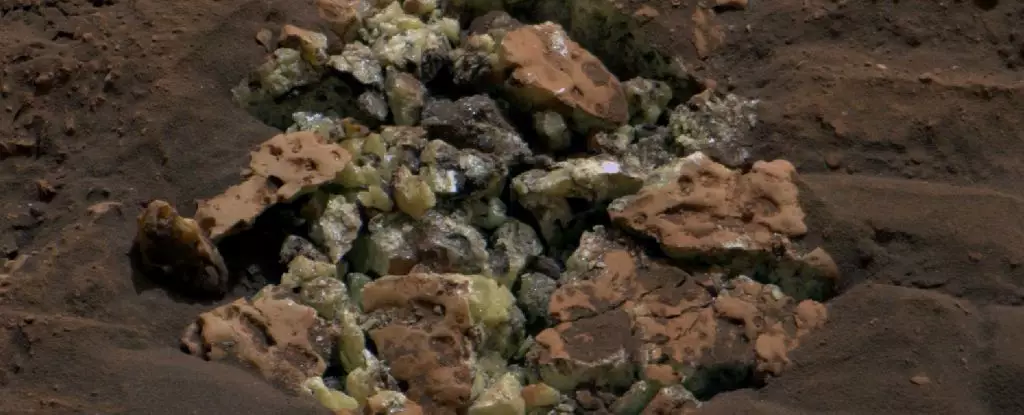
The recent discovery of elemental sulfur on Mars signifies a paradigm shift in planetary science. While sulfates have been familiar companions in the Martian landscape, finding pure sulfur crystals in situ is unprecedented. This finding challenges long-held assumptions about the planet’s geological processes and hints at complex, previously unconsidered environments beneath the surface. It is tempting to interpret this as a new chapter in Mars exploration—one where surprises await just beneath the surface, defying our expectations and inviting us to look deeper into the planet’s mysterious history.
What makes this find remarkable is the manner in which it was uncovered—not through targeted sampling but as an accident of exploration. Curiosity, the robotic geologist on wheels, rolled over a seemingly mundane rock and inadvertently cracked it open. The moment was serendipitous, yet profoundly significant, revealing yellow crystals that turned out to be pure elemental sulfur—something rare and extraordinary on Mars. This accidental discovery is a testament to the importance of persistence and curiosity-driven exploration, reminding us that sometimes, the universe reveals its secrets in unexpected ways.
Environmental Conditions and Geological Implications
The occurrence of pure sulfur on Mars raises intriguing questions about the planet’s past and present geochemical environment. Typically, sulfur appears on Mars as sulfates—salts formed through aqueous processes that involve sulfur compounds dissolving in water and later crystallizing as water evaporates. The presence of pure sulfur suggests an entirely different set of conditions, perhaps an environment where sulfur could separate from other minerals and exist in its elemental form.
Most theories about Mars’s geological evolution involve water’s role in shaping its surface, and sulfates have been invaluable in reconstructing its aqueous history. The appearance of pristine sulfur, however, points to processes that are not just about water chemistry but involve volcanic activity, thermal processes, or other geothermal phenomena that might produce or concentrate elemental sulfur. Such conditions could indicate a more dynamic and geochemically diverse history than previously thought, where localized volcanic or thermally driven processes created pockets rich in pure sulfur.
The Significance for Astrobiology and Future Missions
Sulfur is essential for life as we know it, primarily as a building block of amino acids, proteins, and enzymes. The existence of pure sulfur deposits is not inherently a sign of life, but it does suggest complex chemical environments that could have supported microbial activity in Mars’s past. It fuels hypotheses about habitable conditions that might have existed in ancient eras, possibly providing energy sources where chemical reactions could sustain microbial life.
Furthermore, discovering elemental sulfur is a game-changer for future Mars missions. It serves as a potent reminder of how much we still don’t understand about the planet’s geological history and surface chemistry. Future missions could focus on analyzing sulfur deposits in even greater detail, employing advanced instrumentation to determine their origins—whether volcanic, hydrothermal, or otherwise—and assessing their potential as resources or biosignatures.
Rethinking Mars’s Geological Narrative
This unexpected find compels scientists to reconsider Mars’s geological narrative. Previously, the emphasis was on water and water-related minerals to tell the story of the planet’s habitability. Now, the presence of pure sulfur suggests additional narrative threads—thermal processes, volcanic activity, or even unknown chemical cycles—that need further exploration. It indicates that Mars was not just a place of ancient lakes and rivers but may have experienced more varied and energetic geological phenomena.
The challenge ahead is to reconcile this discovery with existing models, using it to refine our understanding of Mars’s evolution. The next steps involve detailed spectral analysis, geochemical modeling, and possibly sample return missions that could bring these sulfur-rich rocks back to Earth for comprehensive laboratory testing. Only then will we begin to piece together the true story behind these yellow crystals and what they reveal about the Red Planet’s hidden past.
If these findings teach us anything, it’s that planetary exploration is a journey full of surprises—each discovery peeling back another layer of Mars’s complex, enigmatic history. As Curiosity continues to trundle forward, the landscape’s secrets are slowly, but surely, coming into focus, promising new insights and unanticipated revelations.
Leave a Reply