
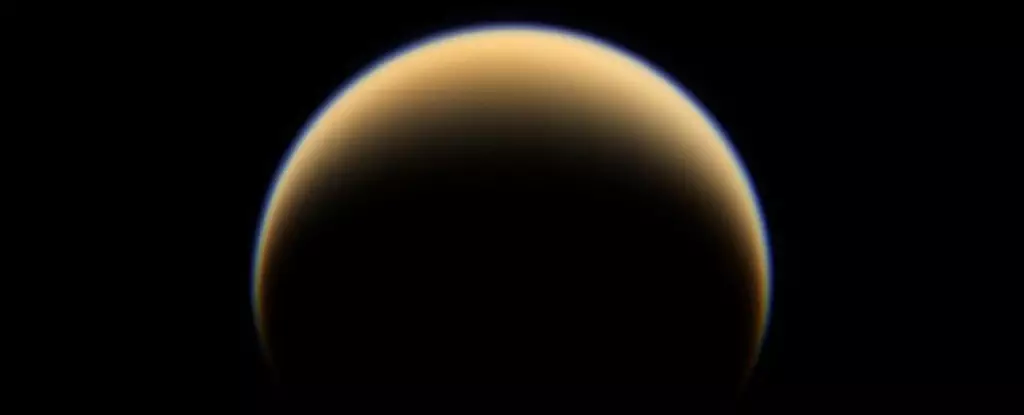
When we gaze at Saturn’s largest moon, Titan, with its thick hazy atmosphere and methane lakes, it sparks both wonder and skepticism. Is it a promising candidate for extraterrestrial life, or just another icy world with tantalizing clues that ultimately fall short? Recent research paints a sobering picture: Titan could harbor microbial life, but the scale of such life would be remarkably tiny, bordering on negligible. The moon’s subsurface ocean, shielded beneath kilometers of ice, might host life that’s so sparse that finding even a single living cell would be comparable to searching for a needle in a haystack millions of miles away. This stark reality challenges our expectations of extraterrestrial ecosystems, forcing us to reconsider what it means for a celestial body to be “inhabited.”
The Biological Feasibility and its Stark Limitations
The core question researchers seek to answer is whether Titan’s hidden ocean has enough energy to sustain even the simplest forms of microbial life. Using bioenergetic models, scientists have deduced that the potential energy sources—mainly complex organic molecules derived from Titan’s atmosphere—are insufficient in quantity and energy flux. These molecules, primarily glycine and its precursors, originate from complex atmospheric chemistry driven by solar radiation, then seep into the ocean via meteoritic impacts or upwelling from the rocky core. However, despite the abundance of organic compounds, only tiny fractions might be accessible to microbes. It’s akin to a vast desert with a few scattered droplets of water—technically there, but hardly enough to support a thriving ecosystem.
The analogy of microbial life on Titan resembles Earth’s fermentation processes more than complex cellular communities—strictly anaerobic and minimalist. On Earth, fermentation allows some organisms to survive in oxygen-starved environments, but even here, the energy yield is limited. Transferring this understanding to Titan highlights a critical point: the biosphere would be unimaginably sparse. The estimated biomass might not exceed a few kilograms—less than a small dog—and the entire ocean might support fewer than one cell per liter. Such a scenario transforms our idea of life as a thriving community into something almost microscopic and nearly imperceptible.
Reevaluating the Conditions for Habitability
Why is Titan’s potential biosphere so fragile? It boils down to the constraints presented by the moon’s environment. The interactions between organic molecules, energy availability, and the lack of oxygen create an extremely challenging setting for sustaining life. Titan’s organic molecules, although abundant over geological timescales, are not enough to produce the kind of energy flux necessary for an active ecosystem. The organic influx is more akin to a trickle than a steady flow, severely limiting energy resources for microbial metabolism.
Furthermore, the environment is characterized by an extreme cold, with surface temperatures around -179°C (-290°F). Such frigid conditions diminish reaction rates, making biochemical processes sluggish and energetically costly. Without substantial sources of energy—like sunlight or abundant chemical gradients—life’s potential on Titan is confined to a tiny, isolated handful. This isn’t just a matter of microbial isn’t thriving; it’s about whether it can exist at all in a meaningful “population” to be detectable.
The Broader Implications for the Search for Extraterrestrial Life
Titan’s subdued biosphere serves as a humbling reminder that planetary habitability is a delicate balance. The presence of organic molecules alone does not guarantee an active or detectable biosphere. Instead, energy flux, environmental stability, and chemical accessibility prove to be critical factors determining whether life can flourish, even at minimal levels. For astrobiologists, this underscores the importance of calibrating expectations: not every oceanic moon or icy world will be a vibrant hub of life, but rather a realm where the faintest microbial whispers might still exist—if at all.
This revelation pushes us to refine our search parameters. We must acknowledge that some celestial bodies—like Titan—may harbor life that is virtually undetectable or functionally inconsequential in size. This understanding tempers both our aspirations and our excitement, preventing us from overestimating the prevalence of life across our solar system. Instead, it encourages us to focus on discovering the subtle signatures that might evidence even the faintest existence, while recognizing that such evidence may be exceedingly difficult to find.
Final Reflection: Living on the Edge of Possibility
In the grand narrative of space exploration, Titan’s potential biosphere invites us to confront the harsh realities of extraterrestrial habitability. It challenges the romantic notion that organic molecules and liquid water automatically equate to lively ecosystems. The cold, resource-starved environment, coupled with the limited energy sources, suggests that if life exists, it is likely a fragile and isolated phenomenon—almost a cosmic mirage. Yet, this very fragility is a testament to the resilience of life, and perhaps, under different conditions, it could expand into something more robust.
Until we develop tools capable of detecting such minuscule biospheres, Titan remains a enigmatic, subdued world—a quiet testament to nature’s tenacity and its limitations. Our pursuit of alien life must be tempered with realism, recognising that some worlds might offer only ghostly echoes of life, rather than vibrant civilizations. The universe’s silence, in this case, could be just as telling as its potential for discovery.
Leave a Reply