
The realm of quantum physics continues to challenge our perception of reality, pushing the boundaries of what we consider possible in measurement and information retrieval. Recent breakthroughs suggest that, rather than the science fiction notion of literal time travel, we might harness quantum phenomena to “look back” at past events with unprecedented clarity. This development isn’t just a small step in technology but a giant leap in how humanity can understand the universe. By exploiting the peculiarities of entanglement and the concept of “hindsight,” scientists are paving the way for sensors capable of accessing information about past states of complex systems—effectively allowing a form of retrospective observation that was once deemed impossible.
Quantum Entanglement: The Gateway to Temporal Awareness
Central to this revolutionary approach is the phenomenon of quantum entanglement—described famously by Einstein as “spooky action at a distance.” Entangled particles share a link so profound that measuring one instantaneously influences the other, regardless of the distance separating them. Traditionally, this phenomenon has prompted questions about nonlocality and causality. However, recent research turns this strange connection into a tool for “time-aware” measurement. Instead of viewing entanglement as a mere curiosity, scientists are now leveraging it to encode information about a system’s prior states, using a process akin to sending data backwards in time within the quantum realm.
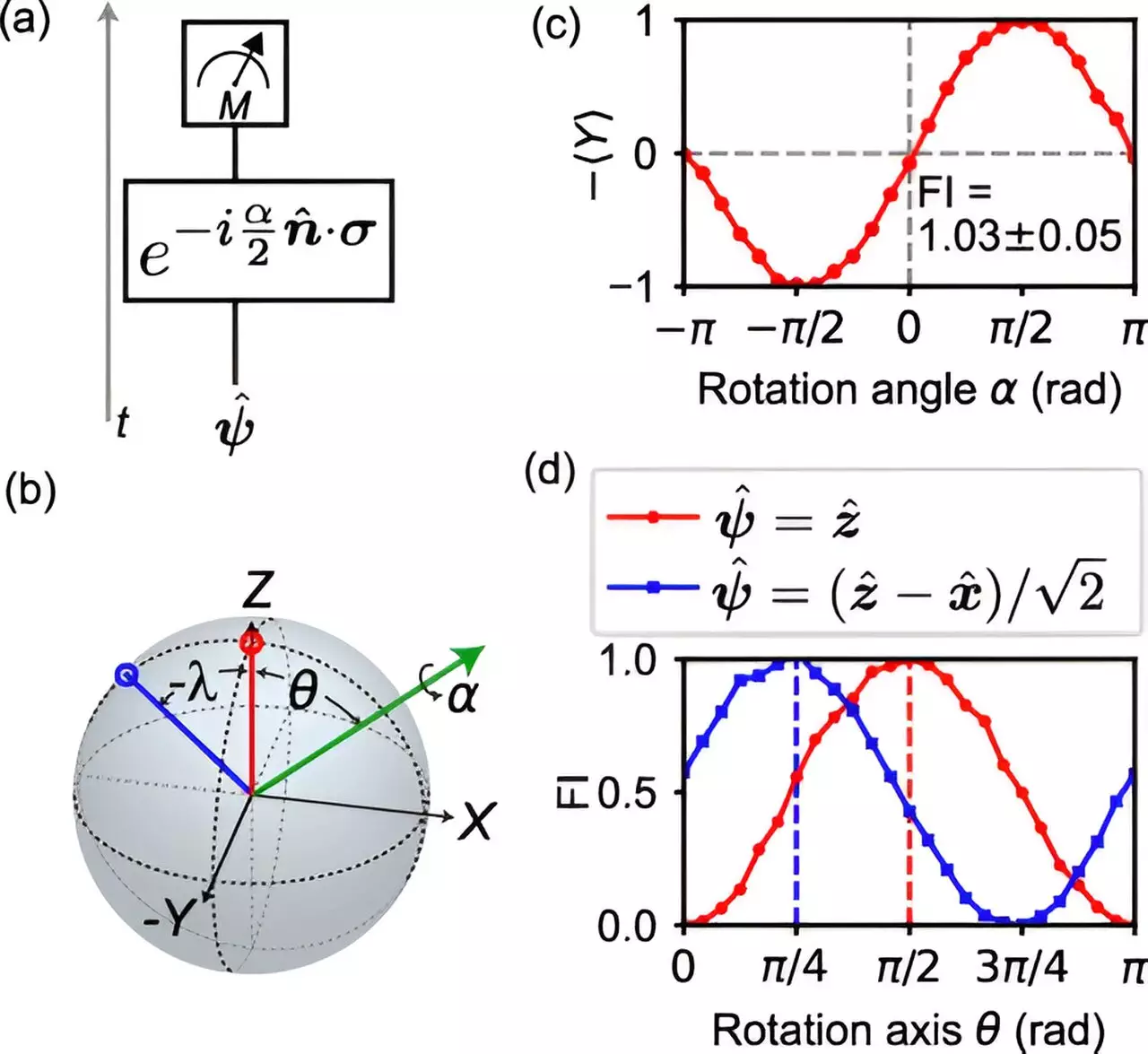
The research, led by Professor Kater Murch and colleagues, utilizes entangled qubits—tiny quantum bits similar to the classical binary units but governed by quantum rules. They initialize a pair in a specific entangled state and then subject one qubit, the “probe,” to a magnetic field. The interaction with this field rotates its spin, an effect conventionally used to measure magnetic properties. What distinguishes this experiment is the subsequent measurement of the entangled partner, which somehow transmits information about the magnetic field’s influence *backwards* through quantum entanglement. This “hindsight” effect allows scientists to preemptively determine the optimal conditions for the probe, dramatically reducing the risk of measurement failure.
From Theoretical Potential to Practical Breakthroughs
In traditional magnetic sensing, the uncertainty arises because the magnetic field’s interaction with the quantum sensor can be aligned or misaligned in such a way that its effects are nullified. This introduces a one-in-three chance that measurements will be inconclusive. But with the quantum “hindsight” technique, scientists essentially turn back the clock on the measurement process. They select the best measurement parameters after the fact—leveraging the entanglement’s “retrocausal” properties—to improve accuracy and reliability. This breakthrough holds profound implications: it could significantly enhance our capacity to detect faint signals, view distant cosmic phenomena, and pin down elusive magnetic signatures in complex environments.
Furthermore, the philosophical implications are staggering. Entangled particles are not merely separated but can be conceived as existing in a superposition of states that span both forward and backward in time. This blurs the classical lines of causality and offers a glimpse into a universe where information flow isn’t strictly linear. While science remains far from knocking on the door of literal time travel, these advances suggest that the fabric of reality is more malleable than previously thought when viewed through the lens of quantum physics.
Implications for the Future of Science and Beyond
The real power of this innovation lies in how it redefines our approach to measurement and understanding. With these quantum sensors, we’re moving into an era where the past can be scrutinized with a precision previously reserved for theoretical speculation. Imagine being able to study the magnetic fields of distant stars with clarity, to peer into the history of complex systems, or to analyze phenomena that occurred moments before detection—everything with a certainty that was once impossible.
This also invites us to question the very nature of causality and the flow of time. Quantum physics suggests that, at least on the smallest scales, the universe might be less linear than our perceptions impose. As researchers develop this technology further, we could unlock not just scientific insights, but fundamentally alter our philosophical understanding of reality itself.
While these advancements are still in their early stages, the potential applications extend beyond pure science. Next-generation sensors could revolutionize medical imaging, improve navigation systems, or enable security measures that detect hidden anomalies by peering into the “past” states of matter or energy. The boundary between the impossible and the plausible is shifting rapidly, driven by bold innovation and a willingness to challenge long-held assumptions about the universe’s limits.
In essence, quantum “hindsight” isn’t just a technical novelty; it’s a paradigm shift. It signifies a new era where the past can be revisited, analyzed, and understood more intimately than ever before—opening doors to knowledge that was once thought to be locked behind the constraints of time itself.
Leave a Reply