
At the core of all physical matter lies the atom, a fundamental building block that Richard Feynman regarded as the single most crucial piece of scientific knowledge to pass on. This isn’t mere trivia—it’s the foundation for understanding everything with mass in the universe. Atoms, with their unique structure of protons, neutrons, and electrons, create the staggering diversity of elements that compose not only the cosmos but also life as we know it. Understanding where atoms come from is not straightforward; it’s a journey through the universe’s fiery beginnings and the hearts of stars.
Atomic Composition and the Birth of the Early Universe
An atom’s structure is deceptively simple yet profoundly important. At its center sits the nucleus, a dense cluster of protons and neutrons. Electrons, negatively charged particles, orbit this nucleus, balancing the positive charge of the protons to neutralize the atom. Hydrogen, the simplest atom, houses a single proton and electron, while helium follows closely behind with two protons, two neutrons, and two electrons. These two elements make up the overwhelming majority of ordinary matter—roughly 90% hydrogen and 8% helium—highlighting their cosmic significance.
However, these atoms didn’t always exist. Their origins trace back to an epoch roughly 400,000 years after the Big Bang, when the universe significantly expanded and cooled. Before this cooling, the intense heat prevented electrons from settling into stable orbits around nuclei due to excessive energy. This epoch—often confusingly labeled “recombination”—was actually the first combination of electrons with nuclei, leading to the formation of neutral atoms. Prior to this, the universe was a high-energy soup of free protons, neutrons, and electrons.
Primordial Nucleosynthesis: Forging Nuclei in the Universe’s First Minutes
Hydrogen and helium weren’t the first particles to exist; their nuclei came into being mere minutes after the Big Bang in a blazing inferno reaching over a billion degrees Fahrenheit. Under such extreme conditions, protons and neutrons collided and fused, driven by high energies and the fundamental strong nuclear force—an interaction capable of overcoming the repelling forces between protons. This process, known as primordial nucleosynthesis, shaped the early inventory of light elements that seeded the cosmos. Yet, heavier elements remained absent in this early phase, as the universe wasn’t yet mature or cool enough to build them.
The Stellar Alchemy of Heavier Elements
The fascinating chapter in atomic formation continues within stars—stellar furnaces where lighter elements transform into heavier ones through fusion. The strong force once again plays the starring role, compelling protons and neutrons to stick together beyond the simple hydrogen and helium nuclei. This fusion requires incredibly high temperatures—exceeding a billion degrees Fahrenheit in massive stars bigger than our Sun—conditions where atomic nuclei collide with monumental energy. Here, elements from carbon to iron are forged, building the chemical diversity necessary for planets and life.
However, star birthplaces encounter limits. Even the hottest stellar interiors cannot produce elements heavier than iron efficiently. Elements beyond this threshold require additional energy input since these heavier nuclei are inherently less stable and prone to breaking apart—in other words, the formation process is not energetically favorable under normal fusion.
Supernovae and Cosmic Collisions: Crafting the Heaviest Elements
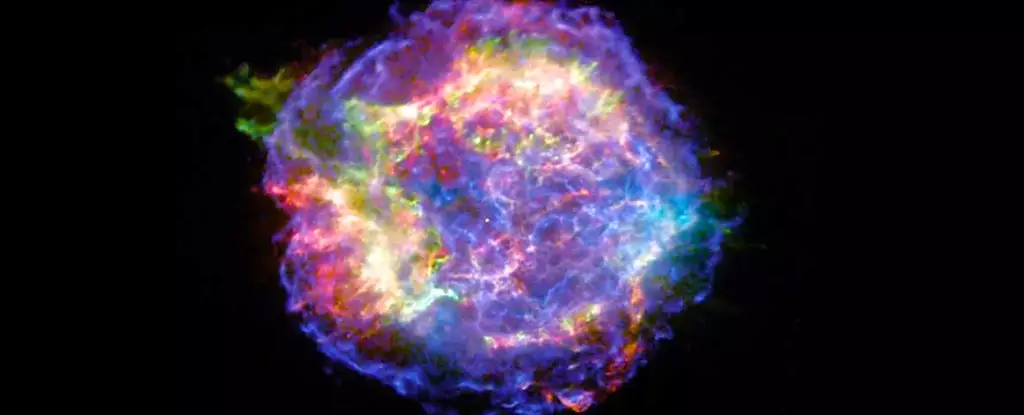
Nature’s solution to building elements heavier than iron lies in violent and cataclysmic events like supernova explosions and neutron star mergers. When a massive star runs out of fuel, its core collapses under gravity, resulting in an intense explosion that scatters heavy elements into space. These dramatic moments supply the necessary energy to form and distribute atoms like gold, uranium, and platinum—elements far heavier than iron.
Moreover, the recent study of neutron star collisions reveals an even more spectacular source of heavy elements. These collisions, among the most energetic events in the universe, not only create black holes but also release torrents of exotic matter, seeding galaxies with precious and rare elements. Such cosmic fireworks illuminate the dynamic processes behind atomic evolution, far beyond simple fusion reactions.
The Complexity Beyond Ordinary Matter
While this narrative explains how the atoms forming ordinary matter came to be, the universe is far more complex. Most of its mass, intriguingly, seems to be invisible and not composed of atoms at all. This mysterious “dark matter” dominates the cosmos, eluding scientists who continue to investigate its properties and ultimately how it fits into the grand picture of matter formation.
In sum, the story of atoms is an epic saga spanning billions of years—from the fiery birth of the universe through the cooling waves that allowed electrons to settle, to the nuclear forges inside blazing stars, and finally the cataclysmic deaths of those stars seeding new generations of matter. It’s a vivid reminder that the elements making up everything around us—and ourselves—are the product of cosmic forces and stellar alchemy unfolding over incomprehensible spans of time.
Leave a Reply