
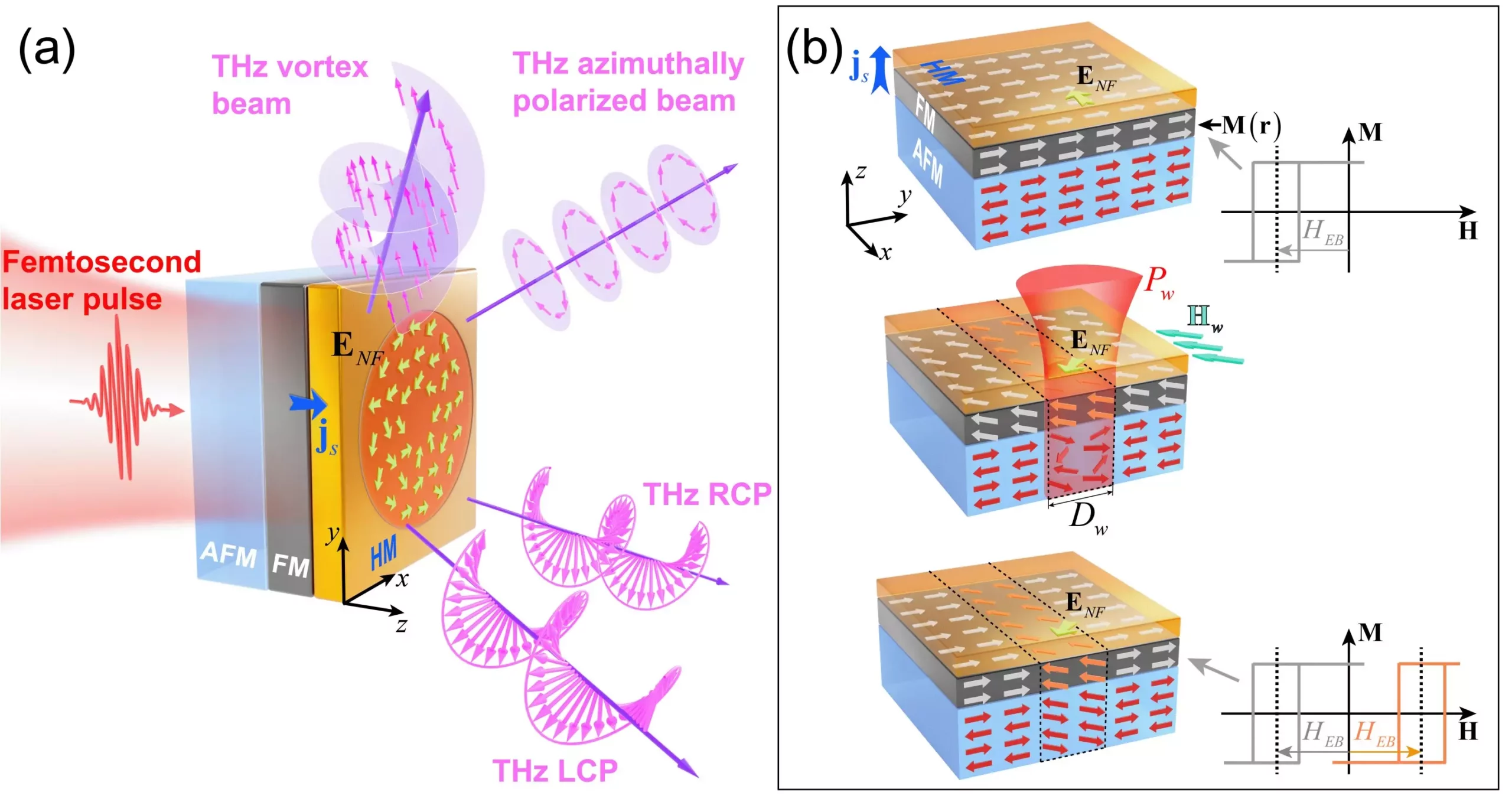
The intersection of technology and physics has long been a breeding ground for innovation, and recent advancements in terahertz (THz) light generation exemplify this trend. Researchers at Fudan University and Capital Normal University, under the guidance of Professors Zhensheng Tao and Yizheng Wu, have unveiled a groundbreaking technique to generate structured terahertz light beams using programmable spintronic emitters. This development is not merely an incremental improvement; it represents a monumental shift in how we understand and manipulate light at terahertz frequencies, melding spintronic technology with high-precision control of light’s angular momentum.
Understanding Terahertz Radiation’s Unique Position
Terahertz radiation occupies a compelling niche in the electromagnetic spectrum, bridging the gap between microwaves and infrared light. This spectral zone is rich with potential applications ranging from security scanners that enhance safety protocols to advanced medical imaging technologies that may revolutionize diagnostic methods. However, the challenge of effectively generating and steering terahertz light has historically limited its broader deployment. Previous methods have struggled with efficiency and effectiveness, making the breakthroughs outlined in this research absolutely critical for the future of terahertz technology.
The Technology Behind Programmable Spintronic Emitters
The novelty of the research rests on the exploitation of programmable spintronic emitters that operate on the principles of exchange-biased magnetic multilayers. These innovative devices intricately combine magnetic and non-magnetic materials, enabling them to convert laser-induced spin-polarized currents into a rich array of terahertz radiation. This meticulous approach allows researchers to manipulate the magnetization pattern within the emitters with astounding precision and spatial resolution. Graduate student and lead author Shunjia Wang emphasizes the significance of this ability, indicating that it permits the production of terahertz beams that feature complex polarization states—intriguing configurations previously unattainable.
Exciting Applications and Future Directions
The implications of this research extend well beyond simply generating terahertz light. The ability to create structured beams with properties such as spatially separated circular polarizations and full Poincaré beams opens the door to numerous advanced applications. Poincaré beams, which can exhibit all possible polarization states within their cross-section, are particularly intriguing due to their potential in generating special optical forces and optimizing intensity profiles. Such capabilities could enable single-shot polarimetry measurements that are more precise than ever, enhancing both scientific research and practical applications alike.
Paving the Way for Novel Terahertz Devices
As the researchers successfully demonstrated various structured terahertz beams, it is clear this work is not just an academic exercise; it holds real-world promise across multiple industries. Prof. Zhensheng Tao’s assertion that their findings pave the way for innovative terahertz devices aligns with the vision for a future in which terahertz technologies can thrive. This advancement is all about pushing boundaries, encapsulating the ambition of scientists to harness the naturally occurring phenomena of the world around us for transformative technological applications. The potential for progress in fields such as telecommunications, healthcare, and beyond is staggering, ushering in a new era where terahertz light could play a pivotal role in shaping future innovations.
Leave a Reply