
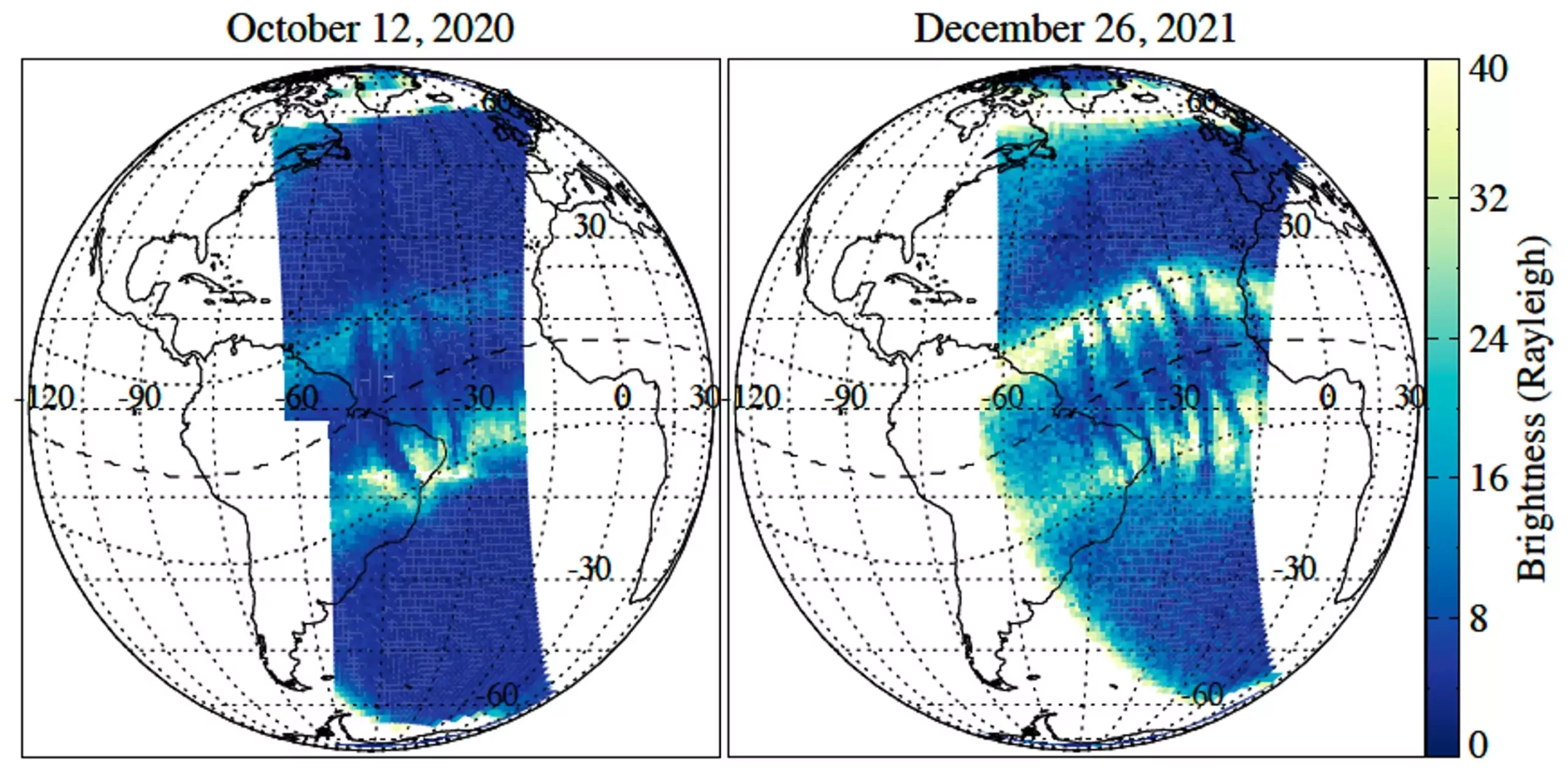
NASA’s Global-scale Observations of the Limb and Disk (GOLD) mission is shining a light on the enigmatic realm of the ionosphere—an electrified layer of gases that stretches between 50 to 400 miles above the Earth’s surface. While the possibilities within this region have intrigued scientists for decades, recent revelations from GOLD have brought to focus intricate formations reminiscent of letters—C’s and X’s—that challenge previous understandings of this atmospheric layer. These discoveries not only expand our comprehension of ionospheric dynamics but also underscore the significance of these phenomena on communication and navigation systems that rely heavily on radio signals traversing them.
The Ionosphere and Its Role in Communication
The ionosphere acts as a vital conduit for long-distance radio communications, becoming electrically charged during daylight when solar energy strips electrons from neutral atoms and molecules. This process generates charged particles and forms a plasma soup that enables radio signals to traverse vast distances. However, during the night, the reduction in solar energy leads to the creation of low-density regions known as bubbles, which can disrupt the integrity of these signals. Traditionally, scientists have identified these disturbances through sporadic observations, but GOLD’s unique geostationary orbit allows for prolonged study and provides a more comprehensive look at the ionosphere’s behavior.
Unexpected X- Shaped Formations
One of the most surprising findings from the GOLD mission is the detection of X-shaped structures forming during periods previously categorized as “geomagnetically quiet.” Traditionally, similar formations were associated with severe disturbances such as solar storms or volcanic eruptions. This newfound observation challenges current models and suggests that the atmosphere’s intricacies are influenced by factors previously unaccounted for. According to Fazlul Laskar, a primary investigator on the project, the appearance of these X shapes in a calm ionospheric state implies the involvement of localized driving factors in plasma dynamics. Such findings prompt a reevaluation of how external atmospheric conditions—specifically those from the lower atmosphere—affect the ionosphere.
The Turbulent Dance of C- Shaped Bubbles
In addition to the mysterious X formations, GOLD has observed an intriguing variety of C-shaped plasma bubbles, a discovery leveling up the complexity of ionospheric studies. It has long been established that most plasma bubbles appear linear and align closely with magnetic field lines. However, the presence of C-shaped features implies that atmospheric winds significantly influence bubble morphology. This observation echoes a well-known analogy: just as a tree leaning in the direction of strong winds grows in that direction, plasma bubbles are sculpted by the turbulent forces at play in our atmosphere. Deepak Karan and his team at LASP found these C-bubbles existing anomalously close to each other—around 400 miles apart—leading to the hypothesis that considerable turbulence, perhaps even vortex-like activities, are at work.
Significance and Legacy of GOLD’s Findings
The implications of these findings extend far beyond academic interest; they carry immediate relevance for critical communication and navigation technologies that can be disrupted by the ionosphere’s whims. Thus far, GOLD has detected only a handful of instances showcasing these complex shapes occurring in close proximity, yet the potential for greater occurrences exists. Understanding the mechanics behind these disturbances could become paramount, given that extreme ionospheric disruptions could lead to total signal loss. Scientists eagerly anticipate continuing research with GOLD and other heliophysics missions to unveil the underlying causes and ramifications of this intricate machination.
Looking Forward: The Future of Ionospheric Research
As more data pours in from GOLD’s ongoing observation missions, researchers find themselves at the cusp of a potentially revolutionary understanding of the ionosphere and its multifaceted interactions with both terrestrial and extraterrestrial systems. The oddities presented by this mission pave the way for new theories in atmospheric science and could lead to technological advancements in the ways we communicate and navigate our world. There is an abundance of exploration left to undertake, and each discovery propels us closer to unraveling the myriad secrets that lie within our atmospheric envelope. As we grapple with these complexities, one thing remains crystal clear: the ionosphere is far more nuanced than we ever imagined, and NASA’s GOLD mission has only just begun to scratch the surface.
Leave a Reply