
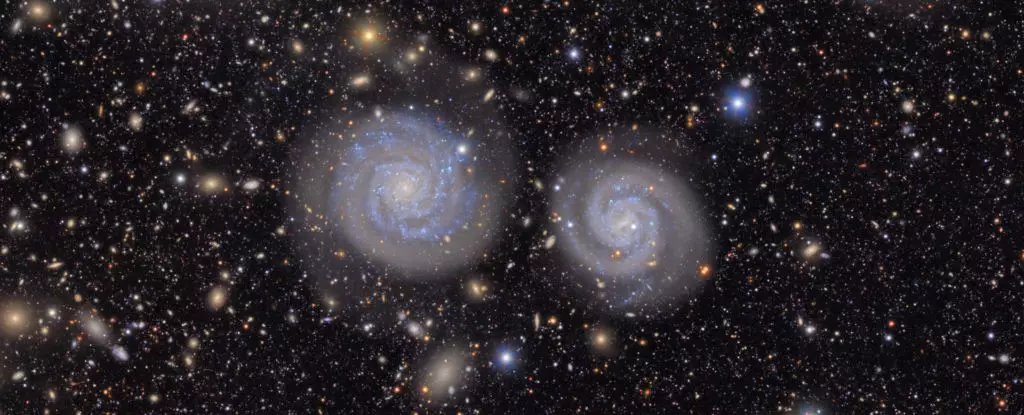
The Vera C. Rubin Observatory, nestled within the collaborative efforts of the US National Science Foundation and the Department of Energy, has made a striking debut with its first images of the cosmos. This observatory is anticipated to be a game-changer in our quest to comprehend the Universe, and its initial outputs certainly spark excitement among astronomers and enthusiasts alike. With a deep gaze that stretches beyond mere optical visibility, the observatory’s advanced imaging technology captures phenomena across near-ultraviolet, optical, and near-infrared wavelengths, ushering in a new chapter for astronomical observation.
The Promise of the Legacy Survey of Space and Time (LSST)
Central to the Rubin Observatory’s mission is its ambitious 10-year project called the Legacy Survey of Space and Time (LSST). Unlike any other observational initiative, LSST is designed to scan the southern sky repeatedly—in fact, it aims to document each section approximately 800 times. The telescope, equipped with the world’s largest camera at 3,200 megapixels, generates a colossal wealth of data that will eventually compile into a detailed 10-year time-lapse of the Universe. This will prove invaluable in tracking dynamic celestial events, from the flicker of supernovae to the movement of asteroids within our Solar System.
Revolutionizing Cosmic Cataloging
The scope of the Rubin Observatory’s mission extends far and wide. It is not just focused on distant galaxies; it also intends to catalogue more local phenomena, such as asteroids and comets that reside in our Solar System. The observatory’s capability to capture anything that moves or pulses presents a frontier of astronomical discovery. In its inaugural images, Rubin has already showcased its power by presenting stunning visuals of the Trifid and Lagoon nebulae, regions dense with star formation. With just 7.2 hours of imaging, the telescope produced a mosaic image nearly 5 gigapixels in size, emphasizing its detailed observational capacity.
Flourishing Discoveries and Earth Defense
Among the astounding revelations from the Rubin Observatory are its findings related to asteroids. In a span of just over 10 hours, it identified an astonishing 2,104 asteroids that had previously evaded detection. In contrast, traditional observational methods yield approximately 20,000 new asteroid discoveries annually across all other ground-based telescopes. The implications of this are profound—not only will the Rubin Observatory redefine our understanding of the Solar System, but it also plays a critical role in planetary defense. The telescope will help identify and monitor potentially hazardous asteroids, contributing to Earth’s safety from cosmic threats.
Innovative Technology Driving Scientific Frontiers
What sets the Vera C. Rubin Observatory apart is its pioneering combination of technology—ranging from its innovative mirror design to its unmatched camera sensitivity and rapid imaging abilities. This infrastructural advancement creates possibilities previously deemed unattainable. According to representatives from the NSF and DOE, the observatory occupies an entirely new category of scientific instrument, laying the groundwork for profound discoveries related to dark energy and dark matter. This signifies not just incremental improvements in astronomical research, but a fundamental leap in how we understand the very fabric of the Universe.
The Journey Ahead
As astronomers, scientists, and enthusiasts engage with the expansive data generated by the Rubin Observatory, the excitement surrounding its potential continues to swell. The promise of unraveling cosmic mysteries—those unanswered questions that have captivated humans for centuries—is tantalizing. With each image captured and each celestial phenomenon recorded, we draw closer to unveiling the hidden mechanics of the Universe, enriching our understanding and appreciation of the cosmos. The journey that the Rubin Observatory has embarked upon is not merely one of observation; it is a quest for knowledge that invites us all to imagine the unimaginable and ponder the vast expanses beyond our Earthly home.
Leave a Reply