
The energy landscape is undergoing a transformative change, pivoting towards cleaner and more efficient sources. At the heart of this revolution lies fuel cell technology, particularly solid oxide fuel cells (SOFCs), which promise exceptional power generation capabilities. Recent research by a team from the Korea Institute of Energy Research (KIER) has unveiled a groundbreaking catalyst coating technology that could redefine the norms of fuel cell performance. Under the guidance of Dr. Yoonseok Choi and his esteemed collaborators from KAIST and Pusan National University, a swift and simple method has emerged that enhances SOFC efficiency in less than five minutes.
Fuel cells, known for their environmentally friendly operation and high efficiency, are gaining traction as vital instruments in the hydrogen economy. These devices can harness various fuel types, such as hydrogen and biogas, and are particularly well-suited for combined heat and power (CHP) systems. As researchers delve deeper into optimizing these complex systems, understanding the intricacies of their reaction mechanisms becomes crucial.
Unpacking the Performance Challenges
A significant hurdle in the advancement of SOFCs is the sluggish kinetics of the oxygen reduction reaction (ORR) at the air electrode. This reaction is critical as it dictates the overall performance of the fuel cell. While the fuel electrode operates efficiently, the air electrode lagged behind, creating a bottleneck in the energy conversion process. Researchers have recognized this challenge and embarked on a mission to uncover alternative materials that could elevate ORR activity. However, the quest for robust materials often ends in a compromise—enhanced performance frequently comes at the cost of chemical stability.
Rather than seeking entirely novel materials, Dr. Choi and his team redirected their focus to optimizing the widely-used LSM-YSZ composite electrode. They aimed to enhance an already reliable solution instead of reinventing the wheel. Such a strategic approach highlights both practicality and innovative thinking within the sphere of fuel cell research.
Nanoscale Innovations Lead the Charge
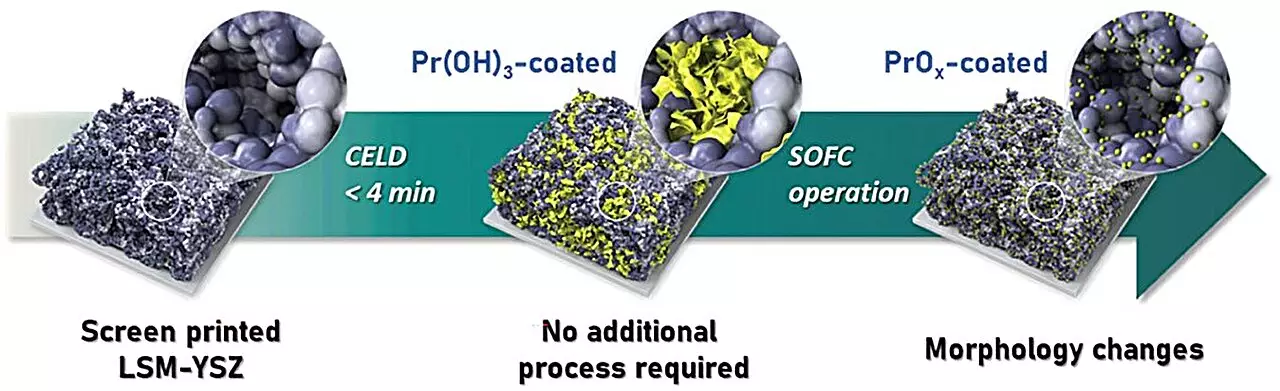
The team’s solution involved a pioneering coating process that leverages nanoscale praseodymium oxide (PrOx) as a catalyst. This process does not only underscore simplicity but also efficiency as it operates under room temperature and atmospheric pressure. By applying a straightforward electrochemical deposition technique, the research team successfully generated a uniformly coating on the composite electrode through an electric current and a praseodymium ion solution. The ingredients of this innovative method culminate in a stable oxide layer that profoundly bolsters the oxygen reduction reaction in challenging high-temperature conditions.
The transformation from hydroxide to oxide through a drying phase is a testament to engineering creativity. Within a mere four minutes, operators could enhance the surface characteristics of their electrodes, laying the groundwork for dramatic improvements in overall cell performance.
Transformative Results and Industrial Implications
The results from this research are nothing short of remarkable. During extensive testing, the catalyst-coated electrodes demonstrated a staggering tenfold reduction in polarization resistance compared to their conventional counterparts. Furthermore, the peak power density achieved with this method reached an unprecedented 418 mW/cm²—over three times greater than uncoated electrodes. This sets a new benchmark in the literature for SOFCs utilizing LSM-YSZ composite electrodes, marking a pivotal moment in fuel cell technology.
Dr. Choi’s assertion about the economical viability of this process cannot be overlooked. The introduction of advanced oxide nano-catalysts through an uncomplicated post-process offers substantial potential for the fuel cell industry. This innovative technology promises to marry enhanced performance with existing manufacturing frameworks, ultimately accelerating the adoption of fuel cells across various sectors.
In a world grappling with energy challenges, such strides in solid oxide fuel cell research exemplify how scientific ingenuity can foster practical solutions. As we stand on the cusp of a new era in energy technology, research like this reaffirms the importance of innovation in driving sustainable progress. The implications of this work extend beyond the laboratory, heralding a future where efficient, clean energy becomes the standard rather than the exception.
Leave a Reply